
By Dairell Alvarico
There are many aspects to consider when creating a firm grasp on social dynamics. Things like circumstance, environment and relationships can determine how unique and diverse it can be.
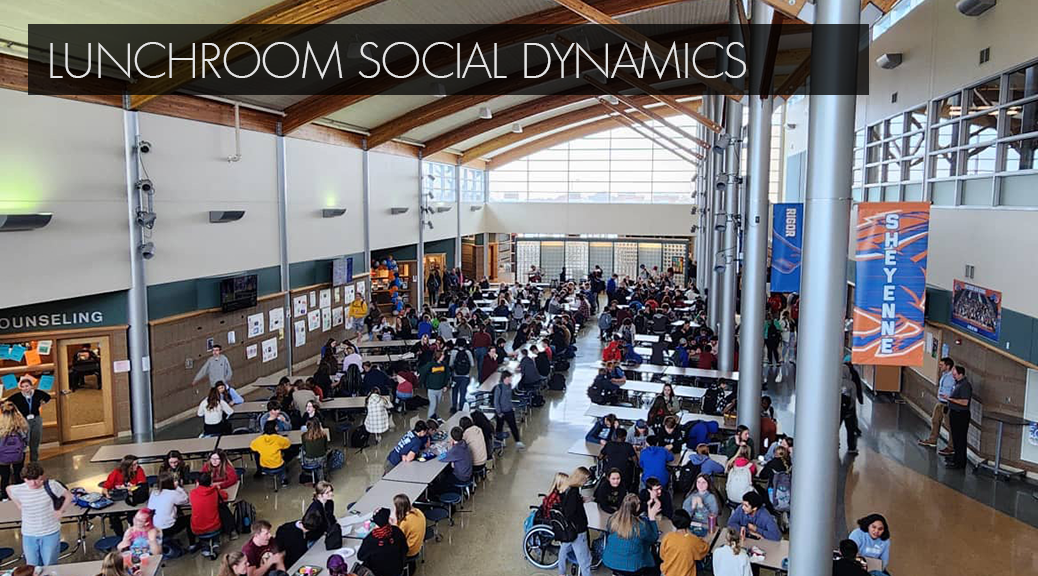
Society has always been intertwined with the element of change, even if it’s forced. Considering all the characteristics of dynamics, this can be easily applied when it comes to the basic idea of school lunches, more specifically in Sheyenne.
If you were to think about it deeply, there is always a reason for certain students to sit in a particular spot and it varies based on their personal or practical interests.
But how do these types of things come to be? How does one decide to pick a preference in a place as common as a school cafeteria? There are many factors to evaluate to gain understanding.

We can first consider the new arrangement of the lunch tables that happened recently.
Due to this unexpected change, students have taken new spots to eat their meals since the ones they usually go to have been positioned differently from what they remember and yet they migrated to the same, general location yet created new lunchroom dynamics.
Everybody has a preferred spot to sit in the commons. Their reasons differ from each other based on how specific it can be.
Understandably, many students wished to remain anonymous. So, we won’t be using the students’ real names. Let start with, say Sam.
According to Sam, “I sit near the counseling office, because on the first day, me and my friend just chose that spot, so we have been sitting there.”
Based by this quote, it has been shown that circumstances may just have been rooted from an in the moment decision.
There is no deep reasoning other than the fact that they both chose a random spot and stuck with it since it was their first choice.
The same student shared that there were no benefits at all that relates to their position, and if there was a day that their seats were occupied, they would either sit on the front or the back of the commons but only for the reason of finding available seats and nothing more.
However, this versatility isn’t always the case.
Many students refuse to sit anywhere else. They’ve chosen a table and that is their table.
Even within their groups, they have a seating chart: one friend sits on one stool and the others have their own stools.
Take, for example, Alex and Alex’s friend group. They have their seating positions set. This is because they sit together with another group of students well acquainted with one of their companions, who isn’t fond of eating lunch with just one group.
Alex and the others aren’t particularly familiar with them, so they tend to sit on the right while the other group sits on the left with the mutual friend between them.
This writes down that relationship status is considered when it comes to who sits beside who. According to a student who will be referred to as Tony, seating arrangements in his group are figured out by who is closer with who because, “Some people are like best friends.”
This checks out Alex’s situation as well. Several groups in the lunchroom consist of more than two students, a lot tend to sit closer to those they are more friendly with, creating a social dynamic that shows how familiar they are to other people.
In other circumstances, most lunch groups with two people prefer the other person to be across them rather than beside them.
A student who will be named Amy agrees with this wholeheartedly.
“Me and my friend sit facing each other to talk easier.” she shared. “About whom sits where doesn’t really matter. My friend tends to be there first, so I just sit across wherever she is.”
Another student who will be called Chris made a similar statement as well. “I mean, I don’t like to turn my head to the side when I talk to my friend. It gets awkward later and I like to talk while looking at his entire face. That’s why I sit across him.”
This preference is based on how comfortable they prefer to talk to someone. Despite multiple people agreeing with sitting across their friend, there are some students that don’t mind being beside them either.
Someone who will be called Kim said, “I’m used to sitting beside my friend. I don’t really want to change that.”
The number of students in an area can also decide someone’s seating arrangements.
A student who will be referred to as “Tony” prefers an emptier and more obscured spot because he prefers a less crowded room.
But if he were to sit beside other people, he would like to sit near the “smart and goofy” students.
In contrast, Jody is more influenced by the types of people she sits next to.
Instead of choosing a more vacant area like Tony, she prefers a controlled environment where other students are not “jumping on tables and smashing food.” Which also lies in her sitting with quieter people.
This shows that many students have a bias when it comes to the personalities and behaviors of the people around them if they want to interact with anyone at all.
Usually, many students prefer minimum interaction in the lunchroom for reasons that involve their desire to have time for only themselves, but it doesn’t stop there.

Room temperature is also a factor when it comes to choosing different seats.
Jody likes to sit near the doors because she likes a cooler environment. A student named Jacob also has the same preference.
“Anywhere is fine as long as it’s not in the heat.” He speaks.
From what was gathered, a few students want to be in the cooler area of the lunchroom. This ties with the fact that a crowded room will be likely to form up heat from body temperature.
I have noticed that Jacob doesn’t sit near the doors that lead outside, but he is around the area near the vending machines where the double doors that lead to a freezer are usually open and a cold breeze would come out from time to time, also he is always at the edge of the table, the area with less people.
Seating arrangements are also chosen by the conveniences that students want to be closer to for less distance between them and what they need.
Take for example, Jody; she likes it when she is close to the garbage cans and restrooms. The reasons are clear enough.
She likes to clean her tray with less time to waste compared to if she were to be across the room where her walk would be lengthy and time consuming.
Additionally, she would also use the restroom without worrying about borrowed time or vacancy.

Tony’s seating position is more on his convenience after lunch break ends. His arrangement helps him with his desired convenience to be closer to his next class.
This is applied to many other students who would be near the stairs or the tables across the theater or gym.
Time is of the essence and in this scenario, a factor in how students find their place in the lunchroom.
Surprisingly, the intent to be closer to people is a familiar factor in seating arrangements.
A student called John likes to sit beside someone he is interested in to increase the chances of them talking to each other.
Other students have also admitted to this but for the respect for privacy, no names will be revealed.
Based on all of this information, lunchroom dynamics are formed by one or more components based on what a student wants or needs.
Relationships, environment, peers and personal taste in certain parts of the room. All these alone create diverse surroundings revolving around a student’s preference.
 The Mustang Post