
EPISODE ONE: ROUTINE AND THE UNEXPECTED
By Hailey Boehme
Official Transcript:
Hailey Boehme: I’m so happy to finally introduce you to our new exploration: podcasts! This episode dives right into our first series on human behavior. From the perspective of wins and losses, fitting in and standing out, or hiding behind the camera versus standing right in front of it…. Welcome to Sheyenne Perspectives from Mustang Post News, I’m Hailey Boehme.
[THEME SONG – KOLBY THOMPSON.]
Hailey Boehme: Through our research we have discovered truths of the unconscious mind and learned things about ourselves that we never noticed before.
This journey into understanding the nature of our minds began with school psychologist Emily Dempster. But where should we start? In no better place than our very own Sheyenne High School.
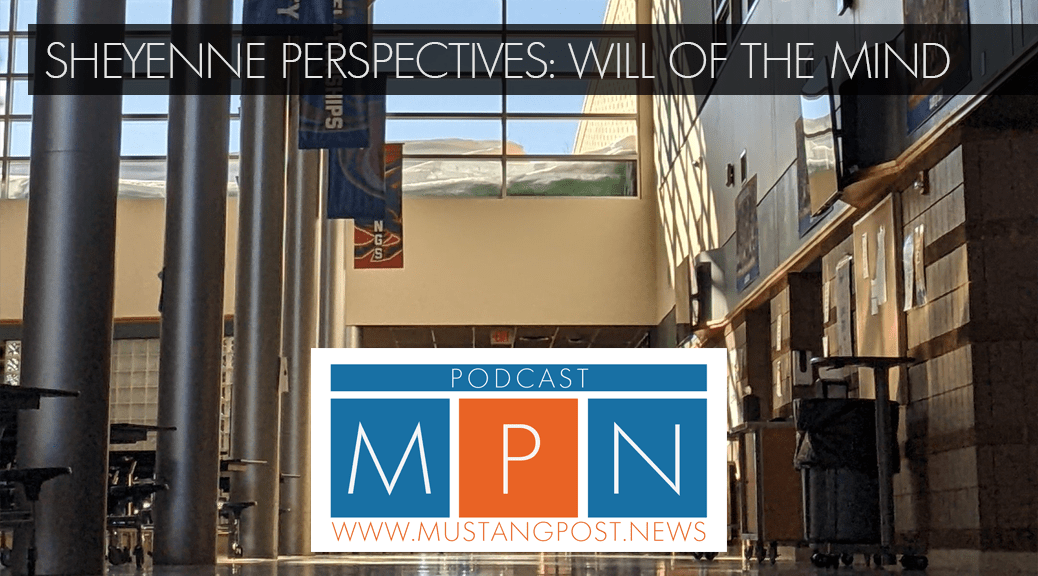
There must be a method to the chaos…some hidden factor to navigate the constant chatter, full trays of food, and tightly packed tables…
[LUNCH ROOM SOUNDS]

Hailey Boehme: Certainly, to an outsider it would appear to be nothing short of a disaster, but to the regulars of the Sheyenne High School lunchroom, dodging bodies in an attempt to secure a seat by their best friend is second nature.
To get a better view of this dynamic, we have decided to take a step back and observe the behaviors that occurred; and sure enough, like ants running about, each person seemed to know exactly where they were going amidst the madness.
People sat in the same spots every day, careful not to sit too close to the unacquainted group next to them, yet comfortable in the routine of their daily arrangements. Almost down to each minute, it was easily identifiable who would be coming to sit down next, what table they would choose, and the other students who would sit there.
Even after days of paying attention to the arrangements everyone made for themselves, I was surprised that they rarely changed. Despite the tables shifting to different spots, students filed into designated seats without hesitation.
Though this may seem normal to those who participate in it every school day, I couldn’t help but wonder why we form groups for ourselves. After all, no one was making anyone sit there, so what caused this phenomenon to take place? Was it simply routine, or did it rely on something bigger?
What is the psychology behind this tendency?
Emily Dempster: My name is Ms. Dempster, and I am the school psychologist here at Sheyenne.
Hailey Boehme: Routine. And the unexpected.
Emily Dempster: I think we definitely all benefit from routines. We like to know what’s coming up in our day. Like, you probably enjoy knowing that you have English first, and then science. Could you imagine coming to school and not knowing what class you would have first? That would probably cause a lot of anxiety, so people do benefit- um.. from routine- just so they know what’s going on in their day and so that they get done what they need to get done.
Hailey Boehme: At first, I couldn’t help but to wonder why humans enjoyed doing the same thing every day, yet the thought of never knowing what might happen next seems stressful. For many, the lunchroom setting feels exactly that way.
Emily Dempster: Oh my gosh! SO many! I mean just depending on what kind of gives you those worries- maybe you are more worried about the social aspect. Like are your friends going to be there, are they going to want to talk to you… um…. maybe you’re worried about what they’re serving for lunch if you have some food aversions… maybe you have some sensory, you know… difficulties. Maybe it’s really loud in there and you don’t like the sound of the forks on the trays. So, it will be really dependent on the person, but there- in a big space like that, especially here at school, there’s a lot of stressors that kids and students and even teachers can encounter. Depending on the day and who you are, I think the biggest thing to remember is that even like, as worried as you might be about someone looking at you, or being embarrassed, everyone is as equally worried about themselves. They don’t have time to worry about anything else.
Hailey Boehme: There was one overarching point: personality. No matter what the situation is, it is safe to assume that the amount of stress one might feel depends on how it personally affects them.
Emily Dempster: You know, if you enjoy sitting around in big groups of people and that kind of, “fills your cup”… um- then you’re probably going to enjoy high school lunch a little bit more. But if you don’t like big group of people, lots of noise, if you like to have, you know, conversation with more just you and a friend, uh, the lunchroom could certainly be a tricky, tough place for you.
Hailey Boehme: So if we all enjoy different aspects of socializing….does that impact our chosen spot? Would we find the extroverts at the heart of the lunchroom? There was only one way to find out…
Kennedy Kambeitz: Yes, who else is sitting at the table
Hailey Boehme: With the establishment of personality traits came a new focus: location preference. In the end, they seemed to connect to the same word, “routine.” Students confidently stated again and again how they just went through the motions, not realizing everything that factored into those choices,
Hailey Boehme: How do you decide who you sit by in a big group?
Anonymous Student: I would say it’s like a routine.
Hailey Boehme: Yeah, is it by like who you like more?
Anonymous Student: Oh yeah, I would say it’s sort of by who you like more.
Alison Hollatz: It depends on the size of the group, like if it’s a lot of people, I’m going to sit who I’m closest to.
Hailey Boehme: So, if certain people put us more at ease, how do we find those people? Do we group ourselves by similar interests or unintentionally become confined to fit into a social norm. For example, do I choose not to sit by a group that knows each other from orchestra simply because I don’t think I possess the shared experiences they do? Or is it more complex? It is possible that I could have unconsciously labelled myself in such a way that I don’t feel like I fit in anymore? By straining to fit into a group I don’t believe that I belong in, I would make myself uncomfortable and prone to social anxiety. Now I’m thinking to myself, how do I even begin to navigate through the hour when everything is making me feel nervous.
Emily Dempster: Human kind all over, we’re always looking for like an ”in” group… or for people that like, kind of get us or we share a similar interest with. We’re looking to be accepted into a larger group of people that we feel comfortable with…. So, it might be natural that yeah, if you play basketball you likely are going to sit with your teammates. Or if you really enjoy art or music, you’re likely going to sit with people who also enjoy that, and that’s pretty natural.”
Hailey Boehme: The answers are pretty consistent: most people felt at ease when they focused on the value of comfort, relationships, and being themselves. No matter how much of those elements are needed to thrive, it is likely that a routine will form from the perfect mixture – whether it’s intentional or not. There is something so beautiful about the endless preferences for food, location, noise, style, and conversation topics. Yet we all exist simultaneously, functioning together as a community. At the end of the day, maybe we aren’t so different after all.
[THEME SONG – KOLBY THOMPSON.]
Hailey Boehme: Up next week in Sheyenne Perspectives is Dairell Alvarico with a unique take on change and social dynamics.
This podcast was recorded and edited by Hailey Boehme. Today’s theme music was composed and performed by Kolby Thompson under the direction of Mark Berntson. And our thanks goes out to Emily Dempster, and students Jasmine Brisonet, Alison Hollatz, Kennedy Kambeitz and all others who participated in this podcast, we couldn’t have done it without you! This has been a production of Mustang Post News.
 The Mustang Post