
By The Mustang Post Staff
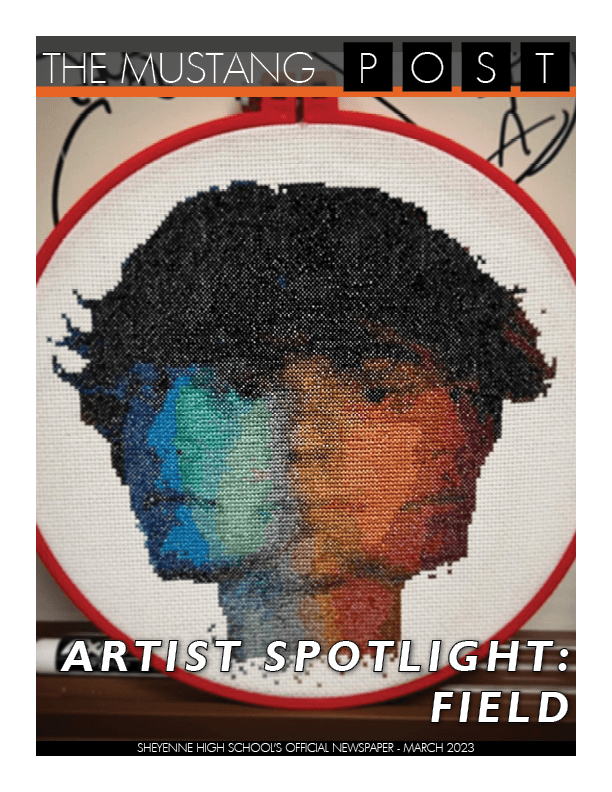
The latest issue of the Mustang Post is available in eMagazine or blog!


EPISODE THREE: CREATIVES IN CINEMA
By Carter M. Phillips
Official Transcript:
SOUND: THEME SONG FADE IN TO FULL THEN FADE TO LOW
Welcome back, everyone. From Mustang Post News, West Fargo, this is Sheyenne Perspectives. I’m Hailey Boehme.
SOUND: THEME SONG FULL
You know, sometimes things just don’t turn out the way you expected. Snow days. Illnesses. Absences. And general bad luck. But! We’re back on track with our latest podcast.
In our last episode of Sheyenne Perspectives, Logan Jacobs reflected on success in the music industry.
SOUND: THEME SONG FADE
This week Carter Phillips continues our series through the lens of creativity and why people are driven to use it both the stage and behind the camera. Here’s Carter.
SOUND: THEME SONG INCREASE (5 to 10 seconds)
CARTER M. PHILLIPS
What will last after we are gone? Art and brick might be the only things in this world that outlive us. And can the inhuman read without a Rosetta stone, or admire music without understanding the words? They can see images, and people, alive, in movement.
Cinema is immortal, and perhaps that is why it fascinates me. It creates the illusion of time incomplete, and frozen.
No other form of art can better show what it is like to be human, to show you a soul in a human face and to show a heart in a hand.
Maybe that is why, regardless of failing, I keep making movies. Regardless of the stress, pain, and disappointment, I never plan on stopping.
To surrender to conventional and hardships would be to let my friends down, who help me make my movies.
These are the words of my friends, who made movies.
GAVIN VILLAREAL (Gav-in Vil-are-Eel)
I was there and Aiden was there and Tuker was there, we were all getting ready to film and all that stuff and we had to do this scene where we had to poor blood on Carters face, but like the blood was, what was it? Like cool aid mix-
AIDEN VILLAREAL
It was crystal light Gavin
GAVIN VILLAREAL
-or some stuff like that, but it stained my shirt permanently but whatever.
AIDEN VILLAREAL
Crystal light. Oh, it was Crystal light Gavin.
GAVIN VILLAREAL
Crystal Light, I can’t even remember.
CARTER PHILLIPS
Yeah, it was crystal light. It was the Fruit punch flavor.
GAVIN VILLARAEL
Yeah, so we had to do that. And we had to poor it on your face. And yeah, it ended up getting in your eye. It was- HA HA
GAVIN VILLAREAL
Hello, my name is Gavin Villareal and I’m a junior in high school and I go to Wahpeton High School in Wahpeton North Dakota.
GAVIN VILLAREAL
[They] Came from the Attic, that was an amazing film, I loved to work on. That was amazing, that was fun. I mean of course I didn’t get as much to work on with that, but you know, still fun to make, nevertheless. Um and then, ah Sometime after Midnight.
CARTER PHILLIPS
As started the conversation our topic, swayed into the trials and errors of filmmaking. He just, quite simply started talking about his experiences on a set and things he’s seen me go through and things he’s seen some of his other cast and crew members go through.
GAVIN VILLAREAL
I mean I’m not really a director myself, but I do new- I do know thing or two about it, so you know, I know the trouble it is to like, you know, shoot and film and ‘do it again, do it again’ you know. That’s a big trouble when it comes to creating.
CARTER PHILLIPS
Gavin started talking about what makes a person creative whether its through being influenced on something or perhaps a spark that ignites in your mind and I began questioning him on if it was better or worse to be influenced by something or if it was better or worse to come up with it on your own.
GAVIN VILLAREAL
I think what makes a person creative is when are um- they have a unique idea that isn’t too similar to others. Like I know how people get they’re creativity. Sometimes they get it from other people, but you know, I feel like being really, like really creative would be having your own main idea when it comes down to like, I guess you could say movies and shows and stuff like that you know.
GAVIN VILLAREAL
I feel like some people when they make like, I guess you could say, short stories or things like that, I feel like there’s people who make it just so they can get popular or people that actually put time and effort into it and therefore [are] making, you know, creative stories.
CARTER PHILLIPS
He started talking about the advantages that occur when you’re working with friends instead of colleagues apposed to friends, or rather when your colleagues are your friends; and the atmosphere that brings apposed to an entirely professional one.
GAVIN VILLAREAL
Even when you’re shooting and like, uh, just hanging out, your still like having a good time. Your still like hanging out but like, doing something and usually when you’re doing that something your more serious but like we also have a good time we also laugh, you know, all that fun stuff.
GAVIN VILLAREAL
For us, it makes it better cause we know each other, and you know, it’s easier to act for like different things and stuff like that. We know each other’s like, I guess, set of emotions and all that so, uh I guess, it’s easier for us to have a role that you know [that we would] best [be] played in.
GAVIN VILLAREAL
An average scene? Well, when we’re not messing around uh, probably get like an average scene done in like a half hour if we’re lucky enough.
CARTER PHIILLIPS
Those roles need a beginning, an inception. And that’s where the role of the creative begins. The beginning of creation. That initial idea that leads to shared art.
As my microphone waited for me to speak, I looked down at my hands and saw they’re cracked and weary skin with strayed strands of winkles unfit for a boy of 17, and at the mirror saw my eyes somber and meaningless, declaring emptiness with they’re soundless piercing look, staring at me. What do they long for? What does anybody long for?
I can’t go on living without goals and motivation, without feeling like I’m doing something worthwhile. WE can’t live like this. As humans we desire art. To experience it? To make it? Are they not one in the same?
A person closes their eyes and dreams and is that not art of its own. Maybe the best movie is the one happening outside your window, with gains and losses and good and bad. Art is a mere reflection, refracting images into a vague contraption of mirrors inside our minds. Where do these ideas come from? Where do we come from? How does art confront this?
If it got an audience in the first place, who loved it and cherished it, is that not good enough? For a person to give something to the world instead of take something, to make a film belong to humanity itself, to be construed, loved, hated, believed in, subjectifies and objectified. They are like people, alive and received, but more so they are like my memories and remain linked with the eras in which I made them, a trophy for my work.
This podcast was recorded and edited by Logan Jacobs and hosted by Hailey Boehme. Sheyenne Perspectives theme music was composed and performed by Kolby Thompson under the direction of Mark Berntson. Special thanks goes out to Anthony Peterson.
HAILEY BOEME
In our next release of Sheyenne Perspectives, Jaxson Miller be taking a look at wins and losses and the highs and lows of those moments especially when those wins and losses are unexpected.
See you soon, everyone.
This has been a production of Mustang Post News.
By Mustang Post Staff
This issue of the Mustang Post is a special release as we say goodbye to one of our journalists who is moving further into the frigid north. We’ll miss her and her joyful insight into all that is BTS.
This special issue is available now as an eMagazine!

EPISODE THREE: THE LONGEVITY OF SUCCESS
By Logan Jacobs
Official Transcript:
Hailey Boehme: Welcome back, everyone. From Mustang Post News, West Fargo, this is Sheyenne Perspectives. I’m Hailey Boehme.
In our last episode of Sheyenne Perspectives, Dairell Alvarico delved into change and how we react to change, whether we like that change or not. This week Logan Jacobs continues our series by reflecting on success. Specifically, what success and failure means in the music industry. Here’s Logan.
[THEME SONG – KOLBY THOMPSON.]
Logan Jacobs: How does success stand against the test of time? Will those that are successful now find success in 20, 30, even 40 years? How can we know?
Will we yearn for music like this in the future? What makes an artist successful and how long that success last.
But what is success?
Anthony Peterson: the easy answer is sales, in the short term.
Logan Jacobs: That’s Mr. Peterson, choir and History of Rock-n-roll teacher at Sheyenne High School.
Anthony Peterson: Are they selling records, digital downloads? Are they streaming on YouTube? All of this is now playing a factor into the top ten records or song in a country or in the world
Logan Jacobs: Although that may not be all there is to it, maybe success is something much more complicated.
Anthony Peterson: Sustained success is really more about can you evolve with the time and be a trendsetter instead of just repeating yourself over and over.
Logan Jacobs: Take for example rapper Redveil. For three years now he’s been producing successful albums. Three, in fact. He’s certainly popular enough where people are taking inspiration from him at this point. But will his success last? Will he be able to evolve and maintain his trendsetting creativity?
But who are some others that could be successful?
Anthony Peterson: Well, historically if you look at the bands or the artists that were able to recreate themselves year after year and record to record and do new things, while doing it at a certain level and keeping their level of success and sales, you have to initially look at someone like the Beatles or the rolling stones in the 60s and the 70s as a group that not only was massively successful but they were pioneering new styles and genres every year, and doing it in a way no one else had before, so not only were they successful but they were trailblazers into new areas of music
Logan Jacobs: Chance, another rapper, was once trailblazer, yet in recent years he has seen a significant decline. He hasn’t adapted. He hasn’t maintained a level of creativity and work ethic that promotes continued success.
Will, however, he reach a turning point? An epiphany? A moment where he’ll regain his creativity that will lead to a level of success as he achieved before. Lead to record sales.
Although, there are some who are still successful
Anthony Peterson: More recently I think you have to look at someone like a Taylor Swift who started in a more traditional country world and every record she’s had in the last decade plus seems to change and evolve artistically and lyrically which allows her to not repeat herself and she’s finding new success with new audiences; and she’s in her mid 30s now, for 20 years of success is not easy. In the music world it’s very easy to be a one hit wonder and then disappear because you have nothing else in that bag.
Logan Jacobs: The key to finding sustainable success is not only to grow and change, but to be untouchable by others in your genre. An unrealistic level of ability is needed at all times for you to keep your success. Chance had built up this reputation that came crashing down through the release of one record.
Anthony Peterson: The neat thing about older artists success is that it doesn’t seem to go away, there is still a market for something that is now dubbed classic rock, and if you look at, locally at arenas near here there’s going to be a plethora of artists that are selling massive amounts of tickets, that have had their biggest amount of success in the 80s, 70s, and maybe even the 60s. That are still touring and selling out all over the world.
So having that impact that they had in their time is still very relevant because there is still a market for it. I want to assume that modern artists are still going to be musically interesting and sophisticated 30 years from now and people are still going to be seeing their concerts.
Logan Jacobs: Now fans are stuck romanticizing about what they can not have, an older version of Chance. One that has not stained his ethereal presence on the music world. Reminiscing about the past, until another “Chance” comes around.
Anthony Peterson: The one unique thing I could spin in for some artists is some of them never had a reunion, like the Beatles were never able to reunite because John Lennon was killed and now another member of the band has since passed away, there is only two of the four left, they can’t be the Beatles anymore because after the band broke up they were never able to reunite so like with the Rolling Stones who started at around the same time, they’ve been a somewhat stable group for the past 50 years, some people think that tarnished their legacy and its like there not as good as they used to be, or they’re old or dad rockers but obviously people still want to see them,
where you have a different group like the Beatles who only existed in that one decade and they never were able to do anything else, so there are different ways to look at it because I think some people like what they can’t have more than something that’s like still around, I think that’s benefited the Beatles success because they know they can’t see them in concerts so they yearn for that old music cause it only existed back then and there’s no way to ruin it.
Logan Jacobs: Can an entire music career die, only because of one poor release? Can an artist redeem themselves after failure? Or are they forever stuck, known as the person they formerly were?
This podcast was recorded and edited by Logan Jacobs and hosted by Hailey Boehme. Sheyenne Perspectives theme music was composed and performed by Kolby Thompson under the direction of Mark Berntson. Special thanks goes out to Anthony Peterson.
Hailey Boehme:
Next week on Sheyenne Perspectives, Carter Phillips will dig deep into what fuels people’s desire to create.
So long, everyone. See you soon.
This has been a production of Mustang Post News.
EPISODE TWO: PERSPECTIVE ON PREFERENCE
By Dairell Alvarico
Hosted by Hailey Boehme
Official Transcript:
[THEME SONG – KOLBY THOMPSON.]
Hailey Boehme: Welcome back, everyone. From Mustang Post News, this is Sheyenne Perspectives. I’m Hailey Boehme.
In our last episode of Sheyenne Perspectives, we took a look at the unconscious mind and its tendency toward routine and the unexpected.
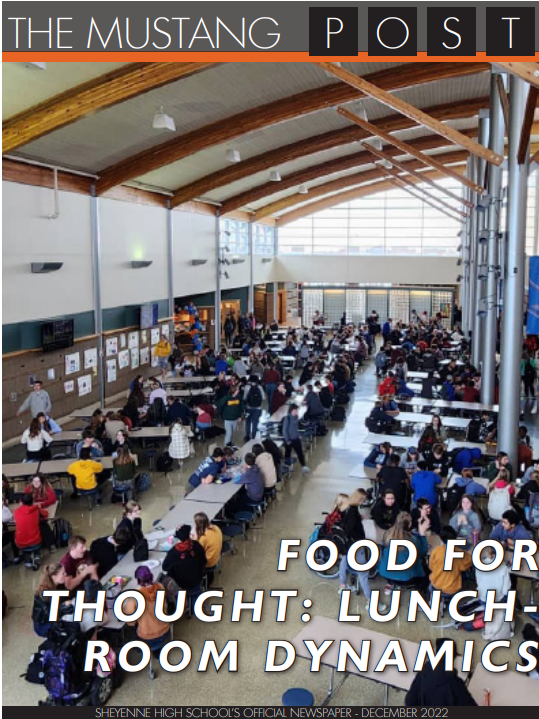
This week in our program Dairell Alvarico continues this theme through a student lens focusing on change in Food for Thought: Lunchroom Dynamics. Here’s Dairell.
Dairell Alvarico: Imagine this.
[LUNCHROOM SOUNDS – FREESOUND]
Dairell Alvarico: You are at your high school and your class just ended… you are finally relieved that it’s your lunch period after hours of sitting, and listening to your lessons.
Eager for your well-deserved break, you make your way to the cafeteria… where you see other students already forming their groups to find their seats. And just like them, you find yours.
Now let’s pause for a moment…
How did you choose your spot? Was it further away from all the noise? Did you and your friends have a mutual decision to sit there?
Or maybe you sat there just for the simple reason of you wanting to.
These are to be considered when it comes to lunchroom dynamics.

Dairell Alvarico: Their relationships, the environment around them, and the people they tend to talk to or avoid, can create this simple but compelling dynamic that can be unique like no other. Yet, there are many questions to be answered.
Do students agree by the idea of change, or do they frown upon it? What are the factors of picking a spot, and why mostly stick with it throughout the school year?
There’s always some form of basis, the root to all the decisions students make to create a dynamic, to have a routine.
If it were to be stripped down in a more simple way, we can grasp an idea of how social dynamics can be applied in the lunchroom. Or, ultimately, how change; even the most simple, impacts people.
And what better way to find out more than asking the students themselves?
Thomas: I think it’s like, kind of random.
Dairell Alvarico: This is Thomas, a Sheyenne student. Like everyone else, he has his own set of opinions on the matter.
A lot of things we do in high school are based on a whim. We don’t really think deep enough to gather logical factors as to why we do it. If it does the job, then there’s nothing else to consider.
This can be applied in the lunchroom. Majority of the students just sat wherever; a common thought of, “Hey, I’ll just sit here.” without any specific reason. Thomas believes this is the most common cause of the lunchroom dynamics we have today.
Thomas: You just choose it when it happens, you know? You kind of just go with the flow. Sometimes its like, situational of like um, they did it before in past years. or closer to a certain spot. All in all, I think it’s just random where they pick, and they just stick with it throughout the year.
Dairell Alvarico: There are many instances where the situation was purely just leaving things to chance. But this does not pertain to everyone. A number of students have their reasons other than randomly choosing their respected seats. If anything, there are a good deal of people who are more specific on what they like.
For an example, Jan likes to sit with people who share the same ethnicity as him. He even likes to branch out more and meet new people.
Jan: Currently my reason is because the people I sit with, is.. the people I know, for the purpose we’re both Filipino. (Laughs)
Dairell Alvarico: Or Adrian, who thinks that food is a main factor as to why students choose their spots.
Adrian: Probably because it affects ability and comfort to like the nearest, you know, the nearest food that they can get.
Dairell Alvarico: Even Thomas prefers a certain side of the lunchroom.
Thomas: Of my seating arrangement, it’s quiet, I can go wherever I please, and yeah it’s quiet, chill, go wherever I please… yeah I’m just free basically, that’s all I can say.
Dairell Alvarico: Wanting to be closer to the people you’re similar with, to being in reach to the ever changing food the cafeteria has to offer, or being in the more discreet part of the area. These are very precise judgements, how does this come to be?
Well, it all lies with preference. According to Merriam-Webster, it means “The power or opportunity of choosing”.
Everyday, students choose something that would benefit others or themselves. Preference laid the groundwork for lunchroom dynamics. When asked about anything regarding their seats, all of them have inclined to what they want, or what they don’t want.
But if it were to be changed under different circumstances, to move out of the comfortable bubble they have made for themselves, how are they willing to adapt into a different environment, or do they like to stay where they are?
Carefree is one way to handle it.
Adrian: I’ll be consistent with it because I already like my spot, and I don’t really wanna change anything. Well, I’m fine with doing anything.
Dairell Alvarico: Prone to change isn’t far off either.
Jan: Uh, I guess I prefer to be consistent, but change is constant nonetheless. Uh I guess it’s, uh it will be nice to talk to other people but yeah I still prefer with the people I’m with.
Dairell Alvarico: Or the unyielding drive to not change at all.
Thomas: Personally, I don’t like change, when you have a certain like seating arrangement in the lunchroom, I don’t feel like it should be changed because it’s an order and if you break that order things just go crazy because then you could steal a spot from another group and then that one person can’t sit there. So I think lunchroom dynamics shouldn’t really change.
Dairell Alvarico: When asked about change, a lot of students preferred the opposite. They’d rather have change as the last option and would prefer to stay where they’ve already made a familiar routine on.
Consistency is key, and they prefer to stick with it and not break the chain that already binds them to conformity.
They have a routine, breaking that would leave them muddled and they’d be forced to sit somewhere else. But then again, their new spot could be someone else’s and that person would find a new seat and it just goes on and on until there’s just an unorganized chaos.
Anything being unpredictable can set people off course. Students have enough of that as it is, so they find comfort in knowing where they are in the lunchroom.
Lunchroom dynamics ties with the concept of change, despite it being inevitable, students would rather go by their own pace. This is their preference, it’s what they like.
Will they have to accept it at some point? Of course, but consistency is what made change unhurried and when it comes to the lunchroom, there is no better way than that.
[THEME SONG – KOLBY THOMPSON.]
Dairell Alvarico: This podcast was recorded and edited by Dairell Alvarico and hosted by Hailey Boehme.
Sheyenne Perspectives theme music was composed and performed by Kolby Thompson under the direction of Mark Berntson. Our thanks goes out to Jan, Adrian, and all others who participated in this podcast but wished to remain anonymous.
Hailey Boehme: Next week on the podcast of Sheyenne Perspectives, Logan Jacobs will take over with his take on success and failure in the music industry.
So long, everyone. We hope to see you soon.
This has been a production of Mustang Post News.
EPISODE ONE: ROUTINE AND THE UNEXPECTED
By Hailey Boehme
Official Transcript:
Hailey Boehme: I’m so happy to finally introduce you to our new exploration: podcasts! This episode dives right into our first series on human behavior. From the perspective of wins and losses, fitting in and standing out, or hiding behind the camera versus standing right in front of it…. Welcome to Sheyenne Perspectives from Mustang Post News, I’m Hailey Boehme.
[THEME SONG – KOLBY THOMPSON.]
Hailey Boehme: Through our research we have discovered truths of the unconscious mind and learned things about ourselves that we never noticed before.
This journey into understanding the nature of our minds began with school psychologist Emily Dempster. But where should we start? In no better place than our very own Sheyenne High School.
There must be a method to the chaos…some hidden factor to navigate the constant chatter, full trays of food, and tightly packed tables…
[LUNCH ROOM SOUNDS]

Hailey Boehme: Certainly, to an outsider it would appear to be nothing short of a disaster, but to the regulars of the Sheyenne High School lunchroom, dodging bodies in an attempt to secure a seat by their best friend is second nature.
To get a better view of this dynamic, we have decided to take a step back and observe the behaviors that occurred; and sure enough, like ants running about, each person seemed to know exactly where they were going amidst the madness.
People sat in the same spots every day, careful not to sit too close to the unacquainted group next to them, yet comfortable in the routine of their daily arrangements. Almost down to each minute, it was easily identifiable who would be coming to sit down next, what table they would choose, and the other students who would sit there.
Even after days of paying attention to the arrangements everyone made for themselves, I was surprised that they rarely changed. Despite the tables shifting to different spots, students filed into designated seats without hesitation.
Though this may seem normal to those who participate in it every school day, I couldn’t help but wonder why we form groups for ourselves. After all, no one was making anyone sit there, so what caused this phenomenon to take place? Was it simply routine, or did it rely on something bigger?
What is the psychology behind this tendency?
Emily Dempster: My name is Ms. Dempster, and I am the school psychologist here at Sheyenne.
Hailey Boehme: Routine. And the unexpected.
Emily Dempster: I think we definitely all benefit from routines. We like to know what’s coming up in our day. Like, you probably enjoy knowing that you have English first, and then science. Could you imagine coming to school and not knowing what class you would have first? That would probably cause a lot of anxiety, so people do benefit- um.. from routine- just so they know what’s going on in their day and so that they get done what they need to get done.
Hailey Boehme: At first, I couldn’t help but to wonder why humans enjoyed doing the same thing every day, yet the thought of never knowing what might happen next seems stressful. For many, the lunchroom setting feels exactly that way.
Emily Dempster: Oh my gosh! SO many! I mean just depending on what kind of gives you those worries- maybe you are more worried about the social aspect. Like are your friends going to be there, are they going to want to talk to you… um…. maybe you’re worried about what they’re serving for lunch if you have some food aversions… maybe you have some sensory, you know… difficulties. Maybe it’s really loud in there and you don’t like the sound of the forks on the trays. So, it will be really dependent on the person, but there- in a big space like that, especially here at school, there’s a lot of stressors that kids and students and even teachers can encounter. Depending on the day and who you are, I think the biggest thing to remember is that even like, as worried as you might be about someone looking at you, or being embarrassed, everyone is as equally worried about themselves. They don’t have time to worry about anything else.
Hailey Boehme: There was one overarching point: personality. No matter what the situation is, it is safe to assume that the amount of stress one might feel depends on how it personally affects them.
Emily Dempster: You know, if you enjoy sitting around in big groups of people and that kind of, “fills your cup”… um- then you’re probably going to enjoy high school lunch a little bit more. But if you don’t like big group of people, lots of noise, if you like to have, you know, conversation with more just you and a friend, uh, the lunchroom could certainly be a tricky, tough place for you.
Hailey Boehme: So if we all enjoy different aspects of socializing….does that impact our chosen spot? Would we find the extroverts at the heart of the lunchroom? There was only one way to find out…
Kennedy Kambeitz: Yes, who else is sitting at the table
Hailey Boehme: With the establishment of personality traits came a new focus: location preference. In the end, they seemed to connect to the same word, “routine.” Students confidently stated again and again how they just went through the motions, not realizing everything that factored into those choices,
Hailey Boehme: How do you decide who you sit by in a big group?
Anonymous Student: I would say it’s like a routine.
Hailey Boehme: Yeah, is it by like who you like more?
Anonymous Student: Oh yeah, I would say it’s sort of by who you like more.
Alison Hollatz: It depends on the size of the group, like if it’s a lot of people, I’m going to sit who I’m closest to.
Hailey Boehme: So, if certain people put us more at ease, how do we find those people? Do we group ourselves by similar interests or unintentionally become confined to fit into a social norm. For example, do I choose not to sit by a group that knows each other from orchestra simply because I don’t think I possess the shared experiences they do? Or is it more complex? It is possible that I could have unconsciously labelled myself in such a way that I don’t feel like I fit in anymore? By straining to fit into a group I don’t believe that I belong in, I would make myself uncomfortable and prone to social anxiety. Now I’m thinking to myself, how do I even begin to navigate through the hour when everything is making me feel nervous.
Emily Dempster: Human kind all over, we’re always looking for like an ”in” group… or for people that like, kind of get us or we share a similar interest with. We’re looking to be accepted into a larger group of people that we feel comfortable with…. So, it might be natural that yeah, if you play basketball you likely are going to sit with your teammates. Or if you really enjoy art or music, you’re likely going to sit with people who also enjoy that, and that’s pretty natural.”
Hailey Boehme: The answers are pretty consistent: most people felt at ease when they focused on the value of comfort, relationships, and being themselves. No matter how much of those elements are needed to thrive, it is likely that a routine will form from the perfect mixture – whether it’s intentional or not. There is something so beautiful about the endless preferences for food, location, noise, style, and conversation topics. Yet we all exist simultaneously, functioning together as a community. At the end of the day, maybe we aren’t so different after all.
[THEME SONG – KOLBY THOMPSON.]
Hailey Boehme: Up next week in Sheyenne Perspectives is Dairell Alvarico with a unique take on change and social dynamics.
This podcast was recorded and edited by Hailey Boehme. Today’s theme music was composed and performed by Kolby Thompson under the direction of Mark Berntson. And our thanks goes out to Emily Dempster, and students Jasmine Brisonet, Alison Hollatz, Kennedy Kambeitz and all others who participated in this podcast, we couldn’t have done it without you! This has been a production of Mustang Post News.
By Hailey Boehme
We all know the classic gifts that everyone resorts to for Christmas: candles, scented lotion, gift cards, stuffed animals, or candy. While all of that is great occasionally, I have more KitKats than I know what to do with.
Please listen to me when I say that my stockpile of random facemasks has never dwindled. Not once.
Now you may be asking yourself “What do I even get anyone then??”
Have no fear…Allow me to present to you Hailey’s Ultimate Guide to the Best Christmas Gifts!
Coming from a teenage girl, I feel a lot of pressure to get my closest friends and family the best gifts as a token of my appreciation for them. Over time, it has occurred to me that no one is expecting the most “perfect” and expensive gift.
Sentimental Gifts:
Personally, my favorite gifts, both to give and receive, are those that have sentimental value.
In order to come up with a meaningful gift, I first take time to consider the things I know are most important to that person. To put this into perspective, it’s time to dive into the examples.
Those who are close to me know that I never miss out on an opportunity to appreciate the sky. In honor of my passion for admiring the beauty of sunsets, I was gifted a framed collage of my friend’s most awe inspiring (and personally captured) sunset images.
Another passion that I’ve found to be shared amongst a wide variety of people is for mental health. There are ways to get creative with mental health in mind, and the ones I happen to be most fond of include bracelets, shirts, stickers, pins, and room decorations that focus on promoting positive messages. If tangible gifts aren’t your thing, coming together to help a non-profit organization that advocates for change is an out of the box way to show support for a loved one.
The last thing that I will mention holds a special place in my heart: DIY gifts. Painted picture frames, handwritten notes, photo albums, tie blankets, beaded or thread bracelets, etc.
For a Significant Other:
Not everyone tends to agree with my ideas for this topic, BUT HEAR ME OUT!
My first controversial point is that you should not need to spend a lot of money. There are many small things that can go a long way.
For Parents & Other Adults:
This is something I have struggled with my whole life. Mom- if you are reading this: STOP BUYING YOURSELF THINGS RIGHT BEFORE CHRISTMAS TIME! Anyways…
As for all the other sections, the best thing to consider is personal interests and ways to help them with things they frequently complain about. For example, my mother enjoys Hallmark movies, walking our dog, unironically cheesy shirts, and reading. On the other end of the spectrum, she despises cold weather, my dad listening to videos at full volume, and coming up with things to make for family dinner.
To satisfy her movie obsession (yes, I do mean obsession), I planned a movie marathon night. This night would be complete with popcorn, candy, a candle, fuzzy blankets, and heartwarming holiday Hallmark movies.
As for walking the dog, my mom needed some upgrades. The leash was breaking, her coat was not ready to withstand North Dakota chills, and her mittens… well… they have been chewed up a few times.
After returning home from her walks, she usually starts to cook for our family. In an effort to make things easier for her, I have created a recipe book. With the help of recipes, I can not only lend a hand for cooking, but I can also avoid saying “I don’t know” when she asks me what I want to eat.
Using my mom’s claim of my father having horrible hearing abilities (I am convinced they are entirely selective), I came up with a present my dad would actually enjoy.
Instead of buying him random shirts that he shoves under his bed, never to be seen again, my sister and I pooled our money together to purchase AirPods. This saved him from blasting YouTube videos that you can hear across our house and allowed him to work more efficiently at home by being able to take work calls on the go.
Additionally, my dad LOVES to experiment cooking food on an open fire, smoker, and grill. For as long as I can remember, we have been getting him new tools to try out, and it never seems to get old. From customized spatulas, grill covers, a smokeless firepit, cleaning brushes, and various food items to cook, he loves it all.
In the end, the thing to take away from all of this is to make time to spend with those who are important to you. No gift is better than that of community and coming together. The holidays are ultimately about taking time to reflect on the things you are most grateful for.
No matter the gift you end up giving or getting, it is truly the thought that counts. Happy holidays, Mustang Post!
Dear Readers,
The winter season is upon us, and as North Dakotans, we know the worst weather is yet to come. With a holiday break fast approaching and snow days looming in our near future, the Mustang Post has decided to deliver the news in a brand-new format…PODCASTS!
Despite our consistent mention of this upcoming feature, progress has been difficult to come by. Our staff has been busy interviewing, writing, designing, and more!
It is our utmost priority to deliver quality content, so that being said, this e-magazine has seen a late release for the holiday season. We appreciate your patience as we work through the details of creating content and learning how to use software that is new to each one of us.
Since we are so eager to share our passions and the school’s latest news even throughout the busy December month, blog posts will be scheduled for release sporadically, so stay on the lookout for a great read!
Make sure to stay warm for the holidays. We will see you next year!
With much appreciation,

Hailey Boehme, Editor in Chief









 The Mustang Post