Category Archives: Podcasts

Setting the Scene: Episode 4

THE CINEMA CHRONICLES
By Gabriel Sieling
Hosted by Gabriel Sieling

Official Transcript:

CHILDHOOD TRAMA/WHY CHILDHOOD CHARACTERS ARE BECOMING KILLERS

{RISK BEGINNING THEME}

Gabriel Sieling: Hello Everyone and welcome back to The Cinema Chronicles. I’m your host Gabriel, and today we will be talking about how Fan Favorite Childhood Characters are becoming Horror Movie Killers

SOUND EFFECT: Film Scroll

Question 1: What IP’S were affected?

Gabriel Sieling: You might be wondering what I am talking about? Well I’ll give you an explanation. Recently in the 2020’s, Fan Favorite Childhood Fictional Characters have been staring in their very own horror films such as “Winnie the Pooh”, “The Grinch”, “Bambi”, and everyone’s favorite “Mickey Mouse.” People have been using these characters and twisting their origin in order to make a buttload of low budget horror films.

SOUND EFFECT: Knife Slash

Gaabriel Sieling: Because the idea of your favorite childhood characters killing people sounds very funny. So, people like Rhys Frake-Waterfield (Creator of “Winnie-The-Pooh Blood and Honey” and “The Twisted Childhood Universe”), and Stevan LaMorte (Creator of “The Mean One”), are using these characters just for fun, while also making a quick cash grab on the side.

SOUND EFFECT: Film Scroll

Question 2: How are they legally able to do this?

Gabriel Sieling: You might be wondering how these creators are able to get away with using these characters? Shouldn’t Disney be suing them? Well, that’s just it, they cant. The reason people are able to use characters like Winnie the Pooh, and Mickey Mouse, is because they are now in something known as “The Public Domain.” The Public Domain is a law that states whenever IP expires after 100 years of its release, that IP is sent into the public domain. When said IP enters the Public Domain, then they are free to use by any creator and that IP now belongs to the public. So, is that it? Mickey Mouse is no longer owned by Disney.

SOUND EFFECT: Gasp

Gabriel Sieling: Well not so fast. Mickey Mouse is in the Public Domain sure, but only a specific version of Mickey Mouse. Specifically, Mickeys first ever appearance in the 1928 animated short “Steamboat Willie.” And that Mickey Mouse is Black and White. Whereas the current mickey with color we know today, didn’t appear on screen till the 1935 Animated short “The Band Concert.” So, that means the public is not allowed to use the current version of the mouse for another 8 to 9 years. People will only be allowed to use the Steamboat Willie version of the character, like they did in the mickey mouse horror films “Mickey’s Mouse Trap”, and the recently announced “Scream Boat.” But you might be realizing, I mentioned the grinch earlier in the episode, but the original How the Grinch stole Christmas children’s book came out in 1957, that IP will legally not be in the Public Domain for at least another 30 years or so. That leads me to another way people can legally use these characters for their horror movies. The grinch horror film released in 2022 titled “The Mean One” is classified as a “Parody Film.”

SOUND EFFECT: Boing

Gabriel Sieling: Hollywood is no stranger to Parody films, with films such as “Scary Movie”, “Shaun of the Dead”, “Vampires Suck” “The Bill and Silent Bob franchise”, and “The Starving Games”. These films are classified as parodies because they never directly address anything from the original material, they just adapt the film that they are basing the parody on. For example, in the mean one, they never directly address the monster as the grinch. They only address the mean one. Which is a reference to the classic grinch holiday tune.

SOUND EFFECT: You’re a mean on Mr. Grinch.

Gabriel Sieling: This makes it so that the film is safe from being sued as it is under The Parody Label.

SOUND EFFECT: Film Scroll

Question 3: Are there any restrictions?

Gabriel Sieling: So, you may be thinking that all of the stuff I mentioned is kind of an overpowered public right. But there are some restrictions that these creators have to follow. As said in a Video from the YouTube Channel “The Film Theorists”,

SOUND EFFECT: Welcome to film theory.

The head of the channel at the time “Matthew Patrick” revealed that the companies that own these IP’s have the ability to establish “Trademark’s.” What is the Difference between Copyrights and Trademarks you may ask? Well unlike Copyrights, Trademarks do not expire. Let’s take what MatPat used as an example of this, Superman.

SOUND EFFECT: Superman Theme

 The Man of Steel’s first appearance was in “Action Comic #1.” And as of the time recording this, Superman’s copyright is set to expire in January of 2034. But if people want to use Superman for their own projects, they are going to have to get really creative with how they use the character. First off, people are only allowed to use the Superman that appeared in that issue, he has a black and red S on his chest, and the only powers he had were super strength, invulnerability, and the ability to leap tall buildings with a single bound. Therefore, Superman did not have the ability to fly, or shoot lasers out of his eyes. So that would mean that creators could not use his powers. And Second off, The Superman name and iconic logo are trademarked by DC Comics. Therefore, Creators can use the iconic S Symbol, or use the name Superman. They may have to get creative and bring out their hyphens and introduce Super-Man.

SOUND EFFECT: Laugh sound.

Gabriel Sieling: The point is, all of these characters are getting horror films, just because of the fact that they can, and that it’s legal. But still, in the end of the day, the people still care about the source material and use it to make a twisted take on our favorite characters……………except “Mickeys Mouse Trap” that can still burn in a fire. Anyway, be sure to check under your bed for any pooh bears tonight. My name is Gabriel, and this has been the Cinema Chronicles. Thank you.

{RISK ENDING THEME}

(END.)

Chance for Change: Culture Shock

CHANCE FOR CHANGE
By Dairell Alvarico and Wei YiChang
Hosted by Dairell Alvarico

Official Transcript:

[THEME SONG – KOLBY THOMPSON.]

Dairell Alvarico: Good to see you all, and welcome to another episode of Sheyenne Perspectives. For this episode, I will be sharing the fun talks I had with Wei YiChang, a fellow journalist for The Mustang Post. As immigrants, we find a lot of similarities of what we experienced and what we aren’t used to when we first moved here.

Wei YiChang: Immigration is a difficult choice because the future is unknown, and we need to face a different culture, use different languages to have a conversation, everything is hard for me. There are a lot of differences between China and United States . I would like to talk about the differences between them. 

Dairell Alvarico: Welcome to Sheyenne Perspectives from Mustang Post News, I’m Dairell Alvarico.

Dairell Alvarico: So how is like going to school in China? 

Wei YiChang: The high school students go to school at 7a.m and go back to their home at 11 p.m. So that’s a long time, high school students stay in school sixteen each day, sixteen hours each day. 

Dairell Alvarico: And what are the breaks for that? 

Wei YiChang: What break? 

Dairell Alvarico: So, wait, so you stay in school sixteen hours a day and you don’t have any breaks? 

Wei YiChang: Actually, we have like thirty minutes to have lunch and dinner and no more. 

Dairell Alvarico: Just for lunch and dinner?  

Wei YiChang: Yes. 

Dairell Alvarico: So, you saying you still stay in school for dinner? 

Wei YiChang: Yes. 

Dairell Alvarico: Your entire life is basically school, just school, just like that. 

Wei YiChang: Yes, yes, we are, that’s so crazy. 

Dairell Alvarico: So, if like that’s your school life. Mine more like, so we wake up on 4 to 5 A. M. in the morning, because the class starts at 7:00 A.M. and in the Philippines we don’t have hot water, if you have hot water, you are rich.

Middle class, even lower middle class, you buy a house, you buy an apartment, there is no hot water, so everything is just warm or cold, based how cold the day is, or how hot the day is.

Every school in Philippines we have to wear a uniform, even it is a public school, there are public schools in the Philippines but they still have uniforms for that.

Wei YiChang: Oh yeah, same

Dairell Alvarico: Yeah, same?

Wei YiChang: Same. Public school is kind of for everyone you can go, but you also need pay. 

Dairell Alvarico: But what is the difference between private schools and public schools? 

Wei YiChang: Private school is more expensive, just more expensive. 

Dairell Alvarico: Is that the difference? 

Wei YiChang: Yeah, I think that is the only difference, so in China we just pay for it. 

Dairell Alvarico: You just pay for everything in China? 

Wei YiChang: Yeah.

Dairell Alvarico: If you have to have like an estimate how much school in China? 

Wei YiChang: Maybe 6000, it’s like, like- a 1000.

Dairell Alvarico: 1,000 US dollars?

Wei YiChang: Yeah.

Dairell Alvarico: But again, it’s expensive if you had to use that in China? 

Wei YiChang: Mmm yeah. 

Dairell Alvarico: So for my school, it was like 60k pesos.

Wei YiChang: Sixty?

Dairell Alvarico: Sixty like sixty thousand or seventy thousand each student. Each student for a whole year. But they don’t even don’t have air-con, they don’t have any air conditioning it’s only for like preschoolers and the seniors, if we wanted air conditioning, we have to go to the library, but that’s only during break. 

Wei YiChang: But that’s really good you guys have a library. 

Dairell Alvarico: Yeah, we have a library. 

Wei YiChang: We don’t, we don’t have, we don’t have a library. 

Dairell Alvarico: What do you mean you don’t have a library? 

Wei YiChang: Cause we don’t have library in our school. 

Dairell Alvarico: But like, what if you need books? 

Wei YiChang: Um yeah, but our teacher will give us book, and if you want to read some novels or something like that, you can’t have it. 

Dairell Alvarico: But what if you lose a book? 

Wei YiChang: Why you will lose a book? You use it all the time, all day. 

Dairell Alvarico: Wait, to be fair you do stay there most of the day. Where would you-

Wei YiChang: We stay in class most all the day, why there have someone to take your book? Why you will lose it? 

Dairell Alvarico: I arrived here January of 2021, right in the middle of winter. 

Wei YiChang: 2021?

Dairell Alvarico: Yeah, 2021

Wei YiChang: I arrive here at January 22, in-

Dairell Alvarico: January 2022?

Wei YiChang: I think so.

Dairell Alvarico: Yeah, I come here in the middle of winter and I think that was the worst timing for that, because we only have one season in the Philippines, and that’s summer.

Here is the one thing that I hated myself for, because before we moved to America, my favorite season was winter, because I romanticized winter so bad.

Wei YiChang: You are same like me, cause the city I live, we don’t have like any snow. 

Dairell Alvarico: Like no snow? 

Wei YiChang: No snow. So, I really want play snow, I want build a snowman or something like that. 

Dairell Alvarico: Oh my god, I did that, I want to build a snowman and snowball fight, its because like people kept saying that when they go to a country with like snow, They’re like oh my god, dude you make a snowman.

Wei YiChang: Yeah!

Dairell Alvarico: Snow angels, snowballs.

Wei YiChang: Yeah, so interesting. 

Dairell Alvarico: Yeah, it’s like so interesting, like it sounded so fun. 

Wei YiChang: I just feel excited, cause my dad says is very cold here, I was just excited they have snow, I can build a snowman. I was so excited. But now, do you like snow now? 

Dairell Alvarico: God, no, oh my god, no. 

Wei YiChang: Same. 

Dairell Alvarico: We’ve lived here for so long. 

Wei YiChang: Yeah, so I really don’t like the snow and winter. 

Dairell Alvarico: Oh wait, for you what’s like a culture shock when you first moved here from China? 

Wei YiChang: Culture shock?

Dairell Alvarico: Yeah.

Wei YiChang: I don’t really know it, because I didn’t talk to lot other peoples, so I don’t really understand the culture shock.

Dairell Alvarico: I guess, maybe even like the tiny things-

Wei YiChang: I’m really afraid I will make some mistakes, so I just don’t talk. 

Dairell Alvarico: You can say one thing I’ve noticed is that, um people here are more social. 

Wei YiChang: Oh yeah. 

Dairell Alvarico: They’re more comfortable talking to strangers, is that same for you? 

Wei YiChang: I think so. 

Dairell Alvarico: Like how so? 

Wei YiChang: Cause I don’t really talk, but over here their have lot of people want to talk to me. 

Dairell Alvarico: Yeah that makes sense, because going past a stranger here and you’re like, “Good morning” 

Wei YiChang: Oh, yeah.

Dairell Alvarico: “Hello”

Wei YiChang: “How are you?” 

Dairell Alvarico: Do that in Philippines they think you’re weird, because nobody talks to anyone. You’re walking, go on your own way, mind your own business, no one says “good mooring”. 

Wei YiChang: Yeah, no one will talk to you. 

Dairell Alvarico: No one will talk to you, but in America –

Wei YiChang: They will,

Dairell Alvarico: They will. I like it in a way because-

Wei YiChang: I will just feel weird, cause if someone will talk to you, maybe they want something from you, but what they want? I don’t know it. In China if someone talk to me, like “good morning.” I will like oh my goodness, what happened? what things will happen next?

Dairell Alvarico: Someone does that here it’s like casual, you know? “good morning”, “Hello”.

Wei YiChang: Yeah, it’s very normal here, 

Dairell Alvarico: Yes, they’re better at talking to strangers. 

Dairell Alvarico: And also, fun fact… gas stations here, in the Philippines we have gas stations, but you don’t go out to pump you own gas. 

Wei YiChang: What does that mean? 

Dairell Alvarico: There always has somebody who will do it for you, I forgot, it’s actually a job. 

Wei YiChang: Oh, I see, we are the same. 

Dairell Alvarico: Same right? You tell them how many gallons you want or something-

Wei YiChang: They will help you.

Dairell Alvarico: Then you pay them, and they’ll do it for you. 

Wei YiChang: Will you guys give some tips? We don’t, we are never. 

Dairell Alvarico: There’s no tips? 

Wei YiChang: No. 

Dairell Alvarico: Wait, to be fair we don’t have tips either. We never tip. Literally never tip. But in here you tip, in the Philippines you pay, you leave. 

Wei YiChang: Yeah, just pay and leave. That’s ok. 

Dairell Alvarico: Pay leave, but here you got to tip, but for like the gas station, we just pay the guy to fill it up for us, and we leave, so you imagine the difficulty of going in here and we have to gas up and we look at it and we’re like what the hell of post to do. Because  for the entirety of my life, I have never gotten out to gas up my own car. It was until I had to come here and we had to do it ourselves.

Wei YiChang: I’m really lucky, beacuse my dad stay here for six years.

Dairell Alvarico: Oh, at least your dad knew some stuff. For me it was our whole, our entire family came here and we didn’t know anything so…that was bad in itself.

Wei YiChang: I think I more like the Chinese food in China, but I guess I prefer to study in United States because, here there’s more freedom. I like here more and the language is still hard for me so..

Dairell Alvarico: Yeah, there’s so many barriers. If there’s any type of advice I would give to someone, it would be have patience, it’s a whole new country, you’re not familiar with anything, you were raised with different morals, different information and anything that makes you different from the people who lived in the United States their whole lives.

So, at some point it is inevitable that you’re going to see or expereince something that you have no knowledge of and that’s okay. Youre going to adjust, you’re going to adjust as you continue to live in the U.S and that’s the process.

Wei YiChang: I think they don’t need afraid of too much things because, if theyre really come here they will know here’s really free for them, they can do many things they want, so don’t be afraid too much.

Dairell Alvarico:You have so many things to discover, so many things to know, it’s the United States so you can say I’m pretty glad I moved here. Would you say the same thing?

Wei YiChang: Same, me too, yeah.

Dairell Alvarico: Yeah, because we get to expereince things we’ve never seen in our own countries, and that’s a good thing. We’re expanding our knowledge.

Wei YiChang: I think, if they come to study in United States, they will be really relaxed because you have more freedom, you don’t need to spend lot of time in school. More time to do my, do artwork because I had no time to make in China. and what a change…change!

Dairell Alvarico: I do have to say, change can be a good thing.

Wei YiChang: Yes, yes change is good thing.

Dairell Alvarico: It’s just, you know pretty bad at the start. Immigration can be just like that, all you gotta do is guide it to the right direction and you’re going to have more opportunities, you’re gonna learn new things and you’re going to-

Wei YiChang: More chance

Dairell Alvarico: Yeah, you’re gonna develop more as a person. And, that’s nice to think about.

[THEME SONG – KOLBY THOMPSON.]

Dairell Alvarico: This podcast was recorded and edited by Dairell Alvarico.

Wei YiChang: And Wei YiChang

Sheyenne Perspectives theme music was composed and performed by Kolby Thompson under the direction of Mark Berntson.

Dairell Alvarico: Thank you so much, Sunny. I enjoyed the time and effort you made into making this podcast with me.

Wei YiChang: Thank you, I really the casual talk with you.

So long, everyone. We hope to see you on the next episode of Sheyenne Perspectives.

Dairell Alvarico: This has been a production of Mustang Post News. 

Setting the Scene: Episode 3

THE CINEMA CHRONICLES
By Gabriel Sieling
Hosted by Gabriel Sieling

Official Transcript:

How The Spider-Verse Changed Modern Animation

{RISK BEGINNING THEME}

Gabriel Sieling: Hello Everyone and welcome back to The Cinema Chronicles. I’m your host Gabriel, and today we will be talking about how The Spider-Verse changed modern day animation.

SOUND EFFECT: Film Scroll

Question 1: What is “Spider-Man into the Spider-Verse?

Gabriel Sieling: For those who do not know, In December of 2018, Sony Pictures Animations released the first ever theatrically released Animated marvel film “Spider-Man into the Spider Verse.”

SOUND EFFECT: THWIP

Gabriel Sieling: Produced by Phil Lord and Chris Miller, the film follows Brooklyn teenager Miles Morales,

SOUND EFFECT: Miles Morales Quote

Gabriel Sieling: as he suddenly develops mysterious powers that transform him into the one and only Spider-Man. When he meets Peter Parker, he soon realizes that there are many others who share his special, high-flying talents. Miles must now use his newfound skills to battle Wilson Fisk, AKA The Kingpin. A mad businessperson who has a device that can open portals to other universes and pull different versions of Spider-Man into miles universe.

SOUND EFFECT: glitch SFX.

Gabriel Sieling: This Film opened with incredible reviews, and even won the academy reward for best animated feature film.

SOUND EFFECT: wow.

SOUND EFFECT: cha ching.

 Gabriel Sieling: And as you might of guess, the attention this animated film was getting made the other studios very aware.

SOUND EFFECT: film scroll.

Question 2: how did Spider-Verse change the world of animation?

Gabriel Sieling: Spider-Verse had an Animation Style unlike any other animated film before, with the animation specifically made to look like a comic book come to life. The animators wanted to try something different from the common Pixar esk 3D animation, trying innovative ideas such as switching the frames per second on a specific character, and making every character have a unique style and tone to separate hem from the other. This is what caused “Into the Spider Verse” along with its sequel, “Across the Spider Verse” to start a trend in modern animation by invoking its hero’s comic-book origins with Ben-Day dots and wild, hallucinogenic sequences. This made it so that major studios have grown less fearful of animation and encourage them to diverge from the norm. The film proved that audiences would not reject projects that look drastically different from the house styles of Pixar and DreamWorks. Films like “Teenage Mutant Ninga Turtles Mutant Mayhem,”

SOUND EFFECT: ninja slash.

 “The Mitchell’s VS The Machines,”

SOUND EFFECT: robot sound.

 “Puss in Boots the Last Wish”

SOUND EFFECT: fairy tale sparkle.

And “Nimona”

SOUND EFFECT: fire.

Gabriel Sieling: all have distinctive looks that are visually sensational without conforming to established playbooks. Like “TMNT Mutant Mayhems” approach to animation to make it look like it was drawn by a teenager, and “Puss in Boots the Last Wish’s” approach to make the animation look like each frame was pulled from a story book. If Spider Verse did not take the risk and tried to do something different with animation. Sure, not all new animated films take this approach such as animation studios like Pixar and Illumination. It does not affect the impact that these different animated films have on the audience.

Gabriel Sieling: If it were not for Spider-Man into the Spider-Verse, Animation would have never changed. The Spider-Verse films are classified as cinematic masterpieces. And with these films’ combination of great storytelling, animation, special effects, and heart, I believe they deserve that title. This just goes to show that technology is always evolving. And it is our choice if we evolve with it and try new things, or just stay in the past while everyone else moves on.

Thanks For Watching this episode of the Cinema Chronicles!

 {RISK ENDING THEME}

(END.)

The Home Turf: Episode 3

EPISODE 3: The Professional Dream
By Jackson Odden
Hosted by Abby Smith

Official Transcript:

[THEME SONG – ORGAN.]

Abby Smith:

Hello everyone! This is the Mustang Post: The Home Turf, our new sports podcast, where we dive into not just the home turf of Sheyenne but the home turf of the love of all sports for fans and athletes who invest themselves and their lives in their passion. In this episode, Jackson Odden speaks with two Sheyenne baseball players about how they balance sports with education and their personal lives.

Here’s Jackson.

Jackson Odden:

Hello my Name is Jackson Odden I am a sophomore at Sheyenne High School and I will be interviewing two other sophomores.

Gavin Satrom:

I’m Gavin Satrom I’m a sophomore at Sheyenne high.

Ashton Loe:

My names Ashton Loe I’m a sophomore at Sheyenne High School.

Jackson Odden:

Every child has a dream. Sometimes those dreams are as simple as getting that new toy. However, there are those times where dreams become more complex, more life-impacting, bigger than big. Something like, “I want to be a pro athlete. A pro baseball player.” But what impact would attaining a dream like that have on that child’s life and the lives of his family and friends.

However, there’s a lot that goes into building that road to becoming a pro athlete. Namely, there those seemingly simple stages like preparing for a game. Gavin, a sophomore at Sheyenne High School plays on its C team and prepares for that moment he steps up to bat versus the pitcher.

Gavin Satrom: “Well, like if you scout the pitcher, you can like see how he throws, but um, I don’t really scout pitchers that much. So, I really just get there in the game and, like, see how fast he throws and try to time him up.”   
 

Jackson Odden:

Ashton, also a sophomore at Sheyenne high school on the C team, is a bit more focused and determined.

Ashton Loe: “When I am in the dugout or the on-deck circle I try and time him up, look at how he’s throwing what pitches he’s throwing basically all the mechanics of it.”   
 

Jackson Odden:

In order to accomplish the goal of playing professional baseball ball you need to know what goals to have for yourself and for the future. And more specifically the goals you have in life after you have gotten your high school diploma.

Gavin Satrom: “Well, I want go to college to play baseball, and then hopefully we get to the professional level, but like if not, then something probably something in like the accounting business.”   
 

Jackson Odden:

Ashton may share the same goals as Gavin but has a different perspective of life after high school.

Ashton Loe: “First I want to continue my baseball career in college and then if that doesn’t work out somewhere in the medical field like athletic trainer or something like that.”   
 

Jackson Odden:

Having a belief in yourself is a difficult thing to do when your goal is so high as to make it professionally. But it is a requirement in order to have confidence in yourself to accomplish it.

Gavin Satrom: “Well, I would like to say I am pretty good, but, like, you never know what’s going to happen. Its baseball it is up and down a lot of the time. You do good one time, really bad the other.”   
 

Jackson Odden:

Ashton Shares being honest with yourself about your ability can be difficult but necessary in the path of life.

Ashton Loe: ” If I am being honest I don’t really know because a lot of the players around me are really good and watching videos everywhere I see players younger than me that are throwing really hard so I don’t know.”   
 

Jackson Odden:

How does a baseball player maintain their focus amidst adversity, such as when they encounter struggles on the field? Can they find the inner perseverance, despite if they may be struggling in baseball?

Gavin Satrom: ” Well, like honestly you got to leave the last at bat or like batter when pitching behind you. And you just move on next batter, next at bat, all that.”   
 

Jackson Odden:

How can seeking out different environments to practice in help a baseball player regain their focus and improve their performance during tough times?

Ashton Loe: “Whenever I’m struggling on usually I just try and practice that more like go to the Ballyard practice that and get better at it.”   
 

Jackson Odden:

How has the discipline and teamwork learned from playing baseball translated into success? How have skills honed on the field, positively helped you in aspects of your life?

Gavin Satrom: “Baseball’s helped me by like keeping me in like so like for baseball, I have to focus on like on what ever I am doing, and then I can use that like in school too or for like what ever I am doing in my life.”   
 

Jackson Odden:

How does playing giving a person a good mindset in baseball and a peace of mind?

Ashton Loe: ” I like playing baseball because it gives me something to do all the time I am always practicing it.”   
 

Jackson Odden:

In the intricate dance between failure and success on the baseball diamond, how do you navigate the fine line, seeking growth amidst strikeouts and home runs? Can you share the strategies and mindset that help you maintain in your journey as a baseball player?

Gavin Satrom: “Well, Like balance the success is really just how hard I practice and all that, but then with like the failure I can just practice even more and harder to like get that success back.”   
 

Jackson Odden:

Keeping to yourself and working on you can be a great way to challenge yourself.

Ashton Loe: “Well, usually I try to ignore how other people are playing, focus on myself, and make sure I am working hard.”   
 

Jackson Odden:

As the crack of the bat echoes through the air, what specific milestones and improvements do you envision achieving in your upcoming baseball season, both individually and as a team, to make it a truly successful and memorable?

Gavin Satrom: “Well, really, it’s just to win the season and the tournament, so win as much as we can and play as best as we can.”   
 

Jackson Odden:

Self challenges can make you a better leader and player than you think you are.

Ashton Loe: “I want to play really good hit a lot better than last year, and hopeful our team can win the tournament again.”   
 

Jackson Odden:

What aspirations and objectives do you envision for your journey through college and beyond, and how do you plan to achieve them?

Gavin Satrom: ” Well, with college, I hope to still play baseball and keep up good grades, but then after college, I want to play professionally; if it doesn’t work, then something in the accounting business.”   
 

Jackson Odden:

What would you do if everyone didn’t look at you what if baseball doesn’t work out?

Ashton Loe: “For college I want to continue my baseball career hopeful go D1 maybe make it to the majors otherwise probably stay in the medical field like I said before.”   
 

Jackson Odden:

How do you navigate the challenge of resisting comparisons to peers of similar age who might be excelling in various aspects of life?

Gavin Satrom: “When I’m playing the game of baseball, I don’t really look around to see how people are doing; I just care about how I am doing myself and think if I can perform better or, I guess play better.”   
 

Jackson Odden:

Comparing yourself to others can be a tricky thing how do you try to avoid it?

Ashton Loe: “Although I do see a lot of better players I just try and ignore them focus on myself get better get better than them.”   
 

Jackson Odden:

“How do you manage the juggling of your academic studies while also dedicating significant time to practice and play baseball, and what strategies have you found most effective in maintaining a balance between these?”

Gavin Satrom: “Well, I mean If I can focus on the grades, then I can go out and just play baseball.”   
 

Jackson Odden

One of the most beautiful parts of playing sports is you are a student athlete how do you balance being a student and an athlete?

Ashton Loe : “Usually I am pretty good at keeping my grades up keeping eligibility so I just focus on baseballs a ton during school.”   
 

[THEME SONG – ORGAN.]

Abby Smith:

There you have it, with one athlete confident with his rise to the professional level and another riding the wave, who knows what the outcome will be.

This podcast was recorded by Jackson Odden and hosted by Abby Smith and our thanks goes out to Ashton Loe and Gavin Satrom for their time which helped make this podcast possible.

In our next episode of The Home Turf, Reise Berg and Aiden Johnson, take a look at the world of professional basketball.

Goodbye everyone. We’ll see you soon.

This has been a production of Mustang Post News. 

Setting the Scene: Episode 2

THE CINEMA CHRONICLES
By Gabriel Sieling
Hosted by Gabriel Sieling

Official Transcript:

[THEME SONG -RISK.]

Gabriel Sieling: “Hello everyone and welcome to The Cinema Chronicles. I’m your host Gabriel, and today we are going to be talking about what are Fan Films, and what impact do they have on the internet and pop culture.”

SOUND EFFECT: Old Film Rolling sound.

Gabriel Sieling: “You might be asking, what are Fan Films? A film is a film or video made by the fans of a popular form of media such as Films,

SOUND EFFECT: Indiana Jones Theme Song or Star Wars theme.

TV Shows

SOUND EFFECT: Friends (Joey being stupid) or laugh track.

 Comic Books

SOUND EFFECT: Batman Bam Pow!

and Video Games.”

SOUND EFFECT: Mario pipe sound.

Gabriel Sieling: “A Fan Film is a way for beginning creators to make a project about one of their favorite fandoms of pop culture, without having to deal with the copyright laws. As long as you give credit to the original creators of the thing your film is based on, then you can make a fan film on basically anything you can put your mind to.”

SOUND EFFECT: Old Film Rolling sound.

Gabriel Sieling: “The process of making a fan film is not that different from making a normal film. The only difference is that unlike most modern big budget studios,

SOUND EFFECT: Cha Ching Money Sound.

 fan film creators usually take a lot of time and care into a topic they genuinely care about. A fan film creator usually has a lot of respect for the source material and puts every ounce of care they have into the project.”

SOUND EFFECT: Old Film Rolling sound.

Gabriel Sieling: “What kind of impact can a Fan Film have on the internet and pop culture? A Fan Film can usually have any kind of impact on pop culture. For example, fan films can make a good and lasting impact when first announced.

SOUND EFFECT: twitter notification.

But nowadays if something that the creator said a long time ago comes up, it can tear the whole thing down to the ground.

SOUND EFFECT: Destruction

and make people question the point of fan films in general. A huge example of this actually happened very recently with a fan film called “Spider-Man Lotus.”

SOUND EFFECT: Spider-Man Thwip sound.

 When the first full trailer was released on October 27th, 2021, on YouTube, it was a smash hit. The trailer grossed over two million views.”

SOUND EFFECT: Slot Machine Win

SOUND EFFECT: cheer.

 Gabriel Sieling: “Things were looking great for the film until one day, an old tweet made by the creator of the film “Gavin J Konop” was leaked. The tweet had a racist comment, which immediately turned the whole internet on the film. The film was released, but it still made a lasting impact on not just Spider-Man Lotus, but other Spider-Man fan films in general. Spider-Man Fan Films made by people like “Joey Lever” Creator of the “Spider-Man Lost Cause duology,” and “Health Gleason” Creator of the Spidey fan film “Intractable.” Both had their films affected because of this controversy. People have even been commenting on my fan films saying, “I hope this won’t be like Spider-Man Lotus.” I usually do not care for criticism, and this comment does not mean anything to any fan film creators. If anything, I take it as a complement because I personally loved Spider-Man Lotus, and I have even modeled some of my films after it. But at the end of the day, no matter what kind of impact you make on the community, weather good or bad, there will always be people somewhere out there to appreciate what you do, and not just what you did.”

SOUND EFFECT: Awwwwww

Gabriel Sieling: Thanks for tuning in, my names Gabriel and I will see you next time on… the cinema chronicles.

[THEME SONG -RISK.]

The Science Behind the Scare: Episode 1

EPISODE ONE: The Science Behind the Scare
By Addison McCroskey
Hosted by Addison McCroskey

Horror movies. You love ’em or you hate ’em.

Additionally, when watching a horror film, there is control over both the situation and the viewing experience. Unlike the real world, people can press pause when a situation in a film becomes too dire to handle. So, this gives those who do enjoy horror a sense of relief and comfort within their fear. That is, knowing that at any given moment they could turn it off.

This can help maintain healthy anxiety levels and promote healthy coping strategies. Sometimes viewing movies such as these can function as a distraction from other emotions besides fear. Even so, being fearful of a movie does not necessarily make watching it unenjoyable.

Psychological Horror’s Target Audience

Most types of horror can be scary, but psychological horror specifically tends to hook analytical audiences, and provide a sense of curiosity and hunger to identify the plot and characters’ utmost intentions. Horror entertainment such as this can satisfy our constant investigation of the human psyche, and how we relate it to ourselves.

Many people (myself included) are fascinated by what human nature is truly capable of. Research indicates that those who appreciate this genre of horror tend to question mental phenomena, and how mental health can affect the body’s functions. Studies show that those who seek out this specific genre of horror tend to wield more investigative and inquisitive traits.

When it comes to horror films, there is a large spectrum of movies to select from depending on what you’re in the mood for. For some, psychological horror is a thrilling experience. Realistically, sensation seekers tend to enjoy the new and intense experiences that come with lack of control in the film. On the other hand, individuals who are of a more empathetic nature tend to enjoy these movies less. This divide makes fight-or-flight experiences easier for some than others.

Psychological horror explores the anxieties and vulnerability behind the human brain and how flawed thinking can occur when not in the correct state of mind. For example, an unsuspecting woman being chased down a dark corridor may instead of exiting the building back herself into a dead end. ultimately leading to her demise. This can cause the audience to subconsciously root for the woman, yet again relating back to the ideology of empathy and paranoia.

Elements of Psychological Horror

Some additional topics in psychological horror include madness, anxiety, self-doubt, and emotional turmoil. Supposing you put too much thought into the storyline of any other horror, you might find that the plot itself is made of glass. Psychological horror plots on the other hand are often less identifiable.

Some of the most frequently used tropes in psychological horror are a deteriorating mental state, loss of control, or newfound hallucination. These are typically driven by emotional manipulation or when tragedy strikes.

On the topic of tragedy, some writers construct films solely based off true events or events that could take place, in an attempt to scare the audience further. Nonetheless, an audience may not always be aware that the film is based on a true event because of its severity. This can be an adaptation, realistic fiction or even an extension of a real event. Some prime examples of this may include The Conjuring (2013), The Exorcist (1973), Jaws (1975) and Poltergeist (1982) to name a few.

While the film industry has had a lengthy run of high caliber horror cinematography, a person must admit that the recent decline of quality within these movies has been devastating…. Will these motion pictures ever return to their previous state of perfection? Or will they soon develop backwards with a more refined and modern touch?

Subjectivity of Horror

Horror is subjective, meaning certain types of horror may appeal to some but not others. There are several factors that can influence a person’s tolerance towards distinct types of horror films: from gore to possession, slow-burning mystery to full-on slasher.

Another way horror films may appeal to an audience is by using diverse types of media and special effects within the film. This may include CGI, makeup, prosthetics, gore, and many others.

Although some films have limited budgeting, mechanical effects are not necessarily the most blood-curdling aspect of an excellent quality horror film. Each film holds its own story.

Furthermore, there are crucial moments of suspense that can tie a scene together if done correctly. These small thought-provoking details can make or break important scenes.

Some prime examples of this are in Madhouse (2004), when Psychiatric intern Clark Stevens (Joshua Leonard) completes his descent into madness. His coworker turned lover Lisa, (Jordan Ladd) had not yet realized this until after he had already begun killing those around him. In a turn of events, when Clark has Lisa cornered on the deadliest floor of the building, she pleads for him to spare her and for his affection once more. Clark is stunned, and sent into a state of shock. Lisa manages to unarm him and escape.

As well as in Silence Of The Lambs (1991) when Clarise Starling (Jodie Foster) enters the grim and hideous home of Buffalo BIll. (Ted Levine) It is in this house which Clarice must find a beaten woman being held hostage. To her surprise, the entirety of the home is pitch black and covered in filth. The complete darkness combine with the disturbing surroundings is enough to petrify Mrs Starling.

Key Elements of Horror

A few key elements that make these films memorable are the use of dramatic irony, growing tension, and a steady turning point or change of morality. Regardless of what you are shaken by it is undeniable that a good amount of suspense in a film is desirable.

On a different note, some horror films stray from the everyday: exposition, climax, and resolution type storyline. This may include completely different plot elements in many different orders.

But where do jump scares come into play? Most of the time they don’t. They’re far too easy. A broad number of jump scares end up being dragged along in a scene making it blatantly obvious of what is to come. Knowing when to use them is what makes them truly effective.

COOKING UP CONTENTION EP:1

EPISODE ONE: COOKING UP CONTENTION
By Chad Neumann, Logan Jacobs & Roland Regner

Official Transcript:

[THEME SONG – ELEVATOR MUSIC.]

Roland Regner: Hello everybody and welcome to our new podcast called Cooking Up Contention. A new argumentative podcast from Mustang Post News. Today we will discuss 4 arguments that myself, Chad, and Logan will argue about. Welcome to Cooking Up Contention from Mustang Post News. I’m Roland Regner.

CAST YOUR VOTE FOR DEBATE ROUND WINNERS!

Roland: SALSA obviously.

Logan: Clearly queso is the better dip. Not only is it great to dip your chips into but queso also goes amazingly with numerous amounts of food. For example, burritos, or tacos, both great choices that are elevated if you eat them with queso. The cheesy and sometimes spicy sauce really adds the final touch needed to make a good meal great.

Roland: While true, don’t forget how closely correlated chips and salsa are with one another. Queso goes well with lots of things, but chips GO WITH SALSA. What do you get when you order chips at a restaurant? Salsa. It’s perfect for chips; it doesn’t need to be “good” on other things when it complements chips the way it does.

Logan: Sure, salsa is almost synonymous with chips but queso is a much more far-reaching food. It’s found almost everywhere all around the world, for example with Korean corn dogs. A half cheese half meat delicious concoction often enjoyed, dipped into an amazing queso dipping sauce. 

Roland: The widespread use of Queso is impressive, but it’s always the same. There are only so many varieties of queso, at the end of the day it’s just a cheesy flavor. Meanwhile salsa comes in TONS of different varieties. Regular salsa, chunky or smooth salsa, mild to spicy salsa, salsa Verde or even SALSA CON QUESO. 

Logan: Salsa may have a wide variety of flavors and consistencies but that doesn’t mean that queso is bad, if anything it proves the opposite. Queso’s flavor has stood the test of time not needing to be altered to enjoy. Just a delicious cheesy flavor that can be enjoyed by anyone. 

Roland: In the same way salsa has been enjoyed by many for a long time, much longer than queso as the first recorded salsa recipe was created in 1574 as opposed to queso’s first recipe in 1896. It’s very flavorful and has an incredibly recognizable taste that goes perfectly with chips, and that’s why, I think.

Logan: Queso may be later to the game than salsa but that doesn’t mean it’s worse. It has an iconic cheesy flavor and the fact that it can complement almost any dish around the world proves that. 

(They overlap).

Roland: Salsa is better.

Logan: Queso is better.


Logan: Since the first chicken was fried there’s been a great deal of debate between which is better? Fried chicken or grilled chicken? This great chicken contest goes back through the ages, our parents’, parents’ argument. Imagine this, the three of us are seated at a restaurant and both Chad and Roland decide to get a chicken sandwich for dinner. After the waiter comes over, they ask the most important question of all, “would you like your chicken grilled or fried”? 

Chad: Fried chicken, obviously!

Roland: Il have the grilled chicken for sure.

Roland: Obviously grilled chicken is better, it’s the classic choice when it comes to eating chicken. Simple yet great, it works in tons of different foods like sandwiches, wraps, chicken tacos, quesadillas, chicken alfredo, and just having it marinated or plain.

Chad: Those are good options, but the amount of choices with fried chicken is WAYYY more. Chicken nuggets, chicken strips and tenders, fried chicken thighs or legs, chicken wings, chicken patties; not to mention that all of these go great with all sorts of different condiments like ketchup, BBQ sauce, buffalo sauce, sweet and sour sauce.

Roland: Okay okay, sure there’s a lot of different condiments that go with fried chicken; but what about sides? Grilled chicken by itself can go with tons of other foods like, fried rice or white rice, soups, salads and other greens, tortilla chips, and pastas like fettuccine or shells.

Chad: Alright, Grilled chicken goes well with rice, but fried chicken goes well with both as well. For example, think of Chinese restaurants; they have fried chicken served with fried and white rice. Fried chicken also goes well with mac and cheese, fries, and mashed potatoes.

Roland: I hear you, but there’s one big problem with fried chicken. IT’S UNHEALTHY; not to mention that most of the sides you mentioned are unhealthy as well. Mac and cheese? Potatoes with gravy? Chicken doused in deep fryer oil? It’s a pretty unhealthy combination, especially compared to grilled chicken.

Chad: Okay fine! You caught me on that part, BUT you’re forgetting one thing… Most people eat it occasionally rather than every day. So even though it might be unhealthy it can be part of a balanced diet when not eaten regularly. Not only that but your sides aren’t exactly the healthiest either. Pasta? It’s loaded with carbohydrates. Tortilla chips? Saltier than the ocean.

Roland: At least it’s only the sides that have issues, your main course and sides have problems. Of course everything can be healthy enough in moderation, but that doesn’t take away the fact that grilled chicken is simply a healthier option all around. Grilled chicken is my preferred choice because of it’s simple and healthy taste that is an essential part of many different delicious meals.

Chad: Even though it’s not the healthiest, fried chicken is a great food choice that always satisfies my “Crunchy Cravings” and goes great with lots of different sauces and sides.

(they overlap)

Roland: Grilled chicken is better.

Chad: Fried chicken is better.


Roland: All this talk of chicken is making me want something SWEET. I think we should order a dessert, but what kind should we get? Cake? Ice Cream? Pie? I can’t decide, Logan, Chad, what do you guys want?

Chad: Ice Cream without a doubt!

Logan: Pie is much better, let’s get that.

Chad: I think that ice cream just has to be the best dessert no questions asked. It’s sweeter than pie and has more flavors. Logan, what do you have to say to defend pie?

Logan: There is no WAY that ice cream is better than pie, think about it, pie may not have more flavors, but they are all natural. Using real ingredients compared to ice creams artificial flavoring. This combined with the fact that pie typically has a pastry crust makes for pie to have an amazing all-natural flavor that clearly stumps ice cream. 

Chad: Okay fine ice cream does usually use artificial ingredients… BUT you’re forgetting one thing… You eat pie and ice cream as a dessert most of the time. Even though pie uses better ingredients sometimes, most people like me for example aren’t going to care about that if you’re only eating ice cream and pie for dessert SOMETIMES. And the creamy and cold texture is obviously much more refreshing and satisfying than crusty dusty pie.

Logan: The only problem with that creamy cold texture is how fast it goes aways, melting within minutes, ending with a soupy bowl of flavored milk. Pie doesn’t have that problem, enjoyed cold, hot, or even at room temperature pie will always be delicious.

Chad: Yeah of course ice cream will melt eventually. You can say the same things for some pie’s as well. If you’re eating ice cream as a dessert, you’re not waiting an hour to eat it all. You’re going to eat it before it melts. Ice cream takes around 15- 30 minutes to melt unless you’re in a hot area of course. so realistically by then you’re probably going to be done eating the ice cream.

Logan: Alright, ice cream may take quite a while to melt but pie has by far the better toppings, whip cream or ice cream most famously. Both are commonly added to elevate pies’ already complex flavor profile by adding in a third flavor. Contrast this with ice cream toppings? A singular cherry?  Oreo crumbs? Pies toppings are much better at adding to the flavor of the dessert. 

Chad: It’s funny that you think those are the only toppings that you can put on ice cream. Why not combine all of those toppings you said? Maybe even add chocolate syrup, sprinkles, nuts, and other candies. The list for toppings could go on for ages. Ice Cream has SO Much more toppings than what you could put on pie!

Logan: Sure, pie may not have all of those toppings, but pie’s toppings improve the dish much more. Regardless, pie has also been around for longer letting the dish gain even more enhanced flavors overtime. This combined with its healthy flavors and delicious pastry crust is why.

Chad: They have both been around for a very long time so they both have enhanced their flavors overtime. Ice Cream toppings are better with more quantity and overall.

(They overlap)

Logan: Pie is better!

Chad: Ice cream is better!


Roland: It’s time for the FINAL most HEAVILY DEBATED food related discussion. Imagine it’s breakfast time, and you need a FRUIT DRINK to wake you up, but you can only pick one. IT’S TIME FOR THE ULTIMATE, HEATED ARGUMENT TO BEGIN. THE JUICE WARS! WHAT’S BETTER, APPLE JUICE OR ORANGE JUICE?!

Chad: Mhm, I’d say it’s pretty good. Better than orange juice.

Roland: Yeah I agree.

Group: (Murmurs of agreement)

Logan: THANKS FOR LISTENING AND WE’LL SEE YOU ALL IN THE NEXT EPISODE!

Chad: Bye bye!

Persona’s Impact on Art

EPISODE SIX: Persona Impacts Art
By Dairell Alvarico
Hosted by Dairell Alvarico

Official Transcript:

[THEME SONG – KOLBY THOMPSON.]

Dairell Alvarico:

Great to see you all again everyone. Here’s to our second year with our new format: Podcasts.

I am excited to introduce the first episode for the year, one that dives into the art scene, more specifically the  impact of someone’s persona when it comes to creating art, the personalization of intricate details and how life experiences and preferences shape the focus of a canvas. 

Welcome to Sheyenne Perspectives from Mustang Post News, I’m Dairell Alvarico.

Dairell Alvarico: Creativity in the form of art can show how diverse society can be. A lifestyle, a talent, some personal affiliation that makes someone who they are. In all four corners of the world, creativity can be sought and shaped. From the first line of a child’s drawing to the beginning stitches of a single crochet. 

It would be no surprise that in the very walls of Sheyenne, creativity runs a great deal among the students. Take, for example, our Artist Spotlight on last year’s issues, previous talents such as Field, Karianna, and Brianna were, rightfully so, displaying their amazing art on The Mustang Post. 

When it comes to their implications and moral messages, it was definitely not scarce. Their works were brimming with their own personal touch, an element that makes an artwork distinct from its peers.

Throughout time, different artworks can reflect an artist’s persona and experience. In this episode, we delve deep into the personal aspects of art and its creation, and answer the question: how can a work of art mirror a student’s diversity? 

In order to gain more insight on this topic, I have gathered people who are familiar with art and creativity and can give a broader perspective about it.


Reagan: My name is Reagan Koppelman, I’m a junior.

Autumn: My name is Autumn Radebaugh, I’m a senior.

Ms. Murphy: I’m Miss Murphy, I’m an art teacher here.

Dairell Alvarico: Art has different meanings for different people: it is ambiguous, it’s fluid and diverse and is sprinkled with details that derive from a person’s interests and experiences. This concept is the basis of what persona can do to influence art, and it is very much so with their unique responses to my simple question: what is art?

Reagan: For me, Art is I guess primarily like a hobby.

Dairell Alvarico: That’s Reagan Koppleman.

Reagan: Like a way to express myself and just like cool off like aside from just like basic like primarily academic focused classes art is like a way to like channel basic my views and like the things that I think in like a constructive way which can also just be fun, win awards, stuff like that.

Dairell Alvarico: Reagan focuses more on portraying what he sees of society’s affairs and how he can express his perspective of  it visually. His view on art leans towards it being a medium, his works are tied to his beliefs… a frame of reference of the outlooks he has on topics that are prevalent for editorial cartoons.

Reagan: Last year, I didn’t do arts I got back into it this year with an independent study with Ms. Hopper and the first piece I did it’s what I’ve been thinking for a bit it’s called “Night of the Woke” right now, it’s over at MSU and it’s basically its a political cartoon in the style of like old like 50s pole- poor comic and it’s basically focuses on like my views and it’s kind of like a criticism of like fear mongering used by like the GOP and stuff. Like within schools to express their own agendas and to marginalize different communities and stuff.

Night of the Woke by Reagan Koppelman

Dairell Alvarico: Autumn has a similar attitude towards art, however her point of interest is on spreading the appreciation of beauty.

Autumn: I feel like a big thing for art for me is like, In Senior Comp. we did like uh a little thing . Where we like picked three of our biggest values and one of the ones I picked was beauty because I feel like , there a lot of like importance in appreciating the beauty of like, not only of the outside world but also like, focus on inside everyone’s minds and stuff so I feel like a big part of art for me is recognizing and spreading beauty.

Dairell Alvarico: Beauty is everywhere in art, it’s the fire that motivates society to turn their heads and admire the work artists put and yet beauty isn’t the only response art creates: revulsion, disgust, confusion, introspection, and much more. 

Those responses, from enrapt beauty to rejection are difficult to portray, but how does an artist get to the point where they can make an audience respond the way they intend? Perhaps it has something to do with an artist’s growth, their development of style and skill that translates into audience manipulation as they develop their persona throughout the years.

Ms. Murphy: I think art can really be a great way to reflect society, uh where we’re at as a species along with like you know the personal venture that people have with art work.

Dairell Alvarico: As an art teacher, Ms. Murphy has observed what students can do as they slowly understand their potential and what they can pursue…when it comes to filling a blank canvas. Reagan and Autumn definitely fit the bill seeing as she spoke with her arms raised to gesture to them both.

Ms. Murphy: At this point in their lives um you know teenagers are really figuring out how to express themselves through their own personal lens um so I think that comes out through their artwork and I think especially these two how they see the world and interact with it.

Dairell Alvarico: Expression is what a teenager holds close to their heart, it’s part of the stepping stones that lead them to discover who they are and what they want. In this phase of life, they discover the deeper intention of the world’s angle: Socially, psychologically and politically.

Ms. Murphy held true to her words FOR not long after, the two students shared their inspirations that were brimming with their own personal touch, and of what connection they have with their work that’s parallel to their own lives.

For instance, Autumn previously shared that she recognizes and spreads beauty, and that made me wonder. How does she convey that in her art in regards to that?

So of course, I had to ask her. 

And when I did, she leaned forward into the mic, her face deep in thought.

Autumn: I suppose, I have a work in progress right now where it’s um. It’s a sculpture of a girl and she’s like standing in water and screaming basically and I’m going to like paint the surface of the sculpture with oil paint and it’s going to depict um like a family on the ocean on one side and the other side like somebody alone on the other side and that one has a lot more meaning because it’s like, for me it’s about my relationship with like home. I’ve always felt drawn to the ocean and it always felt like home.

Sculpture made by Autumn Radebaugh

Dairell Alvarico: There is beauty in knowing that home is where the heart is, and yet within the heart bears the feeling of desolation where one can truly feel alone, so much that you can even almost scream.

However no matter the agony, as long as there’s a door that welcomes you, as long as there is the familiar warmth of an awaiting embrace. A family, you can’t truly be alone despite being oceans apart. You’re drawn in, the unbending connection of tranquility, comfort, and contentment. A sorrowful thoughtfulness that emancipates the hidden beauty of home.

As for Reagan, his inspiration originates directly from the environment he grew up in, and the dynamic within his family.

Reagan: I only started pol cartoons recently but I guess my dad, my grandpa, they’re both politicians. My mom was a paralegal so I had lots of connections to like government and law. Um and I guess and also being in things like debate, speech and like student congress now I recently started mock trial team uh I guess politics have always been central in my life it’s just only now I’ve really started expressing my own views on them.

Dairell Alvarico: The amount of key elements in Reagan’s life, such as the extracurricular activities he joined and the career of his parents and grandfather have helped bolster his ideal standing when it comes to expressing his art. 

The political agenda, its effect in society and all the branches under the umbrella term has created leeway for Reagan’s creative undertakings to be manifested into canvas.

What he has learned from his family, his clubs and personal journey has formed his own take of what he perceives of politics. It merged with his persona, his way of thinking and what he believes in. Dabbing in politics is a huge chunk of his persona,

and to take it further up a notch, he expands his agenda with illustrating ideas to make it visional, with its own straight to the point message.

Reagan and Autumn are like two sides of the same coin. They love art, that’s evident enough, they love to create, to make their ideas a reality. It is what makes them stand out, to be their own person and Ms. Murphy couldn’t agree more.

Ms. Murphy: But definitely especially with these two being a junior and a senior you see some deeper development and personal voice in their work. Um, and even just now sitting here listening to these two talk about it. I was like, oh yeah of course.

Dairell Alvarico: But how can these two be so different from each other? What makes them unique? What can they do to further express themselves in the long run?

I turned to Ms. Murphy again, knowing that she would have the answer to that.

Ms. Murphy: Autumn’s soft sensibility I think is also present in her work and um it’s really exciting to see that happen. I know Autumn’s interested in career in art um looking into that so definitely for her, like developing a portfolio, having a strong voice, those are things that will help you get into a solid art program, and um just learning to think like an artist I think is really important for everybody.

Ms. Murphy: Reagan’s sense of humor I think is very present in his work. I don’t really know what Reagans gonna do with the rest of his life, but um again developing critical thinking skills, uh taking feedback, being able to dissect the world around you are all important skills that adults need.

Dairell Alvarico: How marvelous it is, how intricate yet passionate that in the art scene anyone can do anything with what they want to express, what they want portrayed to the rest of the world. Sharing a part of themselves that is so personal and important, that harnessing the imagination of its agenda results in multiple paths of articulate meaning.

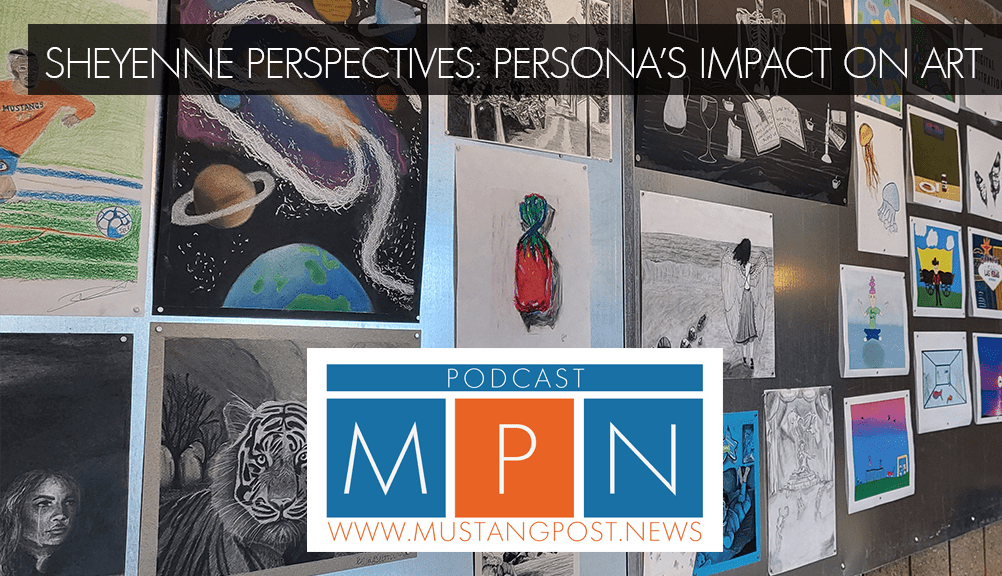
Every time you walk past an art gallery full of works from various artists, even the displays outside by the 1202 art room in Sheyenne, you are unraveling someone’s growth and diversity that led them up to that point. With your own eyes, you are witnessing someone’s identity.

May it be a sculpture of a woman screaming in water, or a depiction of school censorship on watercolor papers or Bristol boards. The diverse results that are presented to the public is more than just work, it’s an artist’s personality, their experience, their life. Look closer into it and you can see truly how persona can impact art.

[THEME SONG – KOLBY THOMPSON.]

Dairell Alvarico: This podcast was recorded and edited by Dairell Alvarico.

Sheyenne Perspectives theme music was composed and performed by Kolby Thompson under the direction of Mark Berntson. Thank you, Reagan, Autumn and Ms. Murphy, for sharing their wonderful thoughts and experiences. 

So long, everyone. We hope to see you on the next episode of Sheyenne Perspectives.

This has been a production of Mustang Post News.