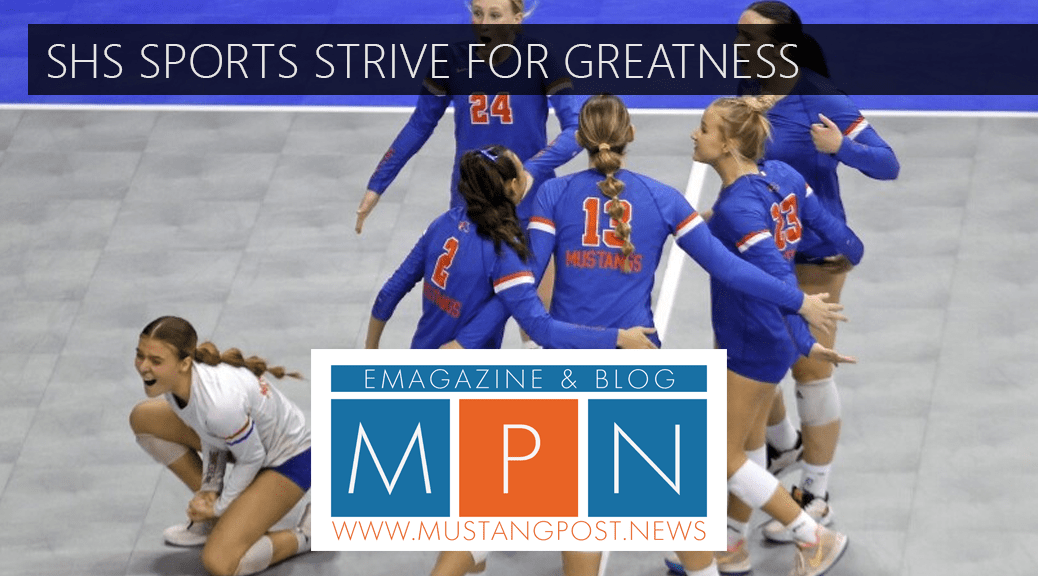
During the 2023-2024 school year, the Mustangs saw great success as state champs in basketball and volleyball. This season is going to come with many successes and maybe some losses all while working toward a state title.
With the changes that come in all sports, Sheyenne will need to figure out what works best for their teams. There are many predictions that can be made about these seasons but only time will tell.
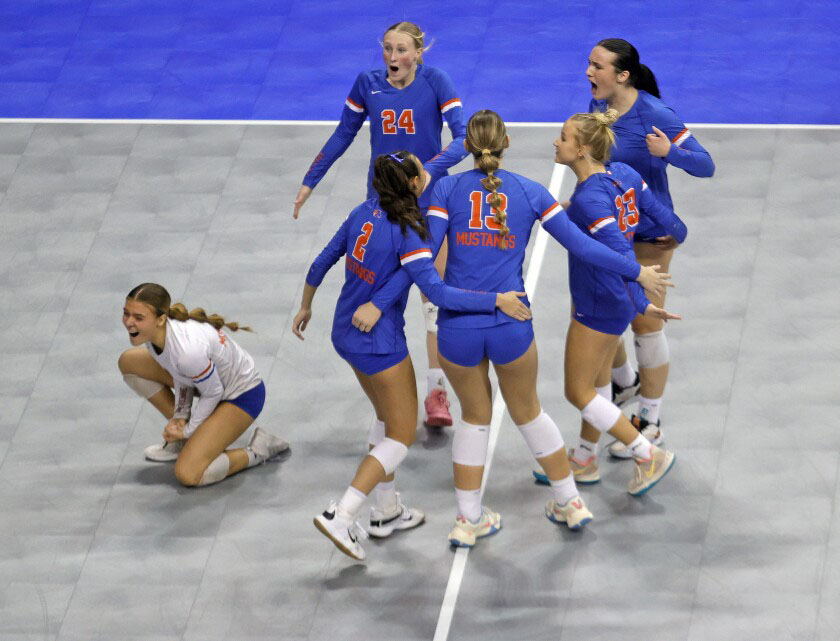
Last year SHS volleyball lost two seniors: Isabelle Albrecht and Mia Engel. While the inevitability of seniors leaving can be hard, losing just two was not as drastic as years past. With three new freshmen on the varsity roster, they will need to work with them and other young players to get them used to the chaotic atmosphere.
Shanley lost to the Mustangs during the EDC and state championship last year. With a target on their back, Sheyenne took on Shanley this season and lost 3-1. Every team will give everything they have to take the title away, but the Mustangs will continue to grow and improve their chemistry and take everything they learn to the state championship court.
State Volleyball 2023, image courtesy of InForum
SHS varsity football lost 16 seniors last year yet brought in many new starting players. To accomplish their goals the Mustangs want their seniors to step up and be good leaders. They want teammates who can hold the underclassmen accountable and show them that they play hard from start to finish.
Football has had a very strong start to their season but have had losses against the west. The team needs to understand that they are going to have to work through challenges, but if they can do that then a state title is right in reach.
Last year, girls basketball lost two seniors, Brynn Bishop and Brenna Dick. The Mustangs base their offense and defense around the current players’ strengths. Brenna Dick was a key player to the Mustangs offence so finding someone that will take her place is going to be a big change. Sheyenne wants to have confident players out on the court giving it their all and the girls team is full of players ready to step up and take that role.
One team that might stand in the way of that state title this year is Horace. Last year, the mustangs lost twice to Horace, so if they manage to grab the win against them this year, it will mean a lot to the team. Mustangs are hoping to give everything they got to win them a state title this year.
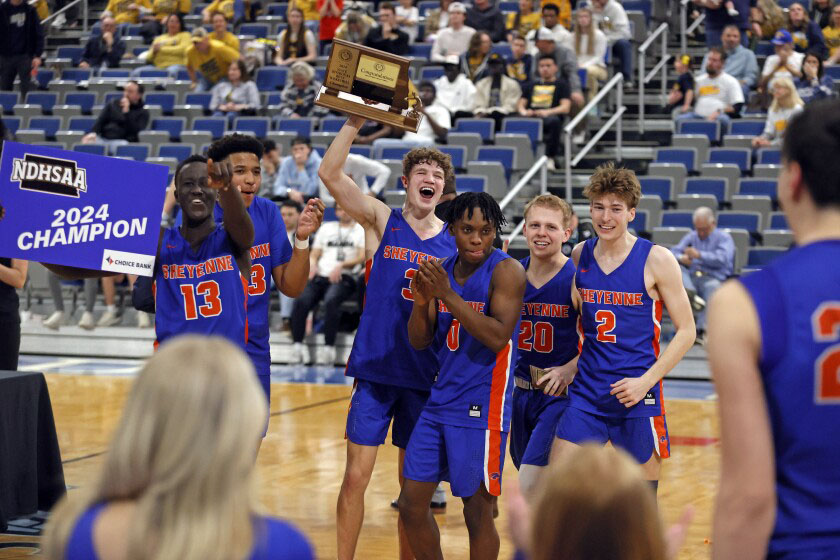
State Basketball 2023 image courtesy of InForum
Boys basketball lost 6 seniors last year and star player Tommy Ahneman who was the majority of their starting lineup. With only one returning player, Sheyenne will have to make up an entirely new team. There are many ways they could go about their play style this year with a whole new team, it will be interesting and exciting to see how this season plays out.
Sullivan Ihry and other seniors will have to show underclassman what it takes to be on the Sheyenne Mustangs basketball team. If this team remains set on the idea of becoming state champs for the second year in a row and willing to work and put in as much effort to get to the point of winning, nothing can stand in their way.
Welcome back! The Mustang Post has survived another year of the long harsh winter known as Summer. Now a new spring is blooming in the Fall, new articles, new students, and even more editing for myself.
Throughout this year we hope to have a steady flow of articles releasing periodically, unlike last year. We also hope to have a bigger focus on the release of individual articles instead of the eMagazine focused format that we went with last year.
Besides the changes mentioned above, no other sweeping changes have been made. Two thirds of our editorial team has departed over the long winter, but with that comes new editors joining the team.
Abby Smith will be joining as an Assistant Editor focusing on podcasts and sports. Addison McCrosky will also be joining as an Assistant Editor with a more general focus.
THE CINEMA CHRONICLES By Gabriel Sieling Hosted by Gabriel Sieling
Official Transcript:
CHILDHOOD TRAMA/WHY CHILDHOOD CHARACTERS ARE BECOMING KILLERS
{RISK BEGINNING THEME}
Gabriel Sieling: Hello Everyone and welcome back to The Cinema Chronicles. I’m your host Gabriel, and today we will be talking about how Fan Favorite Childhood Characters are becoming Horror Movie Killers
SOUND EFFECT: Film Scroll
Question 1: What IP’S were affected?
Gabriel Sieling: You might be wondering what I am talking about? Well I’ll give you an explanation. Recently in the 2020’s, Fan Favorite Childhood Fictional Characters have been staring in their very own horror films such as “Winnie the Pooh”, “The Grinch”, “Bambi”, and everyone’s favorite “Mickey Mouse.” People have been using these characters and twisting their origin in order to make a buttload of low budget horror films.
SOUND EFFECT: Knife Slash
Gaabriel Sieling: Because the idea of your favorite childhood characters killing people sounds very funny. So, people like Rhys Frake-Waterfield (Creator of “Winnie-The-Pooh Blood and Honey” and “The Twisted Childhood Universe”), and Stevan LaMorte (Creator of “The Mean One”), are using these characters just for fun, while also making a quick cash grab on the side.
SOUND EFFECT: Film Scroll
Question 2: How are they legally able to do this?
Gabriel Sieling: You might be wondering how these creators are able to get away with using these characters? Shouldn’t Disney be suing them? Well, that’s just it, they cant. The reason people are able to use characters like Winnie the Pooh, and Mickey Mouse, is because they are now in something known as “The Public Domain.” The Public Domain is a law that states whenever IP expires after 100 years of its release, that IP is sent into the public domain. When said IP enters the Public Domain, then they are free to use by any creator and that IP now belongs to the public. So, is that it? Mickey Mouse is no longer owned by Disney.
SOUND EFFECT: Gasp
Gabriel Sieling: Well not so fast. Mickey Mouse is in the Public Domain sure, but only a specific version of Mickey Mouse. Specifically, Mickeys first ever appearance in the 1928 animated short “Steamboat Willie.” And that Mickey Mouse is Black and White. Whereas the current mickey with color we know today, didn’t appear on screen till the 1935 Animated short “The Band Concert.” So, that means the public is not allowed to use the current version of the mouse for another 8 to 9 years. People will only be allowed to use the Steamboat Willie version of the character, like they did in the mickey mouse horror films “Mickey’s Mouse Trap”, and the recently announced “Scream Boat.” But you might be realizing, I mentioned the grinch earlier in the episode, but the original How the Grinch stole Christmas children’s book came out in 1957, that IP will legally not be in the Public Domain for at least another 30 years or so. That leads me to another way people can legally use these characters for their horror movies. The grinch horror film released in 2022 titled “The Mean One” is classified as a “Parody Film.”
SOUND EFFECT: Boing
Gabriel Sieling: Hollywood is no stranger to Parody films, with films such as “Scary Movie”, “Shaun of the Dead”, “Vampires Suck” “The Bill and Silent Bob franchise”, and “The Starving Games”. These films are classified as parodies because they never directly address anything from the original material, they just adapt the film that they are basing the parody on. For example, in the mean one, they never directly address the monster as the grinch. They only address the mean one. Which is a reference to the classic grinch holiday tune.
SOUND EFFECT: You’re a mean on Mr. Grinch.
Gabriel Sieling: This makes it so that the film is safe from being sued as it is under The Parody Label.
SOUND EFFECT: Film Scroll
Question 3: Are there any restrictions?
Gabriel Sieling: So, you may be thinking that all of the stuff I mentioned is kind of an overpowered public right. But there are some restrictions that these creators have to follow. As said in a Video from the YouTube Channel “The Film Theorists”,
SOUND EFFECT: Welcome to film theory.
The head of the channel at the time “Matthew Patrick” revealed that the companies that own these IP’s have the ability to establish “Trademark’s.” What is the Difference between Copyrights and Trademarks you may ask? Well unlike Copyrights, Trademarks do not expire. Let’s take what MatPat used as an example of this, Superman.
SOUND EFFECT: Superman Theme
The Man of Steel’s first appearance was in “Action Comic #1.” And as of the time recording this, Superman’s copyright is set to expire in January of 2034. But if people want to use Superman for their own projects, they are going to have to get really creative with how they use the character. First off, people are only allowed to use the Superman that appeared in that issue, he has a black and red S on his chest, and the only powers he had were super strength, invulnerability, and the ability to leap tall buildings with a single bound. Therefore, Superman did not have the ability to fly, or shoot lasers out of his eyes. So that would mean that creators could not use his powers. And Second off, The Superman name and iconic logo are trademarked by DC Comics. Therefore, Creators can use the iconic S Symbol, or use the name Superman. They may have to get creative and bring out their hyphens and introduce Super-Man.
SOUND EFFECT: Laugh sound.
Gabriel Sieling: The point is, all of these characters are getting horror films, just because of the fact that they can, and that it’s legal. But still, in the end of the day, the people still care about the source material and use it to make a twisted take on our favorite characters……………except “Mickeys Mouse Trap” that can still burn in a fire. Anyway, be sure to check under your bed for any pooh bears tonight. My name is Gabriel, and this has been the Cinema Chronicles. Thank you.
It’s finally the last month for the 2023-2024 school year! It’s been a fun journey, pumping as many articles and podcasts as we can, with its unique topics and personal touches. Our team has been working hard these past few weeks, creating content that will make a lasting impression before summer vacation starts.
Sharing what we love and adore through The Mustang Post is exhilarating, knowing that there are people out there who would be interested in reading or listening to our works.
Additionally, I am sad to announce that this is also the last year Roland, and I will be in The Mustang Post. Senioritis may be right behind us, but we are definitely not leaving the team without going all out!
Personally, I can’t stress enough how much this experience means to me; from the bottom of my heart, thank you. And enjoy your summer to the fullest! You can read the last issue here!
THE CINEMA CHRONICLES By Gabriel Sieling Hosted by Gabriel Sieling
Official Transcript:
How The Spider-Verse Changed Modern Animation
{RISK BEGINNING THEME}
Gabriel Sieling: Hello Everyone and welcome back to The Cinema Chronicles. I’m your host Gabriel, and today we will be talking about how The Spider-Verse changed modern day animation.
SOUND EFFECT: Film Scroll
Question 1: What is “Spider-Man into the Spider-Verse?
Gabriel Sieling: For those who do not know, In December of 2018, Sony Pictures Animations released the first ever theatrically released Animated marvel film “Spider-Man into the Spider Verse.”
SOUND EFFECT: THWIP
Gabriel Sieling: Produced by Phil Lord and Chris Miller, the film follows Brooklyn teenager Miles Morales,
SOUND EFFECT: Miles Morales Quote
Gabriel Sieling: as he suddenly develops mysterious powers that transform him into the one and only Spider-Man. When he meets Peter Parker, he soon realizes that there are many others who share his special, high-flying talents. Miles must now use his newfound skills to battle Wilson Fisk, AKA The Kingpin. A mad businessperson who has a device that can open portals to other universes and pull different versions of Spider-Man into miles universe.
SOUND EFFECT: glitch SFX.
Gabriel Sieling: This Film opened with incredible reviews, and even won the academy reward for best animated feature film.
SOUND EFFECT: wow.
SOUND EFFECT: cha ching.
Gabriel Sieling: And as you might of guess, the attention this animated film was getting made the other studios very aware.
SOUND EFFECT: film scroll.
Question 2: how did Spider-Verse change the world of animation?
Gabriel Sieling: Spider-Verse had an Animation Style unlike any other animated film before, with the animation specifically made to look like a comic book come to life. The animators wanted to try something different from the common Pixar esk 3D animation, trying innovative ideas such as switching the frames per second on a specific character, and making every character have a unique style and tone to separate hem from the other. This is what caused “Into the Spider Verse” along with its sequel, “Across the Spider Verse” to start a trend in modern animation by invoking its hero’s comic-book origins with Ben-Day dots and wild, hallucinogenic sequences. This made it so that major studios have grown less fearful of animation and encourage them to diverge from the norm. The film proved that audiences would not reject projects that look drastically different from the house styles of Pixar and DreamWorks. Films like “Teenage Mutant Ninga Turtles Mutant Mayhem,”
SOUND EFFECT: ninja slash.
“The Mitchell’s VS The Machines,”
SOUND EFFECT: robot sound.
“Puss in Boots the Last Wish”
SOUND EFFECT: fairy tale sparkle.
And “Nimona”
SOUND EFFECT: fire.
Gabriel Sieling: all have distinctive looks that are visually sensational without conforming to established playbooks. Like “TMNT Mutant Mayhems” approach to animation to make it look like it was drawn by a teenager, and “Puss in Boots the Last Wish’s” approach to make the animation look like each frame was pulled from a story book. If Spider Verse did not take the risk and tried to do something different with animation. Sure, not all new animated films take this approach such as animation studios like Pixar and Illumination. It does not affect the impact that these different animated films have on the audience.
Gabriel Sieling: If it were not for Spider-Man into the Spider-Verse, Animation would have never changed. The Spider-Verse films are classified as cinematic masterpieces. And with these films’ combination of great storytelling, animation, special effects, and heart, I believe they deserve that title. This just goes to show that technology is always evolving. And it is our choice if we evolve with it and try new things, or just stay in the past while everyone else moves on.
Thanks For Watching this episode of the Cinema Chronicles!
Mental health is a key factor in performance and trust in sports. According toPhyisopedia Mental health in athletics is defined as “a state of successful performance or mental function that results in productive activities, fulfilling relationships with others, and the ability to adapt to change and cope with adversity” (Wylleman et al 6).
Mental health is a valuable resource on the field. A positive state of mind enables for better decision making and overall performance. However, having a negative mental state might contribute to slow and sluggish play. Pressure’s negative influence begins with slight unhappiness and a minor decline in a person’s ability to perform. When they are under too much strain, they can feel stressed, anxious, and unhappy.
Mental responses such as worry, anxiety, loss of confidence, denial of injury, leading to irrational fear of re-injury, and a setback in performance can all have an impact on the rehabilitation process of an injury. The challenge of keeping it out of your mind. Remaining upbeat, taking advantage of the setback as a chance to grow, and remain loyal to your goals and self. Furthermore, the ability to shatter the stigma lets a great athlete be authentic and divert failure from their path.
Cultural and societal attitudes within sports often stigmatize mental health issues, hindering athletes from seeking help due to expectations of toughness and the perception of weakness associated with mental health struggles. Fear of judgment and career consequences can deter athletes from seeking mental health support, perpetuating silence and stigma in sports. Limited access to mental health resources further compounds the challenges athletes face in addressing their mental well-being, exacerbating the stigma and barriers to seeking help within the sports community.
In sports, fostering a mental health support system entail offering resources and counseling to enhance athletes’ well-being and performance. Each participant plays a critical role in this battle, including coaches, mental health education, and access to services. For instance, in an article written by Gabe Kapler he underscores the pivotal role of coaches, teammates, and support staff in addressing mental health issues in sports. Sharing that they should be a support system not a system where they are conditioned to appear bulletproof, and to suck it up (Paragraph 4).
Kapler also emphasizes the significance of mental health education and training within the sports community to destigmatize mental health issues and provide effective support systems for athletes (Paragraph 9). Additionally, he advocates for the crucial access to professional counseling and therapy services for athletes and individuals facing mental health challenges, emphasizing the need for sports organizations to prioritize mental well-being (Paragraph 10). Mental health presents a significant concern within the realm of elite athletes, where the relentless pursuit of excellence often intersects with unique challenges and pressures.
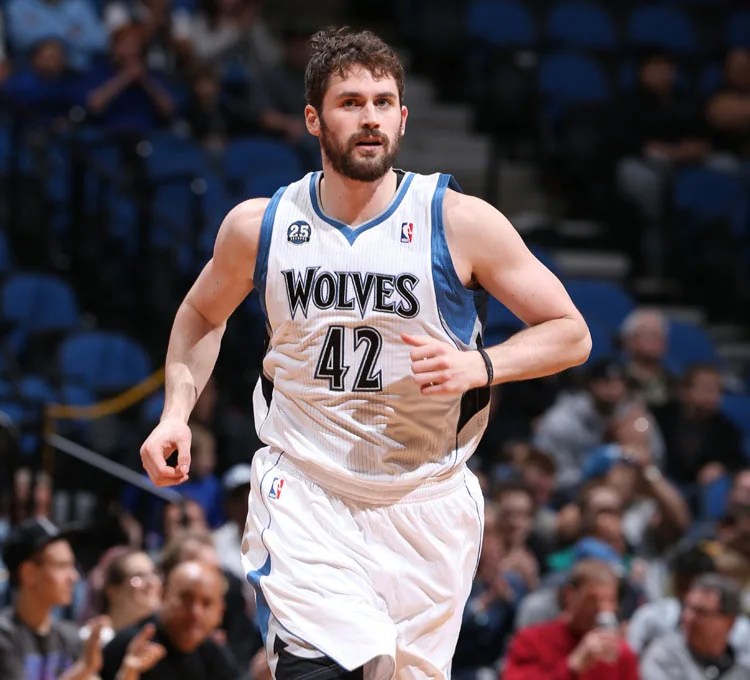
For example, an article titled Everyone Is Going Through Something by NBA player Kevin Love highlights the distinct challenges faced by elite athletes, including societal expectations of toughness and masculinity, which can discourage them from seeking assistance for mental health issues, perpetuating stigma within the sports community (Paragraph 2).
Love’s experience further underscores the delicate balance athletes must maintain between the demands of performance and the needs of their mental health. His panic attack during a game serves as a key reminder of the strain athletes encounter in navigating these competing priorities, emphasizing the crucial importance of prioritizing self-care and seeking support when facing mental health challenges (Paragraph 4).
Additionally, Love’s decision to seek therapy after his panic attack provides a notable example of successful management of mental health in sports, illustrating the significance of openness and professional help-seeking in addressing mental health concerns within the elite athlete community (Paragraph 11).
In conclusion, the significance of mental health in sports is undeniable. As athletes strive for excellence, they face unique challenges that can impact their mental well-being.
It is essential for athletic communities to prioritize mental health awareness and support, creating a culture where athletes feel empowered to prioritize self-care and seek help when needed. By promoting mental health education, reducing stigma, and ensuring access to resources, athletic communities can foster environments where athletes can thrive both in their sport and in their personal lives.
Sports betting involves placing monetary wagers on the outcomes of sporting events, ranging from mainstream to niche competitions. Its rising popularity has made it a significant aspect of both fan engagement and player involvement in the world of sports.
Fan betting involves placing bets on sports events for entertainment, including friendly wagers, fantasy sports leagues, and online betting, driven by motivations like enhancing excitement and testing sports knowledge, yet it poses risks such as financial losses and gambling-related harm.
Player betting refers to the involvement of athletes or sports professionals in placing bets on sporting events, potentially including those in which they are directly participating. Some players sports bet even though they are playing. For example, in article written by ESPN it highlights Titans wide receiver Calvin Ridley who downloaded a gambling app, deposited $1,500, and bet on NBA and NFL games, including betting on his current team at the time the Falcons as a result he was called in front of NFL investigators to be questioned about the bets in November 2021 and ultimately suspended for the entire 2022 NFL season (DiRocco 3). And many people feel as a direct result of any decision like this a player lacks integrity and ethics for a game, they spend their entire life trying to make it too.
The legal status of sports betting varies across jurisdictions, with some countries permitting it under strict regulations, while others have banned or heavily restricted it. Regulatory measures typically include licensing requirements, age restrictions, and consumer protection measures, but their effectiveness can vary depending on enforcement and oversight mechanisms.
Gambling can have the same effect on you as being addicted to drugs or alcohol that can end up leader to many bad habits. For example, an article written by the Mayo Clinic shows these potential problems “Gambling can stimulate the brain’s reward system you may continually chase bets that lead to losses, use up savings and create debt. You may hide your behavior and even turn to theft or fraud to support your addiction” (Compulsive gambling 2). Sports betting can have profound psychological effects on both fans and players, leading to heightened excitement, addictive behaviors, financial stress, ethical dilemmas, and potential damage to reputation. For many people betting is seen as just another form of entertainment but there is the problem. For example, an article titled social influences normalize gambling-related harm among higher risk gamblers highlights this “Social influences are key drivers of gambling and can begin in youth through parental modeling and facilitation. Over time, social influence from friends and colleagues also becomes important” (Russel et al 1).
Sports betting generates substantial revenue globally, contributing to the economic significance of the industry, while its impact on the sports industry includes increased viewership, sponsorship opportunities, and investments in infrastructure and technology. Ethical considerations in sports betting prompt ongoing discussions on regulation and responsible gambling, while the future outlook involves balancing commercial interests with consumer protection and social responsibility amidst technological advancements.
In conclusion, Sports betting encompasses both fan and player involvement, with fans engaging for entertainment and players potentially facing ethical dilemmas. The legal landscape varies across jurisdictions, with regulatory measures aiming to mitigate risks, while the economic significance is underscored by substantial revenue and impacts on the sports industry.
EPISODE 3: The Professional Dream By Jackson Odden Hosted by Abby Smith
Official Transcript:
[THEME SONG – ORGAN.]
Abby Smith:
Hello everyone! This is the Mustang Post: The Home Turf, our new sports podcast, where we dive into not just the home turf of Sheyenne but the home turf of the love of all sports for fans and athletes who invest themselves and their lives in their passion. In this episode, Jackson Odden speaks with two Sheyenne baseball players about how they balance sports with education and their personal lives.
Here’s Jackson.
Jackson Odden:
Hello my Name is Jackson Odden I am a sophomore at Sheyenne High School and I will be interviewing two other sophomores.
Gavin Satrom:
I’m Gavin Satrom I’m a sophomore at Sheyenne high.
Ashton Loe:
My names Ashton Loe I’m a sophomore at Sheyenne High School.
Jackson Odden:
Every child has a dream. Sometimes those dreams are as simple as getting that new toy. However, there are those times where dreams become more complex, more life-impacting, bigger than big. Something like, “I want to be a pro athlete. A pro baseball player.” But what impact would attaining a dream like that have on that child’s life and the lives of his family and friends.
However, there’s a lot that goes into building that road to becoming a pro athlete. Namely, there those seemingly simple stages like preparing for a game. Gavin, a sophomore at Sheyenne High School plays on its C team and prepares for that moment he steps up to bat versus the pitcher.
Gavin Satrom: “Well, like if you scout the pitcher, you can like see how he throws, but um, I don’t really scout pitchers that much. So, I really just get there in the game and, like, see how fast he throws and try to time him up.”
Jackson Odden:
Ashton, also a sophomore at Sheyenne high school on the C team, is a bit more focused and determined.
Ashton Loe: “When I am in the dugout or the on-deck circle I try and time him up, look at how he’s throwing what pitches he’s throwing basically all the mechanics of it.”
Jackson Odden:
In order to accomplish the goal of playing professional baseball ball you need to know what goals to have for yourself and for the future. And more specifically the goals you have in life after you have gotten your high school diploma.
Gavin Satrom: “Well, I want go to college to play baseball, and then hopefully we get to the professional level, but like if not, then something probably something in like the accounting business.”
Jackson Odden:
Ashton may share the same goals as Gavin but has a different perspective of life after high school.
Ashton Loe: “First I want to continue my baseball career in college and then if that doesn’t work out somewhere in the medical field like athletic trainer or something like that.”
Jackson Odden:
Having a belief in yourself is a difficult thing to do when your goal is so high as to make it professionally. But it is a requirement in order to have confidence in yourself to accomplish it.
Gavin Satrom: “Well, I would like to say I am pretty good, but, like, you never know what’s going to happen. Its baseball it is up and down a lot of the time. You do good one time, really bad the other.”
Jackson Odden:
Ashton Shares being honest with yourself about your ability can be difficult but necessary in the path of life.
Ashton Loe: ” If I am being honest I don’t really know because a lot of the players around me are really good and watching videos everywhere I see players younger than me that are throwing really hard so I don’t know.”
Jackson Odden:
How does a baseball player maintain their focus amidst adversity, such as when they encounter struggles on the field? Can they find the inner perseverance, despite if they may be struggling in baseball?
Gavin Satrom: ” Well, like honestly you got to leave the last at bat or like batter when pitching behind you. And you just move on next batter, next at bat, all that.”
Jackson Odden:
How can seeking out different environments to practice in help a baseball player regain their focus and improve their performance during tough times?
Ashton Loe: “Whenever I’m struggling on usually I just try and practice that more like go to the Ballyard practice that and get better at it.”
Jackson Odden:
How has the discipline and teamwork learned from playing baseball translated into success? How have skills honed on the field, positively helped you in aspects of your life?
Gavin Satrom: “Baseball’s helped me by like keeping me in like so like for baseball, I have to focus on like on what ever I am doing, and then I can use that like in school too or for like what ever I am doing in my life.”
Jackson Odden:
How does playing giving a person a good mindset in baseball and a peace of mind?
Ashton Loe: ” I like playing baseball because it gives me something to do all the time I am always practicing it.”
Jackson Odden:
In the intricate dance between failure and success on the baseball diamond, how do you navigate the fine line, seeking growth amidst strikeouts and home runs? Can you share the strategies and mindset that help you maintain in your journey as a baseball player?
Gavin Satrom: “Well, Like balance the success is really just how hard I practice and all that, but then with like the failure I can just practice even more and harder to like get that success back.”
Jackson Odden:
Keeping to yourself and working on you can be a great way to challenge yourself.
Ashton Loe: “Well, usually I try to ignore how other people are playing, focus on myself, and make sure I am working hard.”
Jackson Odden:
As the crack of the bat echoes through the air, what specific milestones and improvements do you envision achieving in your upcoming baseball season, both individually and as a team, to make it a truly successful and memorable?
Gavin Satrom: “Well, really, it’s just to win the season and the tournament, so win as much as we can and play as best as we can.”
Jackson Odden:
Self challenges can make you a better leader and player than you think you are.
Ashton Loe: “I want to play really good hit a lot better than last year, and hopeful our team can win the tournament again.”
Jackson Odden:
What aspirations and objectives do you envision for your journey through college and beyond, and how do you plan to achieve them?
Gavin Satrom: ” Well, with college, I hope to still play baseball and keep up good grades, but then after college, I want to play professionally; if it doesn’t work, then something in the accounting business.”
Jackson Odden:
What would you do if everyone didn’t look at you what if baseball doesn’t work out?
Ashton Loe: “For college I want to continue my baseball career hopeful go D1 maybe make it to the majors otherwise probably stay in the medical field like I said before.”
Jackson Odden:
How do you navigate the challenge of resisting comparisons to peers of similar age who might be excelling in various aspects of life?
Gavin Satrom: “When I’m playing the game of baseball, I don’t really look around to see how people are doing; I just care about how I am doing myself and think if I can perform better or, I guess play better.”
Jackson Odden:
Comparing yourself to others can be a tricky thing how do you try to avoid it?
Ashton Loe: “Although I do see a lot of better players I just try and ignore them focus on myself get better get better than them.”
Jackson Odden:
“How do you manage the juggling of your academic studies while also dedicating significant time to practice and play baseball, and what strategies have you found most effective in maintaining a balance between these?”
Gavin Satrom: “Well, I mean If I can focus on the grades, then I can go out and just play baseball.”
Jackson Odden
One of the most beautiful parts of playing sports is you are a student athlete how do you balance being a student and an athlete?
Ashton Loe : “Usually I am pretty good at keeping my grades up keeping eligibility so I just focus on baseballs a ton during school.”
[THEME SONG – ORGAN.]
Abby Smith:
There you have it, with one athlete confident with his rise to the professional level and another riding the wave, who knows what the outcome will be.
This podcast was recorded by Jackson Odden and hosted by Abby Smith and our thanks goes out to Ashton Loe and Gavin Satrom for their time which helped make this podcast possible.
In our next episode of The Home Turf, Reise Berg and Aiden Johnson, take a look at the world of professional basketball.
EPISODE TWO: The Human Element in Baseball Dwindles By Ethan Laabs and Jonah Peterson Hosted by Abby Smith
The Mustang Post’s Ethan Laabs and Jonah Peterson take a critical look baseball’s mix of technology and humanity and where the fine line between the two begins and ends.















 The Mustang Post