Many distinct types of horror exist. Most hinge on the idea of not knowing what is going on around you: the absence of knowledge. Or they hinge on not being able to do anything about the things around you: the absence of action.
This creates a duality where one coexists with yet is in an imbalance with the other. There is either an absence of knowledge or absence of action: when one is present, the other is lacking. This duality drives conflict.
The problem with this style of horror is the fourth wall, the knowledge that everything is fiction and cannot cause any harm. Because of this fourth wall between the player and the game the absence of knowledge and action’s effects are lessened.
This is where the idea of “meta horror” strives. Meta horror’s goal is to break down the fourth wall and any other boundaries between the player and the horror. Meta horror doesn’t outright abandon the formerly established ideas on how to scare but instead expands on it by breaking down the fourth wall.
Eternal Darkness: Sanity’s Requiem was the first horror game of its kind, scaring players in avenues not previously thought of. Eternal Darkness was released in 2002 exclusively for the GameCube, both the time and the consoles limitations led to a less refined version of meta horror but one that still scared just as well.
Fake ending screen in Eternal Darkness.
In Eternal Darkness a sanity system can affect how the game scares, the bar starts full and slowly empties as time goes on. Starting with minor changes such as noises with no source or even skewing the camera a tiny amount. As the player’s sanity bar gets lower more extreme effects happen such as faking deleting the player’s save file, abruptly ending the game claiming a sequel is in the works, or even having the player character die spontaneously.
While Eternal Darkness got many things right, the game was limited by its hardware and development time. It created a great base for many other games to work off in the future.
Imscared: a Pixelated Nightmare picked up where Eternal Darkness left off and is considered by most to be the most influential and notable meta horror game. Imscared was one of the first meta horror games to be released on pc and it makes use of that fact. Imscared holds no punches when trying to scare the player, using more traditional methods like jump scares to opening a YouTube video in the background without your knowledge.
The horror of Imscared does not just leave the player frightened but leaves them questioning whether they are safe even after closing the game. Imscared achieves this effect by many means for example, faking that the game is closed only to jump scare the player, creating new files and images on the player’s desktop, and even faking that the player’s computer crashed.
DDLC is the last game mentioned here because it strays away from the two other games preestablished ideas of horror. DDLC breaks down that fourth wall by deceiving the player from before they even start the game. It masks itself as a cute visual novel, a genre of game that focuses on player choices, interactions with the story, and less gameplay.
DDLC chooses not to scare the player with jumpscares but instead disturb the player. The first act of the game starts normal by all means but by the time of the second act the player starts to notice cracks in the game. Small instances of abnormalities not mentioned before. All of this culminates in the third act revealing all of horrific elements of the world that the player had come to love.
The three games mentioned above are not the only meta horror games but they were pioneers of the genre and are each in their own way still affecting the meta horror genre today.
Counter Strike: Global Offensive (CS:GO) is one of the most prolific games of all time, and in March of this past year Valve announced the long-awaited sequel, Counter Strike 2 (CS2).
CS2 promised a lot with its reveal: completely overhauled graphics, sub-tick technology, and volumetric smokes. Now just over six months later everyone has access to CS2. Has Valve delivered on their promises or were they flaunting a new game for a quick bump in players?
It is important to note that when talking about CS2, CS:GO was also buggy and unbalanced when it was first released. Only after years of working on the game with feedback from the community did CS:GO become the game it is today.
With that fact in mind, CS2 right now is a buggy mess unlike the now crisp CS:GO.
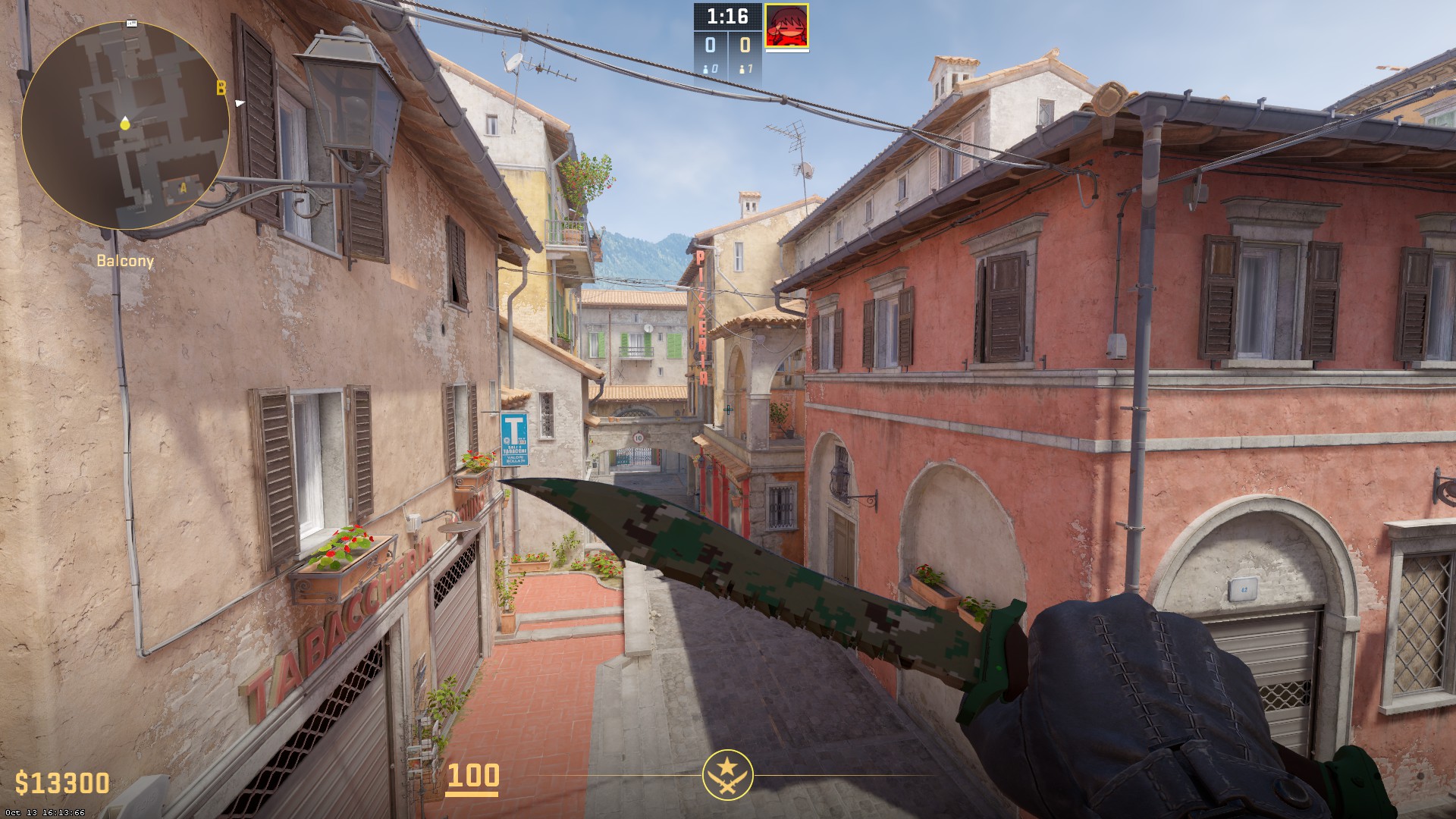
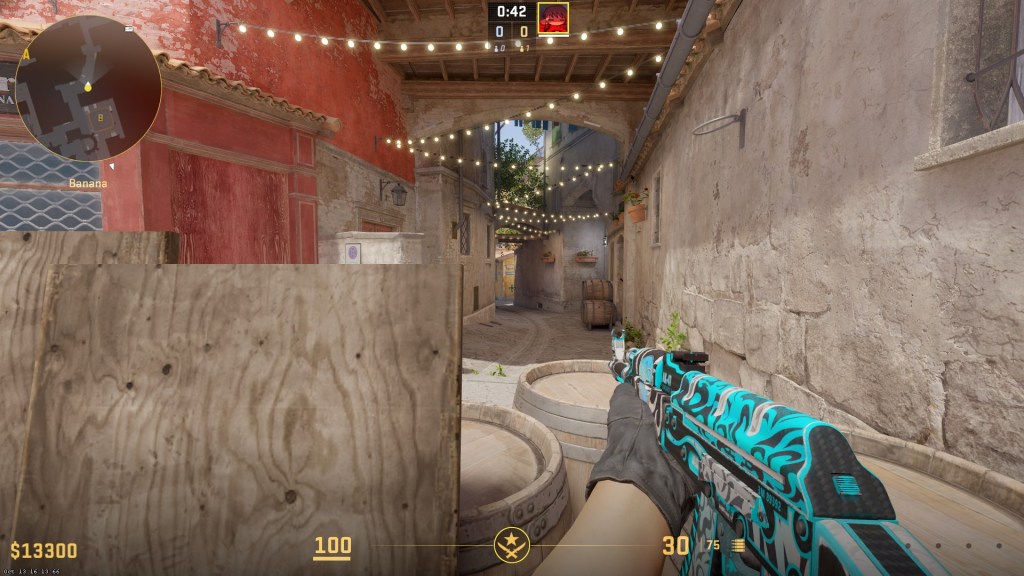
CS2 released with many changes, the biggest being the UI. The player’s HUD is completely different compared to CS:GO, changing the location of the player’s health and ammo with a sleeker more modern design.
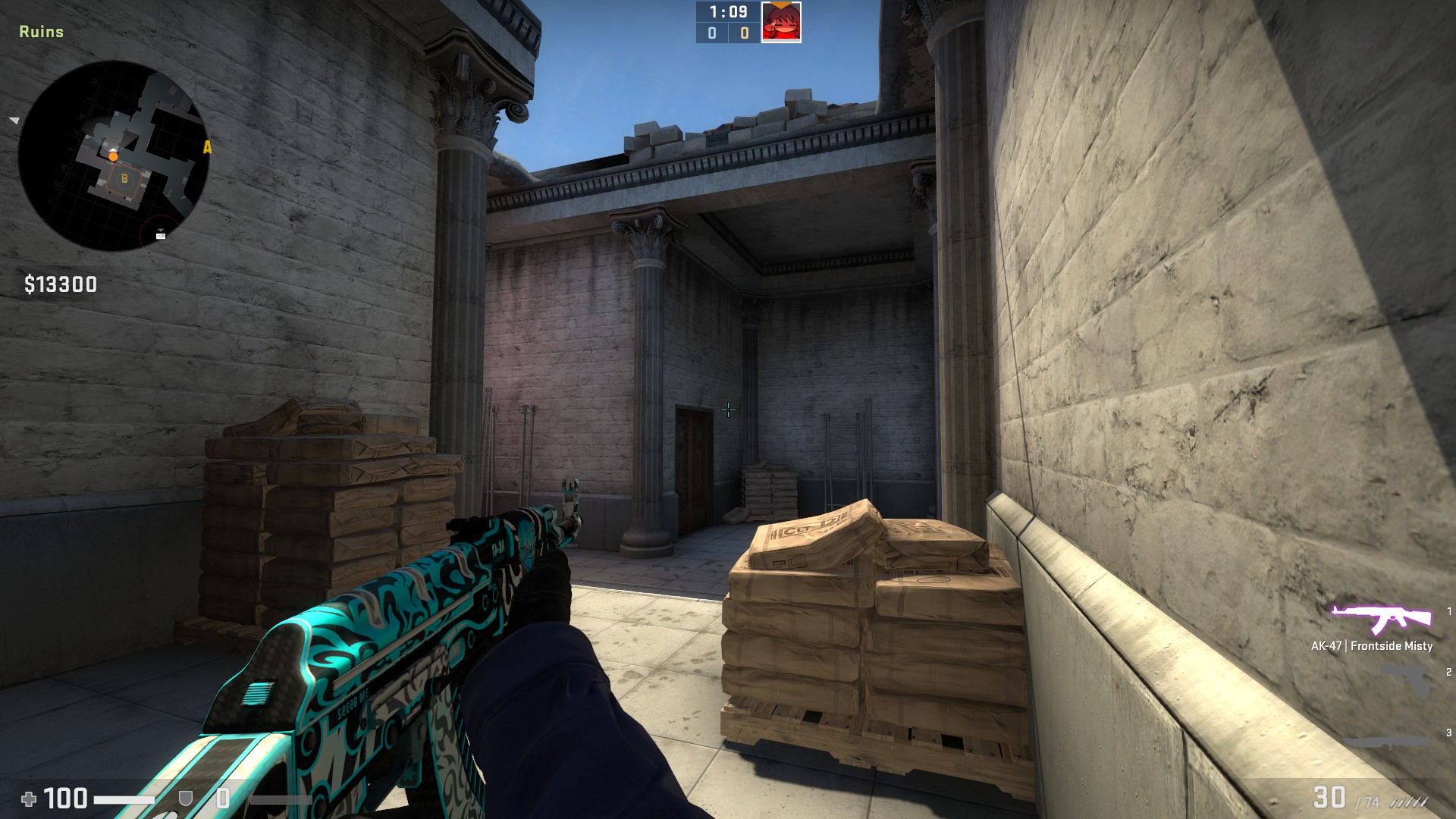
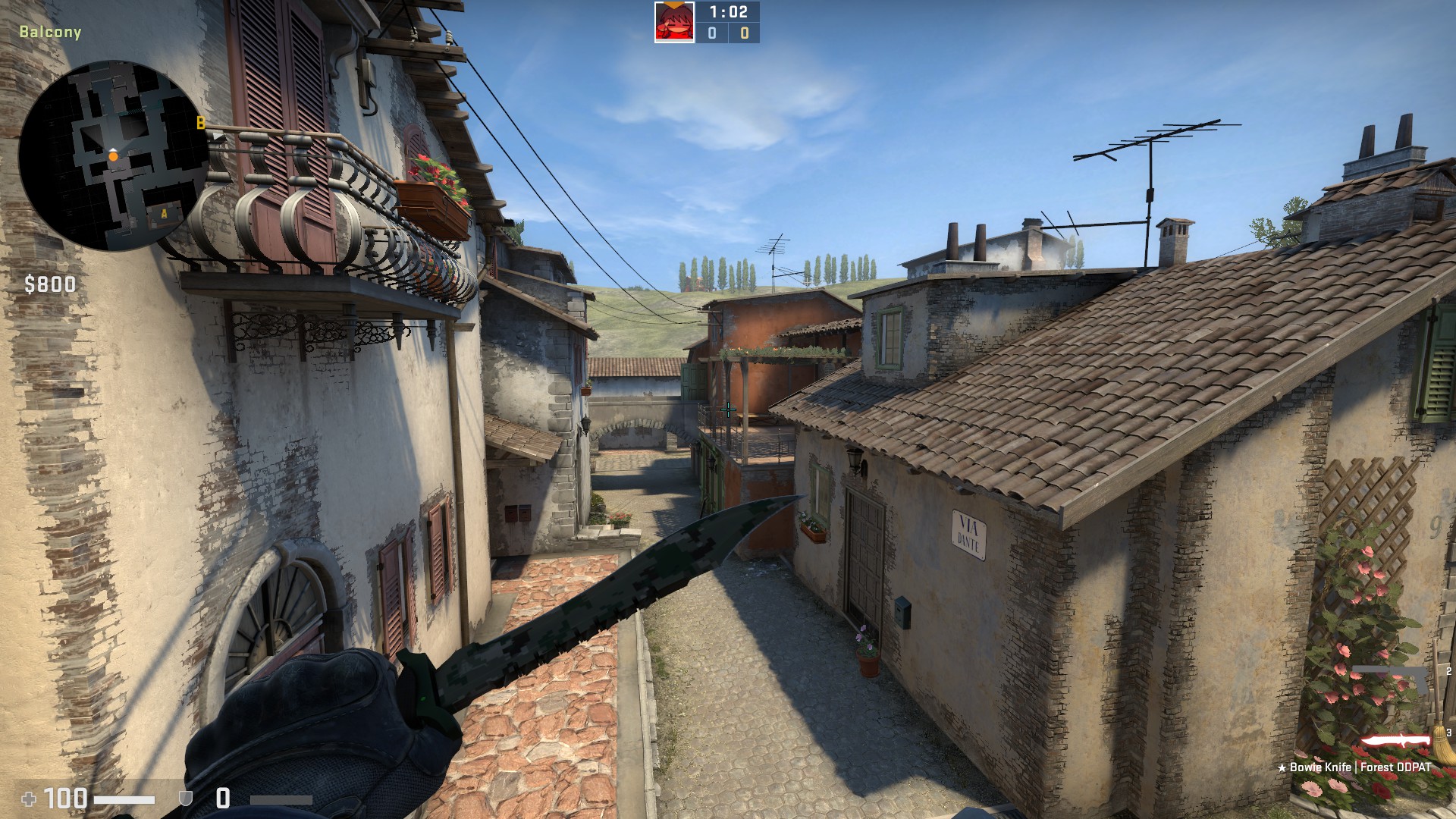
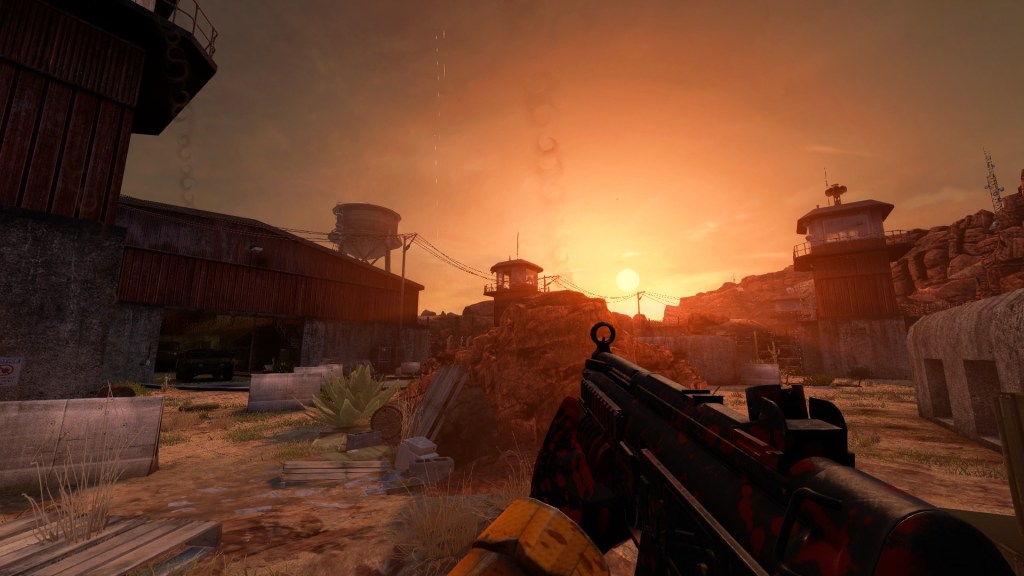
Inferno’s “church”
The UI changes don’t stop there though. They overhauled the buy menu opting for a simpler design compared to the circle menu found in CS:GO.
CS2 has notably forgotten about a beloved setting found in cs:go cl_righthand. This setting would change if your gun model was on the left or right side of your screen. It’s absence from CS2 has left many questioning why they would remove this tactical advantage.
The UI wasn’t the only major overhaul found in CS2. Along with it came a brand-new set of visuals. While CS:GO’s graphics did improve as the years went on, it was always limited by the twenty-year-old source engine.
CS2 abandons that limitation, and it flourishes graphically because of that. Equipped with a new “raytracing esque” lighting system and new textures, the game looks visually stunning on higher settings and is still good-looking on lower settings. But graphics aren’t everything.
Inferno’s “Apartments”
CS2 also chose to change the outdated tick system. Previously, CS:GO relayed what happened every 64th of a second to the main servers, this is also true in CS2. The difference in the two systems is that CS2 records where you are looking when you shoot. Previously CS:GO shot where you are looking at when that shot registered with the server. Theoretically this will be more accurate to what happens but for those with a bad connection this can feel unfair because they seemingly die behind cover.
The gameplay of CS2 is by far the worst part of the game. Most of the community has come to the consensus that the game does not feel as clean as CS:GO did. Both the gunplay and movement feel unresponsive and laggy. This is not helped by the fact that sub-tick heavily favors those with lower ping.
The last major change to CS2 is volumetric smokes. This changed how smoke grenades work entirely. Instead of releasing a ball of smoke that would block vision and penetrate walls, the smoke conforms to the area and objects around it.
Along with this change, came a new way of walking and seeing through smoke. An H.E. grenade’s detonation clears a temporary opening for a person to see or shoot through. These volumetric smokes are executed very well and surprisingly do not cause any major FPS drops.
Despite so many major changes to cs:go’s fundamentals, CS2 still keeps true to what CS:GO built. With that being said, CS2 is a long away from being completed but it will only reach that state if the community sticks with it and helps improve what’s wrong.
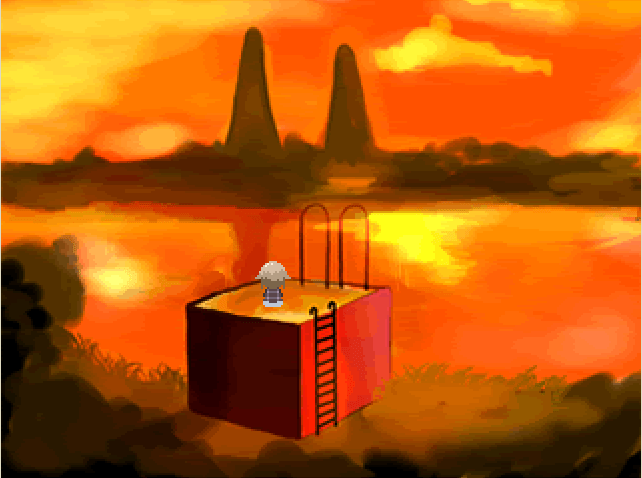
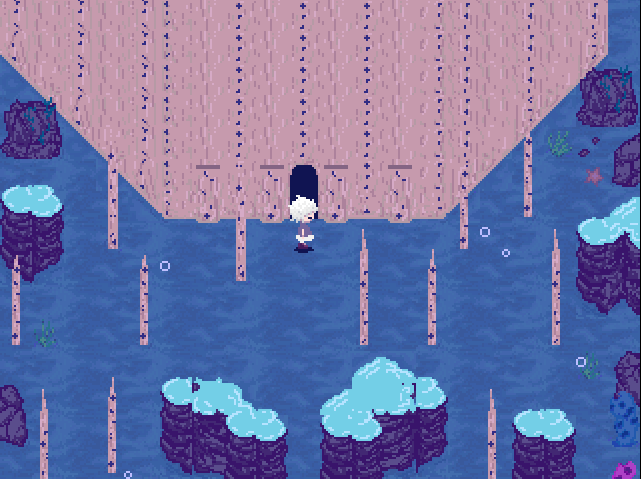
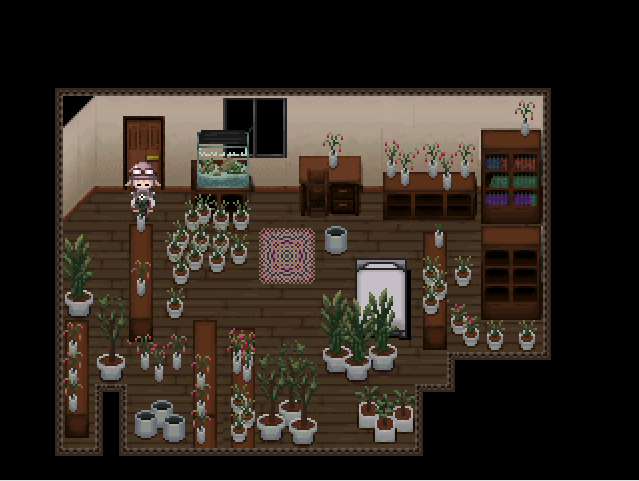
As mentioned in a previous article, Yume Nikki is a cult classic indie game that was released all the way back in 2004 that explores a young shut-in’s dreams.
While Yume Nikki’s influence can be seen in many different corners of the indie scene, the game hasn’t received any updates in almost ten years. Just because there haven’t been updates doesn’t mean the community hasn’t been active; in fact, some of the community has taken it into their own hands to continue the series.
“Dot flow” and “Yume 2kki” are arguably the best and the most popular fan games released. The problem with these two games is just how hard it is to play them. Even with an English translation, there’s still many other steps needed to play them.
Yume Nikki Online Project or YNOP aims to fix that and add even more onto the games. YNOP is a free fan-made port of Yume Nikki, Dot Flow, Yume 2kki, and even more games all modified for online play complete with English translations. The best part? No downloads are required.
INSPIRATION SECTION
Kikiyama is the creator of Yume Nikki, and much like the game itself, he is shrouded in mystery.
Kikiyama has all but disappeared since the last official release of Yume Nikki, only having appearances when a remake of Yume Nikki came out and doing oneinterview with other indie game developer, Toby Fox. This appearance and interview really are loose terms: signing off on the game’s release and nine yes or no questions is all there was, but nonetheless, he’s out there.
Yume Nikki’s inspiration can be seen far and wide across the indie game spectrum but the inspiration for Yume Nikki can be found easily, in fact, you can just look at the title. Yume Nikki directly translates into dream diary in English. Because of this many have theorized that Yume Nikki is Kikiyama’s dreams, giving an explanation as to why there is little to no story.
FAN-MADE PROJECTS
When playing Yume Nikki for the first time some players may be expecting a more horrific experience or even more in-depth exploration of the dream world. Dot Flow and Yume 2kki aim to solve both those problems.
Dot Flow, unlike Yume Nikki, does not shy away from body horror and tries to make the player uncomfortable. Dot Flow consistently offered up scare after scare that all worked well in tandem with the deteriorating mental state of the protagonist.
Yume 2kki is a project for fans by fans, made by over 100 different developers Yume 2kki does not disappoint in the content section. With 36 worlds the player can choose from when entering the nexus Yume 2kki makes sure to never let the player think they know what is going on.
GAME-PLAY SECTION
As mentioned previously, Yume Nikki follows a young shut-in named Madotsuki and their dreams. Yume Nikki establishes a few very important concepts that Dot Flow and Yume 2kki both expand on like the nexus and effects.
In Yume Nikki, the nexus describes the place just outside of Madotsuki’s room which can only be entered in their dream. The nexus as its name implies serves as a connector to many different dreams, in Yume Nikki these dreams are represented by doors with symbols to represent the world.
In Dot Flow the doors are completely gone in favor of exits in each of the cardinal directions, while this does reduce the number of entrances in the nexus it makes it easier to get to important worlds that may serve a story purpose. Yume 2kki decides to expand on the nexus even more making the nexus an even bigger room with objects to interact with that represent the world.
The other concept, effects, is harder to explain because of the many purposes they serve. The main purpose for effects is to reach the end of the game, which can’t really be called an ending in the context of a story because there really isn’t a story. Effects also serve as transformations that have a variety of effects on the player like making them go faster or being able to light up a world.
Yume 2kki doesn’t just expand on existing effects, giving them new purposes for example. But it also adds an entirely new feature in combining effects. This along with improved menu UI and having more effects in general really make Yume 2kki a never-ending game. Dot Flow, despite not changing any major features about effects or even the rough number needed to complete the game, the effects in Dot Flow are an improvement. This is entirely because of the story that is placed around getting the effects and rust.
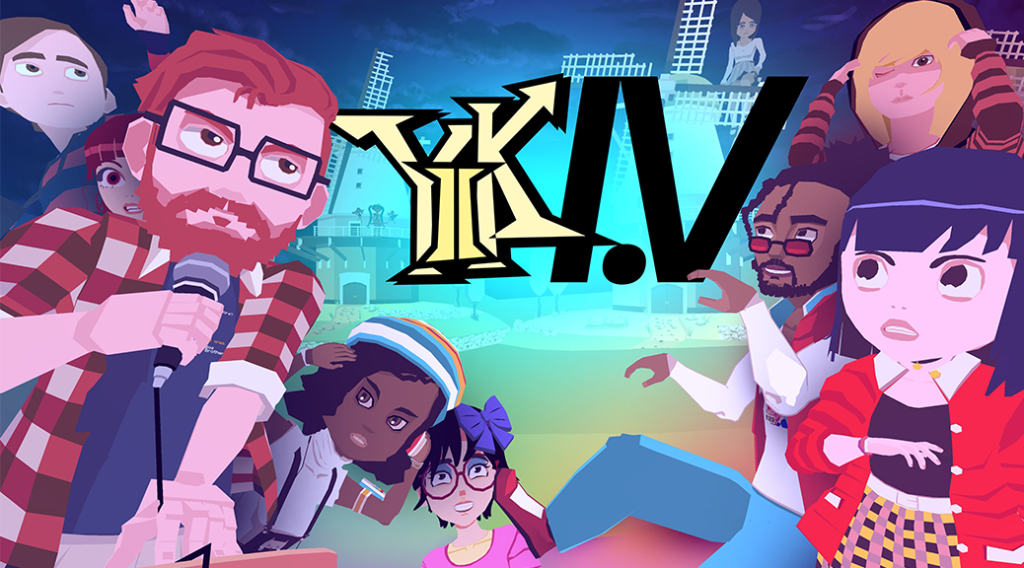
When discussing the worst games ever made many people jump to games like E.T. for the Atari or the original release for Final Fantasy 14, maybe even No Man’s Sky. These games are among some of the most buggy, poorly designed, and rushed games in history. But what if the worst game wasn’t buggy at all? What if it had 8 years of development time? What if it had a good concept with a strong base to build off of? The game that fits into all three of these criteria? YiiK, stylized as YIIK and pronounced YEEK.
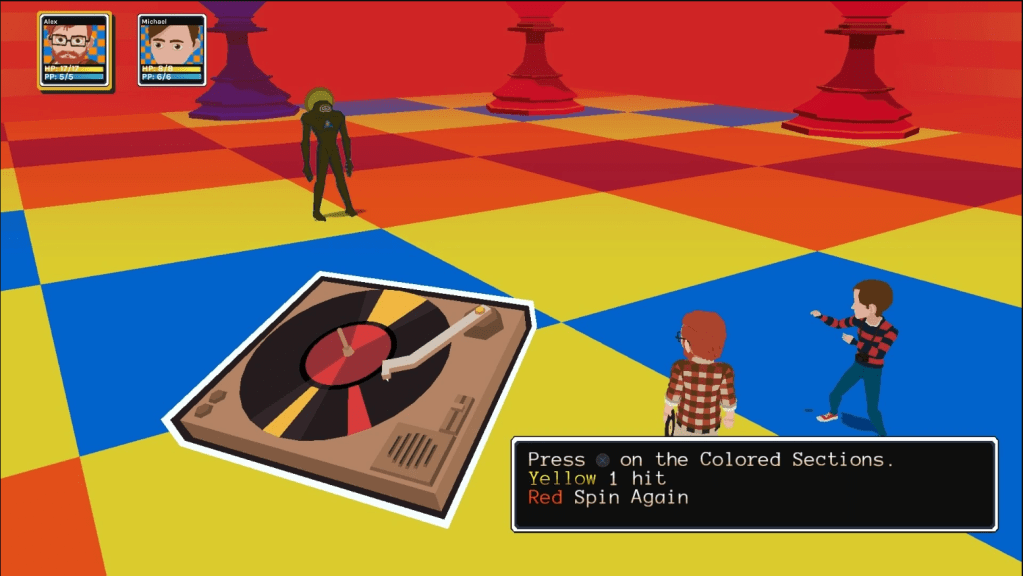
YiiK is a self-described “Post Modern RPG” with all the classic RPG elements: turn-based combat, quick-time events, and party members.
YiiK follows Alex Eggleston, a college graduate coming back to his hometown, while meeting the protagonist the player will encounter the biggest flaw in the entire game, the writing.
Long droning monologues that provide context already given to the player combined with an extremely unlikable and static protagonist culminate in making some of the most difficult writing to sit through.
Arguably the worst part about the writing is the lack of consequences to Alex’s actions. Alex is constantly the worst person possible in every situation or interaction and unlike games such as The Witcher or Skyrim, these actions aren’t the players’ choice, it’s just who the character is, what he says, what he does.
After playing the game for some time players may expect Alex to grow throughout the story, even if that growth isn’t earned story wise. This doesn’t happen. Alex stays the same morally questionable, sometimes even morally reprehensible character that only thinks about himself, and the game agrees with him.
(the next paragraph contains spoilers for YiiK, if you would like to play the game, please skip it)
Throughout the game Alex only thinks about himself, hetruly believes the world revolves around him and at the end of the game it’s revealed that the world does. While I won’t get into massive lore details just know that Alex is right in believing that he is the most important in the universe by virtue of being Alex Eggleston.
While the writing may be bad, that alone wouldn’t ruin a game. The combat mechanics of the game also help to make it the worst game.
Slow, basic, and repetitive are used best to describe the combat of YiiK. At first glance the combat system may not seem horrible; this illusion is washed away by the end of the first hour of gameplay. To understand the games short comings, it’s important to look a game that did this combat style, based around timing inputs, well.
Paper Mario, for the N64. This game had one of the most innovative combat systems found in a turn-based RPG, letting the players’ skill determine how much damage is done. On top of the skill-based combat it also hosted a large variety of moves/attacks. This is where YiiK fumbles.
YiiK’s combat system does not change. The best moves or attack order will always stay the same, there is no room for variety in the game. Another major problem with YiiK is the scripted fights/losses. Multiple times throughout the story you MUST lose in a fight to progress, this is disheartening when playing.
It sows a sense of doubt into the player. It makes them wonder if they even need to try for this boss. If it would just be better to lose instead of trying just in case. And that mindset isn’t even wrong. It would be easier to just lose every boss before actually attempting them.
The last important thing to mention is how much potential that YiiK had. The game had some of the best video game composers making music for it. YiiK also had an interesting idea; a unique art style that was modern while still being blocky/polygonal.
That’s my biggest problem with YiiK. It had potential, YiiK could’ve been a great game and it still can be. Currently the developers are working on the 1.5 update, this update is promised to change the problems that plague the game. Changing the story direction, improving combat and the dungeons found in the game. This update could be what the game needs to switch from being the punchline of jokes to being a great game. When it comes out, I will be playing it and I implore you too as well.
In the west, we’re all too familiar with bands such as the Beatles and the Rolling Stones, bands who dominated the music sphere and culture, and continue to influence music to this day. Even as far as Japan, their influence spread and dominated their youth music scene almost as much as it did ours. In the 1960s, the Japanese rock scene almost parallels ours. Yet how did it reach Japan, a nation so far away from the United States and United Kingdom geographically and culturally?
How Japan had so much western influence has to do with the American occupation between 1945 and 1952. After the destruction caused by the Second World War, the United States wanted to help rebuild the country and turn a former adversary into a current ally. With the influx of western aid and American soldiers, the cultural mixing changed Japan and shaped them into the nation they are today.
In these U.S. military bases would form the most popular style of Japanese rock of the time, with influence with western bands such as the Rolling Stones and the Beatles, groups would form to play western-style music with loud guitars, heavy drums, and punching lyrics.
The Beatles in Japan at the height of Group Sound’s popularity in 1966
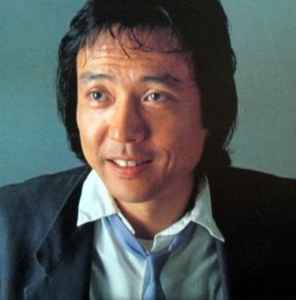
One group of people would form the band “The Blue Comets” in 1952, created by those who would tour U.S. military bases and jazz cafes, places where Group Sounds would commonly be heard. Jackey Yoshikawa (Real name Itaoka Koichi) would join the band in 1957 and become the band leader in 1963. One of their most popular songs to this day is “Blue Chateau” released in 1967. According to lead vocalist “Tadao Inoue”, the song is supposedly “a tragedy” for Group Sounds as a genre.
“But actually, [making Blue Chateau] was a dilemma, because I made something that was the opposite of what I had been aiming for. It was also painful that other GS began to imitate it. I think GS’s tragedy began with that song” – Inoue.
Tadao “Daisuke” Inoue
Other notable bands include The Mops, and The Spiders who are said to have created the first true Group Sounds song, “Furi-Furi” released on May 5, 1965.
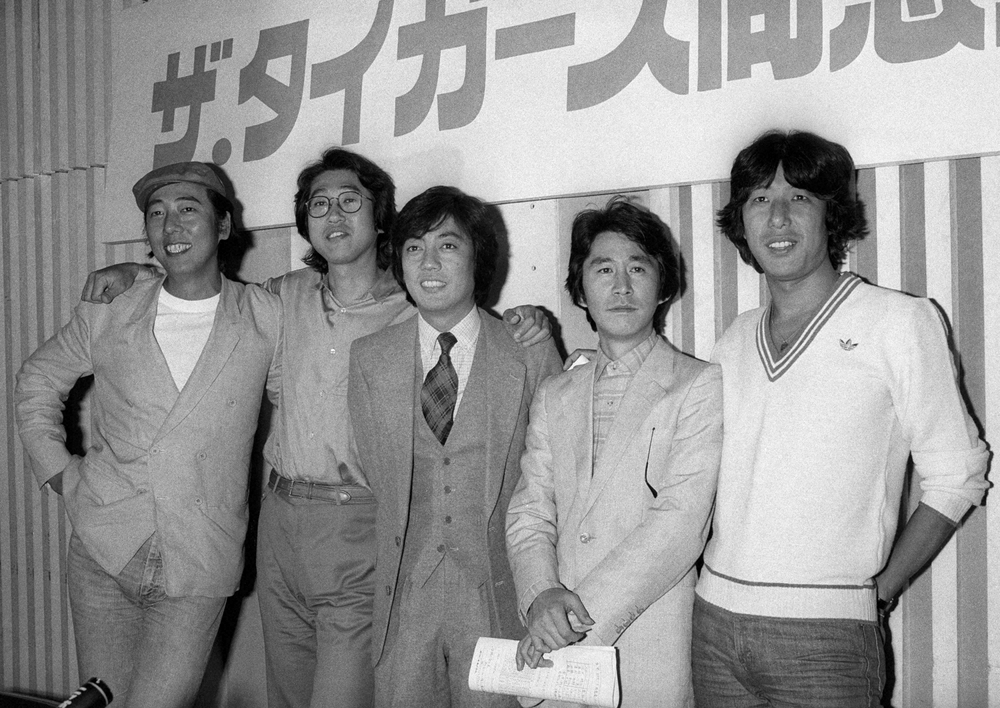
As our rock movement was associated with delinquency and bad youth, so were certain parts of GS in this time. “The Tigers” were one such band, with influences directly stemming from The Beatles, wouldn’t see huge popularity until their single “My Marie” released in March 1967. Some of these groups would embrace the style, and others would reject it.
The Tigers during their reunion in 1981
Pictures of the Blue Comets show the group in clean suits, neat hair, and formal poses, while pictures of The Tigers and The Mops show long hair, leather jackets, and clothing reminiscent more of The Beatles in the late 60s. As the movement carried on through the decade, these cleaner groups would become more widespread and mainstream, while those truer to the fashion of GS would fall to obscurity and typically disband.
Jackey Yoshikawa and his Blue Comets
The Blue Comets would see themselves on the popular Ed Sullivan Show in 1968, whereas The Dynamites would disband in 1969 after four years of relative obscurity. Yet when it comes to all new genres, some original bands would rather go out with the original musical intent than succumb to being “mainstream” as some thought the Blue Comets had become at the time.
As of 1970, most GS bands had already disbanded or fallen to obscurity. The Blue Comets released their last hit in 1971 with “Ame no Sanbika” (Song of Rain) selling less than 4,000 copies of their single. In 1972, many of the members would leave, informally disbanding the group. Most GS bands after disbanding would either form new groups, or reform their old ones such as The Spiders, The Tigers, and some continue to this day like the Blue Comets.
Some of these groups would be seen as pioneers of other genres, such as The Mops for Japanese psychedelic rock. In the following decades, especially the late 1980s, these groups would see a resurgence in popularity, and would continue to have popularity within the older generation.
The Mops
On May 30, 2000, leading vocalist, and songwriter, Tadao Inoue (changed to Daisuke Inoue) committed suicide due to issues from retinal surgery and fatigue from caring for his ailing wife. Following this tragedy, in 2002, the Blue Comets would return as a group and play a tribute to him, and The Spiders would play tribute at his funeral.
Group Sounds would forever be remembered as an old genre of rock music from a time long gone, during the Showa era. Most of the original “founders” or pioneers of the genre left their groups long ago. Very few bands still hold the GS genre these days. Two such bands that were formed after 2000 fit into this genre, such as Kinoco Hotel and The Captains, self-proclaimed the “last Group Sounds.”
Kinoco Hotel has more of a unique sound than replicating the old style like The Captains. They have a style of jazz, progressive rock, and GS inspiration in their music. The Captains by far more popular still, and is the most traditional to how GS sounds as a whole.
Kinoco Hotel – Untamed Women
The legacy of this genre is one that is almost forgotten by the younger generations, it is seen as an old person’s genre, from the “Showa era,” and is mainly remembered by older people in the east and the west.
The popularity cannot be understated, however, because this phenomenon was incredibly impactful on Japanese culture. It was one of the first times east and west met within music, and a divider between the traditional older generation and their children born after the war. It’s something worth remembering, and worth a listen. What was once a big shift in the landscape of Japanese culture is now the tradition. Same as it was here, what was once counterculture is simply just culture.
The progress of technology in video games is always prevalent. Looking at games from 2012, the difference in quality becomes greater every passing year. Cutting-edge technology now will be average by five years and antiquated by ten. Understanding the quality of video games is to understand the technical limitations of hardware during the time. Games evolve with their technology, and sometimes they evolve side-by-side.
It’s easy to say how terrible a game from long ago looks. How blocky the geometry of the levels is, how stiff the player movement is, and how the weapons feel. Yet it is unfair to push these modern critiques on games over a decade old. A fairer assessment is to compare games with their contemporary hardware. We must remember people were still using CRT monitors when World at War was released in late 2008.
Why then should we discuss Half-Life, a vintage game from 1998 with the absolute bare minimum for a shooter? It has a three-dimensional engine, artificial intelligence, and loads of weapons. This is where perspective plays a large role. Our modern perspective gives us the ability to overlook how this game changed the genre after its release.
From looking on 1998 backwards, the biggest games in the shooter genre were that of Doom II and Quake II. Arcade shooters where you circle strafe around hordes of enemies equipped with the arsenal of God. Not many of which have a big semblance of a story, because back then, it wasn’t seen as important. When Half-Life was released, it was bigger step in the direction of storytelling, physics, and worldbuilding.
As soon as you start up Doom, you begin with a pistol and zombie soldier to start shooting at. In Doom II, you start with a pistol and a chainsaw to take out two of them. Starting up Half-Life, you start on a tram ride that lasts for five minutes. For most people playing this game for the first time, it’s as boring as actually going to work.
These graphics, while impressive for their time, quickly grew outdated. The sequel, Half-Life 2, released 6 years later and completely overhauled the look of Half-life. Someone nowadays may not be able to get past them at points with blocky geometry and compressed audio. Some people even may even have motion sickness when playing the original game.
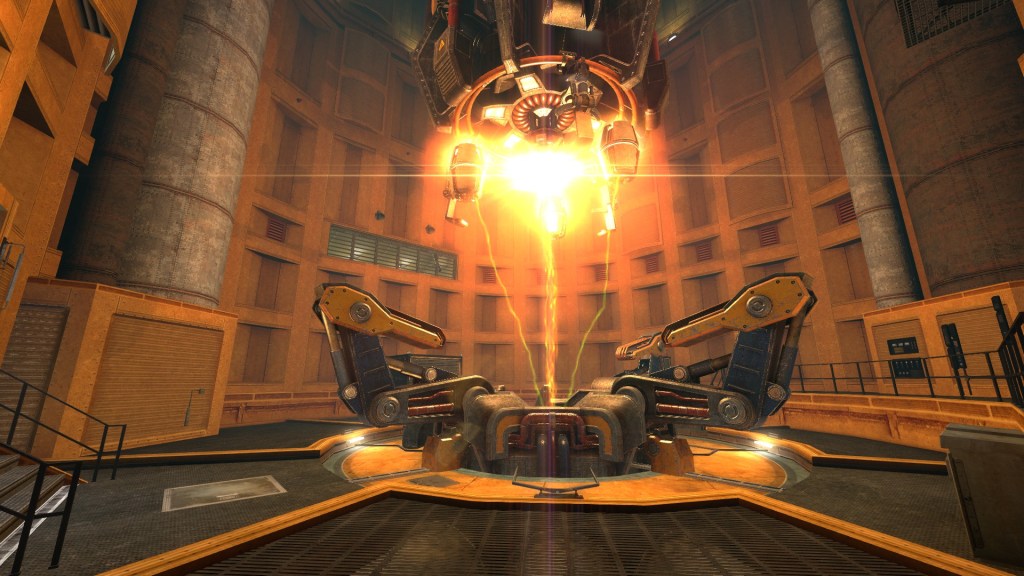
If someone wants to play a modern version of Half-Life, or maybe wants to have a more friendly experience to the modern player, there is a remake under the title “Black Mesa” which in essence is the same exact game, but with extended gameplay and a far more updated experience in terms of graphics and gameplay.
This game pushes the limits of what the old engine it uses can handle in terms of graphics and lighting. The Source engine, the game engine Half-Life 2 and Black Mesa run on, is roughly 20 years old, yet creates environments and atmospheres still impressive to this day. When playing Half-Life, it’s easy to look past the disaster and find the sound effects and voice acting comical or even slapstick. Some even describe the game as a “black comedy” with the absurdity of the situations scientists find themselves in.
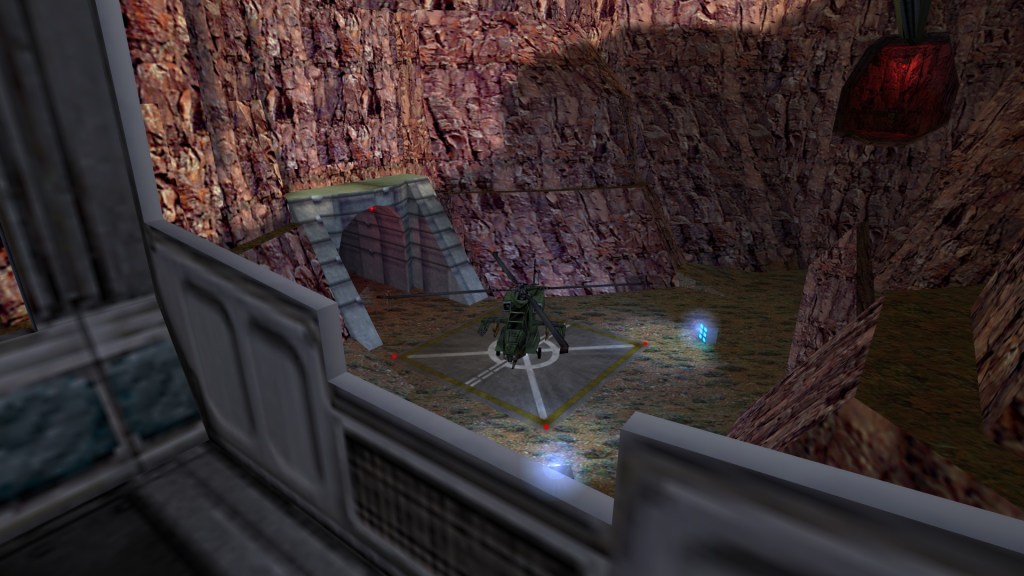
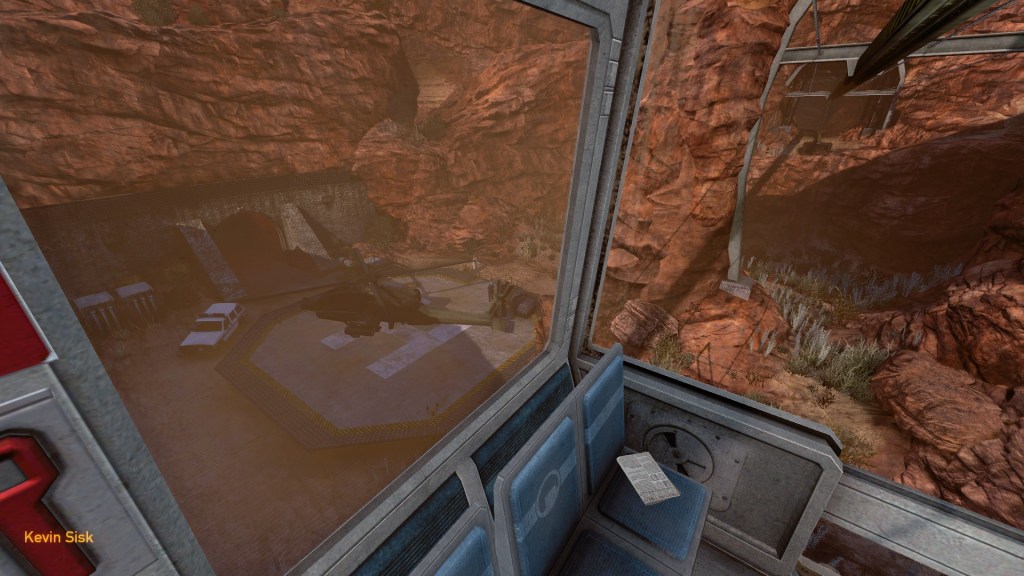
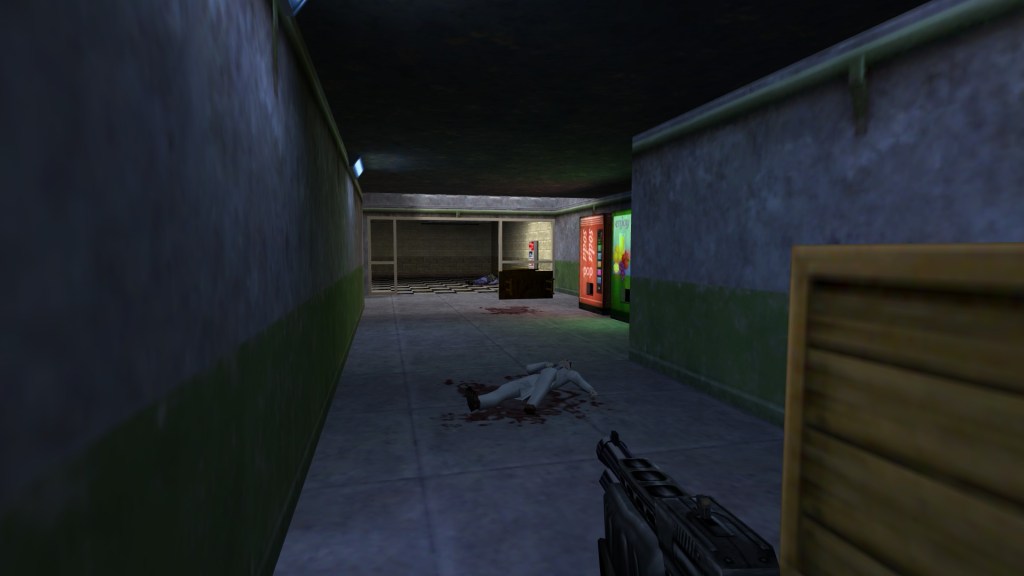
While these two are the same exact game, there remain differences in pacing and tone. In the office section, more is done to expand the whole part to remove the sterile empty hallways and make these hallways look like believable office spaces.
For example, in the original game, one hallway is supposed to represent a cafeteria infested with aliens. At first, it’s almost confusing as for what it’s supposed to represent until you start to look around and take in the atmosphere. In Black Mesa, it becomes a little more clear and sometimes even more believable for a room to exist.
Focusing on the environment and story is not forced upon the player. Barring a single 20 second moment halfway through the game, the player never loses control of the character they play as. You never lose perspective, even during the most important moments of the story.
The game will never take away from the player’s focus, you never leave the character for an important piece of story for a cutscene. Important set pieces can be avoided or missed entirely if the player isn’t exploring their environments. Things such as scientists being pulled into vents, or a hidden shotgun inside a sentry turret room, most of these rely on the player to explore and find them.
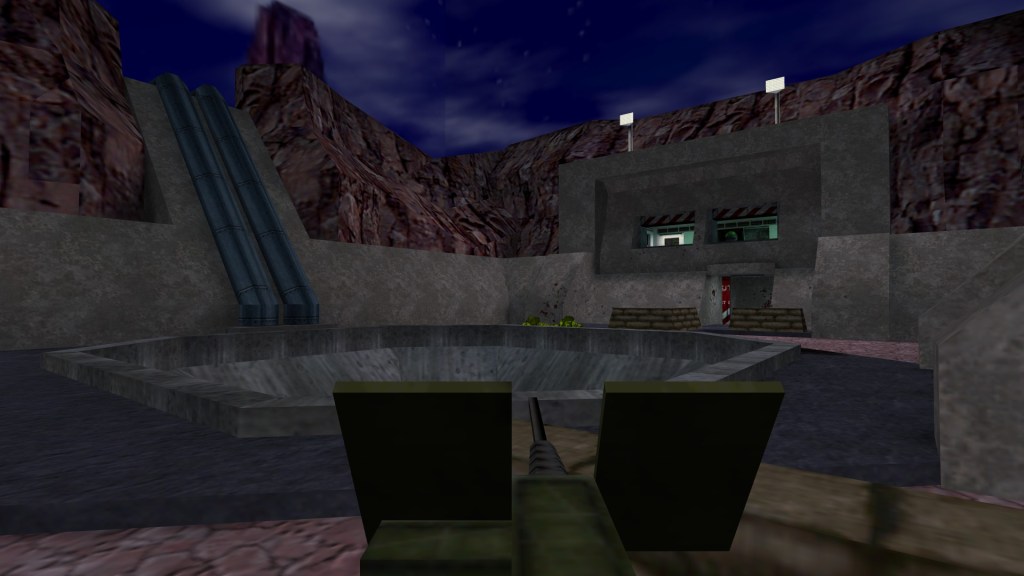
When it comes to improving on the story, Black Mesa wishes to enhance the existing one without huge changes. Those that exist are confined within one chapters of the original game, “On a Rail”. This is the most tedious chapter of the game, yet it is also the most open. It encourages exploration of your environment, but only in theory. It’s a looping claustrophobic maze of concrete tunnels filled with soldiers and aliens, both fighting each other.
In context of the story, it shows how the “human faction” is beginning to fight against the “alien faction”, as well as this satellite that is mentioned in the end of the previous chapter. When it comes to these older games however, you quickly forget what the story is if you cannot progress beyond an unclear puzzle or a looping shooting gallery.
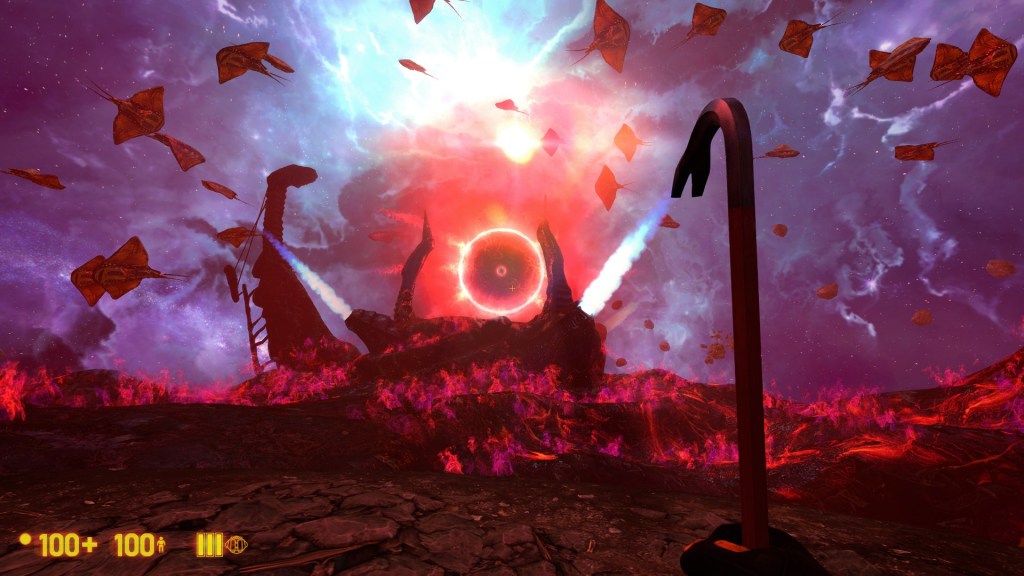
Black Mesa makes the change by cutting out a lot of this chapter. This plus the alien world, “Xen”, at the end of the game, are the only parts of the game that are drastically different from the 1998 original. Many sections considered tedious have been completely removed, and the chapter is heavily modified to continue a familiar feel for original players, but also simplified for newer ones.
Important events in the game are amplified technologically and graphically. The rocket launch at the end of the chapter goes from a slow tube visible through a tiny slit to a huge room with a large glass window to view the huge rocket until it disappears into the sky.
Beyond this chapter, the remake is relatively faithful, with additions for gameplay, or for graphics and worldbuilding. Playing through the original first is recommended far more than this first. It will make you appreciate the advances in technology, but also in gameplay and storytelling. One thing to note is the game’s soundtrack is drastically different in tone and mood from the original. After starting the disaster, the background music goes from ambient sounds to a slightly more impacting synthesized track.
Most of this game’s soundtrack can consist of a heavy guitar for combat, and a slow piano for the quieter/moodier segments. In the original, there’s more of a variety in instrument and style. They set the tone for certain segments and have that cheesy 90s feel to them.
Although both the music and the theme of these two differ completely, they still end up being as good as they both can be in their own way at setting the mood and tone for the player and their environment. The issue that comes with a modern remake is that of how powerful it becomes, and how limited the player may be with a lower-to-average machine. A typical laptop will not be able to run this game. An older desktop computer from 2015 and older will have an issue running this game with the highest settings.
Most modern games have a cinematic graphics setup, and a typical gaming graphics setup. Because the base of the engine is roughly 20 years old, these issues with graphics come into play, even in an updated build.
The source engine by nature is CPU intensive, meaning that is where the most strain will be placed on the computer. In the Earth segments of Black Mesa, the strain is negligible besides the topside chapters. In the Xen chapters however, this is where the graphics and technology of the aging engine get pushed to its limits.
Often will you be in a massive open island surrounded by a large skybox filled with dynamic lights and fully modeled environments, or in giant caverns with bumpy and rocky terrain. When Half-Life 2 was released in 2004, the engine was built with boxy and square arenas in mind. Even in Episode 2, released in 2007, the partial sequel to the game, the cave areas are relatively flat and square compared to the alien world of Xen.
What are the advantages of playing Black Mesa? When playing the original, it’s apparent where the Quake 2 influences reside. Enemies have death animations rather than ragdolls, physics is incredibly limited and questionable, and the stability of the old engine is something to put into question.
Black Mesa has all the benefits and downsides of the source engine. NPCs can sometimes die by tripping over a soda can, or panic over an enemy that is in another room blocked by a locked door. The game tries to solve this by making events heavily scripted, meaning some characters cannot go with the player unless intended to.
Yet unlike Half-Life, the limitations of the engine won’t typically impact the gameplay. It is kept up to date with engine and performance patches, and the developer team is still active, meaning that for them, there is still an active effort to fix bugs common in the engine.
Although Black Mesa is a modification of a 2004 game from 2012, its full release 3 years ago 2020 ensured that the engine is updated far more regularly for player and gameplay convenience. Older games should not be discounted as relics of the past. Black Mesa shows that a dedicated group of programmers and developers can remake an old classic to show their vision for what the original game should have been.
EPISODE FIVE: CHANCE FOR CHANGE By Dairell Alvarico Hosted by Hailey Boehme
Official Transcript:
[THEME SONG – KOLBY THOMPSON.]
Hailey Boehme:
Good to see you again, everyone. From Mustang Post News, this is Sheyenne Perspectives. I’m Hailey Boehme.
In our last episode of Sheyenne Perspectives, Carter Phillips delved into creativity’s drive on the theatrical stage.
This week Dairell Alvarico focuses on a chance for change through the personal experiences of new student immigrants, their personal struggles, and their joys.
Here’s Dairell.
Dairell Alvarico: In my last podcast, I discussed the concept of change in the lunchroom and how students adapt into various environments that come their way. To add a little insight, the majority did not want to change at all, they would rather stay consistent.
Now that we have gathered more understanding towards the topic, I figured I’d branch out more on the subject. Change does not limit in the lunchroom, it also affects people’s lives aside from school; giving them the opportunity to pave a path they made for themselves, and grasping the new obstacles that would either be used to improve their personal development or bring up walls of regret that would take time to break down.
One circumstance that checks off this list is the process of adapting into a whole new country. This type of change exceeds most struggles relating to the lunchroom; trying to find a vacant spot near the restroom does not compare to the anxiety of not knowing what the next step is when you are in an unfamiliar area.
A lot of students here in Sheyenne Highschool moved in America from all distinct parts of the world, learning their ways, and experiencing new heights of appreciation or depreciation towards change.
The American Dream. People who moved here are bound to hear that term at some point, maybe a lot. Great jobs, great pay, more opportunities, and benefits: Land of the Free. But how does this romanticized expectation change their lives in the long run?
This episode, I have gathered stories of fellow immigrants. All of them have something to share, something to reflect on, to reveal that the life of an immigrant is not easy at first, there is always going to be something that holds them back.
Now we get to hear what they’ve been through, what they learned, and how they developed their skills and abilities to adapt to the U.S and finally call this place their home.
There’s always a beginning to all this. Something that convinced them to make the decision to move here. Coincidentally, they are not that different from each other.
Jacob: Apparently my, like my parents found out this like job that was here in the U.S, through Facebook which is probably the most oddest thing you’ll ever see, in Facebooks. And then like we had like go to like the Bureaucratic nightmare of the Philippines. And we like go up and down to these bureaucratic offices, and we uh had to really like ask them, if they’re willing to do it. They had to like beg them.”
Manila (Capital of the Philippines)
Dairell Alvarico: Another student, whom we will call Sam, had a similar scenario, one that involved her dad and his drive to finish his education. Here is an excerpt from her story:
Sam: My father decided to come to America to get his master’s degree when I was in second grade. I was so astonished when I found out we were heading to America because I didn’t want to leave my friends and move out of Saudi Arabia to a place we had never visited before. We had argued with my dad about not wanting to go to America because first we didn’t speak the language, English, and we have no idea about America and how things over there work out.
Dairell Alvarico: Sam and Jacob’s experiences are not that far from each other. In their cases, it was their parents who set the motion to move to America.
This is a very common reason, especially on immigrant children. They may have never even thought of the U.S until their parents mentioned it, and when they do, they are also doing it to give their kids a better life. Like John, who was hesitant at first, but later saw this opportunity as a blessing in disguise, which he makes clear when he wrote his story.
John: Reasons why I moved here? To have a better tomorrow. Every immigrant would have the same answer as me, but the future my parents wanted me to have was an American Education. I wish I had a choice; I wish I could stay in the place I am used to, but I am here and I can’t do anything anymore. So, I have to do this.
Dairell Alvarico: John was supposed to move here when he already graduated high-school, but the plan changed and he arrived one year early. This took a toll on him; he wanted to graduate with his friends. He felt at home and didn’t want to spend his last high-school years in a whole new country, but his parents insisted.
This is one of the most difficult things to do to when moving. Leaving your friends and dreading making new ones, since it can be a bit overwhelming, thinking that you’re different than everybody else. It affects them so much, depleting their confidence and anticipation to learn new things.
John: Leaving my friends, the high-school graduation I always wanted, was so hard for me because I’m graduating here instead of home.
Dairell Alvarico: But John wasn’t alone on this one. Sam struggled among her peers as well.
Sam: I wasn’t fluent in English, only knew just a few basic phrases when I arrived in America. So, my first day of school wasn’t really great. When you travel from one country to another, everything is different: the language, friends, lifestyles, and so on. My teacher was giving me a school tour as I walked; to be honest, I didn’t even understand a single word and was just nodding my head the entire time, wanting to be over with it. My father came to get me out after 3rd period to see how I was doing. With tears in my eyes, I told my father that I wanted to go back.
Dairell Alvarico: English is a very widespread language, but not everybody knows it. And when it comes to moving to America, knowing English is what gets you through basic everyday life.
So, Sam was already a mess. She could not understand anything around her. Overcome with anxiety, her first few days were so bad, it was enough for her to want to go back home.
Jacob on the other hand, did not have these types of struggles. If anything, he actually anticipated moving to America. He was eager to experience things he couldn’t do in the Philippines, and won’t hesitate to share his opinions on it.
Jacob: A lot of stuff actually. I could just get like the stuff I want, that was like being imported before I get it. I had to get stuff like that, because they were imported and they’re expensive too, and I could just get it for a dollar and a half.
Dairell Alvarico: If you care to share, what’s like one negative thing that you experienced.
Jacob: I started working in fast food, ooh man they kinda, kinda entitled not gonna lie, like I don’t know like they’ve been requesting stuff that should not be, you know it’s not even part of their order.
Dairell Alvarico: While Sam and John were mostly worried about the people around them and how to cope with their new life, Jacob was more concerned about the transit system.
Jacob: I mean, I expected them to have like a good like, transportation system when I came here, you know you don’t need to ride a personal car. But then, we still had to buy a car.
Dairell Alvarico: To add more context, the transportation in the Philippines has multiple options. From calling a taxi to randomly riding on the back of a stranger’s motorcycle for less than two dollars.
There’s so many vehicles to pick from that not having your own personal vehicle isn’t a huge deal. So, in Jacob’s case, he wasn’t used to it at all.
There’s always a way to get comfortable with change. There’s time, and patience to adjust themselves to feel comfortable and safe in America.
Sam knew that her not knowing English held her back, so she did her very best to learn it.
Sam: Taking English classes has greatly helped and improved my English compared to when I first arrived. Being bilingual is uncommon in my country; yet, knowing how to communicate in another language, particularly English, opens doors to greater and more chances.
Sam: Looking back, I believe I would not be where I am today if I hadn’t gone through these obstacles. I felt like I wasn’t going to make it at the time, and that nothing I was doing, especially reading a book, would help me improve my English. However, I have discovered that no matter what you do, you will achieve a result.
Dairell Alvarico: John was still bummed out about leaving the people he’s close with, so he grew into his curiosity of experiencing what it’s like to be in America, slowly getting used to it.
John: Studying in Sheyenne is different to what I’m used to. But change is nice overall, I love understanding different cultures beyond what I’m used to. It’s nice on behalf of the weirdness and cultural shock. It’s nice to see what’s on the other side of the wall (metaphorically)
John: The silver lining is I became a better person here, I lost mostly everything I ever was, but I became the person I thought I would be.
Dairell Alvarico: Everybody has a certain reaction moving to America. Fear, excitement, anxiety or all of them at once. But what really matters if how they push through and adapt into the people they are now. Change can be scary, mainly because it’s what would push people to a different path than they predicted.
The people in these stories did see it through, because there’s always a way when it comes to change. They accepted it, found their peace and paved a new path for themselves.
“Your life does not get better by chance, it gets better by change” Jim Rohn, a motivational speaker said that and I am confident to say that these people’s stories are proof that this quote is true.
Change can be a good thing, it’s just pretty bad at the start. Immigration can be just like that. All you got to do is guide it to the right direction.
[THEME SONG – KOLBY THOMPSON.]
Hailey Boehme: This podcast was recorded and edited by Dairell Alvarico and hosted by Hailey Boehme.
Sheyenne Perspectives theme music was composed and performed by Kolby Thompson under the direction of Mark Berntson. Thank you, Dave and Jewelyn, for narrating the excerpts. We’d also like to thank Sam, John, and Jacob for sharing their wonderful stories.
This wraps up Sheyenne Perspectives for this school year. We appreciate you, our listeners, and hope you’ve enjoyed Sheyenne Perspectives.
PART TWO: THE THRILL OF VICTORY By Jaxson Miller Hosted by Hailey Boehme
Official Transcript:
[THEME SONG – KOLBY THOMPSON.]
Hailey Boehme: Hello everyone. This is Sheyenne perspectives, and I’m your host, Hailey Boehme, with Mustang Post News.
In Jaxson’s last episode of Wins, Losses, and the Unexpected, Sheyenne football’s defeat and heartache was his focus.
If you missed this podcast or any other releases, they’re all free to stream on mustangpost.news.
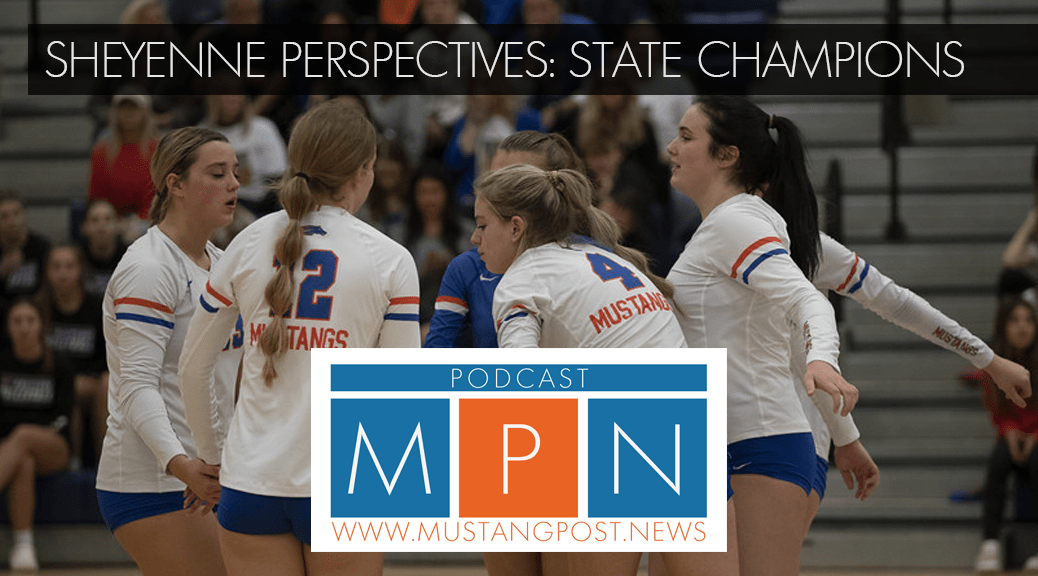
This week, Jaxson wraps up his two-part podcast by taking a turn toward Sheyenne volleyball’s state championship victory and joy.
Here’s Jaxson.
Jaxson Miller: A couple of weeks later, Sheyenne’s volleyball team was back in the state tournament once again. Even before the Mustangs catapulted themselves into the history books, the season they were having was already historic.
The Mustangs won their first 22 games, their best start in program history, finished undefeated in the EDC conference, which helped them capture the EDC regular season title, and then they went on to win the EDC conference tournament.
Sheyenne entered the state tournament 32-2 and had to face a tough Bismarck St. Mary’s squad. The Mustangs swept the Saints.
Next up was the Jamestown Blue Jays. In another great performance, the Sheyenne Mustangs were able to get the sweep against another solid team. They were heading to the state championship for the first time in program history.
Kennedy Colter, one of the top servers on the team and one of the eight seniors on the team, described what she felt throughout the state tournament.
Kennedy Colter: “I think that whole weekend, I thought I was going to have a million heart attacks. That whole weekend was a lot because every game is so important. But, after winning that second game it still didn’t hit me because… just beating Jamestown, they are really good team, and we had to come out… and that we played really good against Jamestown so taking that whole game in was a lot after the game and I don’t think it hit me until later that night… like… holy cow, this isn’t real… like… we are actually going to the state championship.”
Kennedy Colter serving during Sheyenne’s matchup against Fargo Shanley on September 27, 2022. Photo courtesy Mustang Media.
Jaxson Miller: Sheyenne had to face Bismarck Century, a team that was in the state championship for the 12th straight year, a team that was looking for their 10th state title, and their 8th in the last 12 seasons. An absolute dynasty.
Did that bring a lot of pressure or nerves to the Mustangs? Of course. That is part of being an athlete. If there are not any nerves, there is something wrong.
The best athletes in the world get nervous. The players or teams that win are the ones that are equipped to handle it. So how did Kennedy and her teammates manage their nerves?
Kennedy Colter: Our team has two songs that we like to play before big games and to get us into the mindset of how important volleyball is to us and how much we care about each other. We play “I Lived” and “Halo.” And we were like, ‘Okay we have all this extra time’ before the game ‘Let’s play the song’ so we turned off the lights, we all got in a circle, and you could just feel that everyone wanted to win, and that everyone loved each other… we still do. It was a really good feeling and I think that helped calm my nerves down. I think all of us were crying, bawling our eyes out before the game, so that was great, but it was just that moment where we all got together, looked at each other, and it was like… this is the last game we will ever play together as a team, and for some of us, ever again, so it just meant a lot to know that everyone in that huddle had each other’s backs.”
Jaxson Miller: Sheyenne had faith that they could beat this dynasty of a team that Bismarck Century was.
Sheyenne beat Bismarck Century at the Bismarck Crossover, where the teams from the EDC, the Eastern Dakota Conference, travel West to play teams from the WDA, the Western Dakota Association.
Century got the upper hand against Sheyenne at the Fargo Invite towards the middle part of the regular season.
The Mustangs and the Patriots were the top two teams in the Class A state poll all season long. With each team splitting the amount of time spent at the number one spot, it was the perfect matchup for a state championship game.
[VOLLEYBALL BROADCAST SOUND – FREESOUND]
And the Mustangs did not shy away. They came out with a great amount of intensity and won the first set 25-21. Century responded with an early lead in the second set and won the second set 25-22.
Throughout the third set, Sheyenne and Century traded points with each other until Sheyenne was able to pull away. At this point, they were just one set away from their first ever state title, in their first ever state title game.
[VOLLEYBALL BROADCAST SOUND – FREESOUND]
Jaxson Miller: As a winning program, Century was simply not going to back down. With their backs against the walls, Century responded with clutch defense and minimal errors in the fourth set.
However, despite taking the fourth set, the momentum did shift back towards Sheyenne late in the set.
The Patriots had a lead of 24-18, but the Mustangs went on a five-point run to get the lead down to one before Century setter, Geneva Ding, faked out the Mustangs and got the point to close out the fourth set, 25-23.
[VOLLEYBALL BROADCAST SOUND – FREESOUND]
Jaxson Miller: The next set could have gone either way as it was a winner-takes-all scenario. What more could you have asked for as a fan? There was not a lot of room for errors. It came down to who wanted it more.
After the first half of the fifth set went back and forth, Sheyenne went on 5-1 run to go up 12-7. Century called timeout.
That momentum for Sheyenne did not stop. The Mustangs did not collapse and kept their foot on the gas pedal. Great setting by Kennedy led to Isabelle Albrecht and Lexus Terhark each getting a kill to make it a 14-8 game.
Sheyenne was now just one point away from knocking off Century and capturing their first ever state championship.
On the last serve of the game, Century was able to return the ball over the net. Khloe Brown passed to Brooke Johnson, who was serving to close out the game. Brooke Johnson gave outside hitter Reagan Bogenreif a great set.
Bogenreif rose and hit the ball with great power. Century’s front row almost blocked it but… the ball made contact with the ground. At that moment, just a little after midnight, Sheyenne reached the summit at long last. They dethroned the Patriots.
[VOLLEYBALL BROADCAST SOUND – FREESOUND]
KENNEDY COLTER: “I personally didn’t even see Reagan’s hit hit the ground. I didn’t even know, I was in an awkward spot, I couldn’t see, so I was like, ‘If everyone starts running, we won.’ And then everyone started running, and I just followed them. I was like, ‘This is not real’ and it was crazy. The best part of it was… I was sitting there… I think it was the fourth set and only in front of me, I could see our parents, our fans, and the Century fans. I was like, ‘Oh my gosh’ so I was like, ‘You know what? I need to take this all in.’ I stand up, I look around, and behind us is all the teams from the East, the West, and just everyone watching the game, cheering for us, so excited that they were jumping up for every single point. To have that feeling of everyone in the gym besides the Century fans cheering for you is something I will never forget, and that was a really cool experience too.”
Jaxson Miller: Kennedy says that what went on in all the huddles that occurred during the timeouts throughout the course of the match were a big factor.
Kennedy Colter: “I think that she (Newton) was just telling us to keep playing our game and to not get scared or tighten up because that is not going to help you win at all. I think when we got that run at the end of the fourth set, that really helped our momentum coming into the fifth set. I think that is really important and a huge thing in volleyball, is having the momentum of the game and although we did lose the fourth set, we did bring a lot of momentum into the fifth set, which was very helpful and that did push us to win the fifth set.
Jaxson Miller: Aiden Knodel was one of the many fans in the Bismarck Event Center that evening. He was in the student section with some friends.
Aiden Knodel: “Just seeing the redemption that the volleyball team was able to make up for our shortcomings, it was a really cool experience to witness and probably out of all the sporting events I have been to, it honestly was just like… crazy to watch, just the amount of energy that was inside the gym and just watching the emotions of the players, it was really cool to watch. And it kind of makes your heart ache because it is something that you wanted for yourself, but to see someone else go do that for you, was also a really cool experience.”
Jaxson Miller: It took Sheyenne’s volleyball team nine years to finally bring home a state championship trophy. The next step is to build off of this. They will have a good number of seniors to lead the team next year and will look to repeat as state champions.
The football team is hoping to rebound from the disappointing end to the 2022 season and return with vengeance next season.
Here’s the thing with sports, whether you achieve your storybook ending or not, it is important to understand that sports offer us the life-changing lessons that we need to grow as people and to make this world a better place. And for us to bounce back from our failures and our shortcomings.
[THEME SONG – KOLBY THOMPSON.]
Hailey Boehme: This podcast was recorded and edited by Jaxson Miller and hosted by Hailey Boehme. Sheyenne Perspectives theme music was composed and performed by Kolby Thompson under the direction of Mark Berntson (BURNT-son). Our thanks goes to Aiden Knodel and Kennedy Colter for their insight and time interviewing as well as Mustang Media and BEK Sports Network for providing the sports broadcast audio in this two-part podcast.
In our next episode of Sheyenne Perspectives, Carter Phillips returns for part two of his feature on creativity.
PART ONE: THE PAIN OF THE UNEXPECTED By Jaxson Miller Hosted by Hailey Boehme
Official Transcript:
[THEME SONG – KOLBY THOMPSON.]
Hailey Boehme: Hey everyone! It’s your host, Hailey Boehme, and I’m here to welcome you back to another episode of Sheyenne Perspectives from Mustang Post News.
In our last episode of Sheyenne Perspectives, Carter Phillips delved into the human desire to create and share those creations.
This week Jaxson Miller continues our series by taking a look at Sheyenne High School’s volleyball and football teams and how wins, losses, and the unexpected affected them.
Here’s Jaxson.
Jaxson Miller: The court.
[VOLLEYBALL BROADCAST SOUND – FREESOUND]
Jaxson Miller: The field.
[FOOTBALL BROADCAST SOUND – FREESOUND]
Jaxson Miller: Sports. They make the world a better place. They relate to the GAME we call LIFE.
There are highs. After a thrilling state title victory, the team is on top of the world.
Yet, there are lows. There is agony. There is loss. And that loss is made even worse when it’s unexpected.
In this podcast, we’ll look at those losses AND the wins. But really, we’re focusing on the unexpected and how that truly impacts teams and teammates.
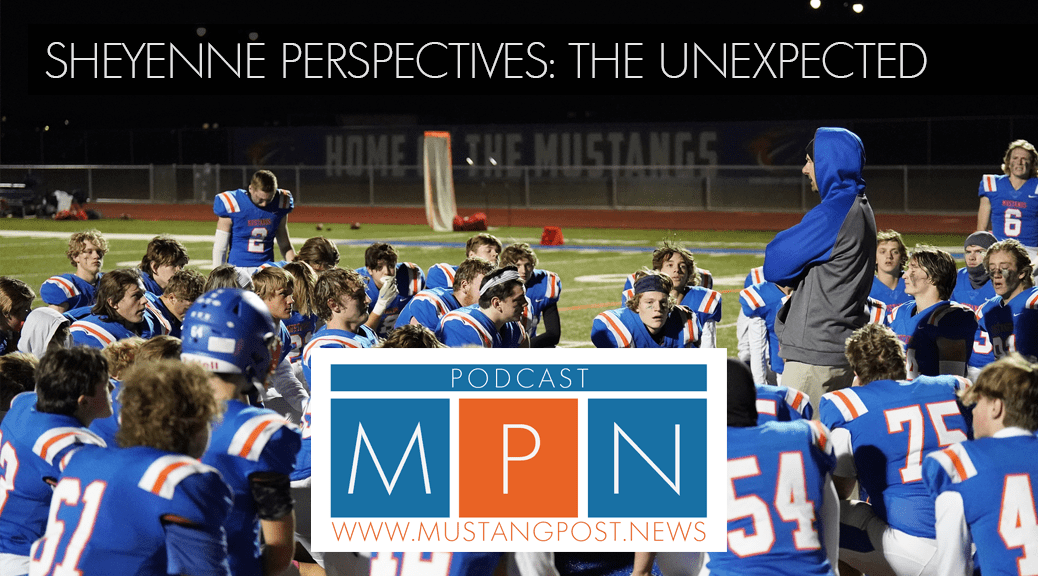
Sheyenne wide receiver Aiden Knodel looking to block during an offensive play against Bismarck Century during their 11AA quarterfinal game on Friday, October 28, 2022, at Essentia Health Mustang Stadium.
Jaxson Miller: When our expectations are not met, how do we react and why do we react the way we do? Change or the unexpected is hard, challenging. And yet, in that change, or in the unexpected, there’s more to learn, more to achieve, more to reflect upon, more to look forward to.
The Sheyenne football and volleyball teams’ seasons ended just a few weeks apart. One team achieved state title glory for the first time in program history and the other suffered an agonizing defeat in the first round of the playoffs.
The football team was upset in the quarterfinal round of the 11AA playoffs by Bismarck Century, who won 27-8 on Sheyenne’s turf at Essentia Health Mustang Stadium. The Mustangs were the number one seed and were looking to win their second consecutive title after taking home their first crown last year.
Aiden Knodel, who is a senior at Sheyenne High School, was pumped throughout the week leading up to that Friday night playoff game against Bismarck Century.
The Mustangs finished the regular season strong by beating Mandan at home, 28-17, in the regular season finale. The Mustangs and the Braves were the top two ranked teams in the state at the time and the Mustangs captured the number one seed for the playoffs with the win and extended their winning streak to seven games in a row.
[FOOTBALL BROADCAST SOUND – FREESOUND]
Aiden Knodel: Throughout the week we knew it was a playoff game, a playoff atmosphere. The week prior, we played Mandan, which was a team that we thought we would be able to see later in the playoffs, potentially a championship level team, and we were pretty high coming off that win, but our preparation was definitely serious for Century knowing that they have gotten the better of us before in years prior. During the regular season we were able to beat them 42-14. So in that element I feel like we maybe could have underestimated them, but because it was a playoff scenario I feel like everyone was locked in and ready to go.
Jaxson Miller: The Mustangs were looking to jump start another playoff run to reach their fourth consecutive Dakota Bowl and have a shot at winning back-to-back state titles.
However, the Patriots came out firing on all cylinders to start the game. The Mustangs fumbled on their second drive of the game and the Patriots capitalized. Throughout the first half, Sheyenne’s offense could not get anything rolling and they trailed 14-0 at halftime… something they were not used to all season.
[FOOTBALL BROADCAST SOUND – FREESOUND]
Jaxson Miller: And the momentum for Bismarck Century continued into the beginning of the second half. On 3rd & 8, with a little over nine minutes to go in the third quarter, quarterback, Kyan Barth, connected with running back, Peyton Arndt, for a 38-yard touchdown to extend Century’s lead to 20.
[FOOTBALL BROADCAST SOUND – FREESOUND]
Jaxson Miller: Trailing 20-0 in the third quarter, the Mustangs’ offense was finally able to find a spark on their next drive. They responded by marching down the field easily. The drive was capped off by a Kaden Rahr rushing touchdown. Sheyenne converted on the two-point conversion to make it a 20-8 ballgame.
[FOOTBALL BROADCAST SOUND – FREESOUND]
Jaxson Miller: However, that spark would not last long. The offense stalled again. Despite the defense keeping the Patriots at 20 points for most of the second half, the Mustangs could not climb themselves out of the hole that they were in. Aiden could not believe what was happening.
Aiden Knodel: Never did it cross my mind that we would be in that situation where we would be down, and it was just like… we were getting beat pretty bad at that point. Never in my mind did I think that we would lose that game. So, as the clock was ticking down, it was a shock to me as I was just standing there. It felt out of my control. Nothing I could do. It just felt like a bad dream.
Jaxson Miller: Bismarck Century went on to win 27-8. Just like that, Sheyenne’s season… was over. There would be no back-to-back champion. There was not much to say.
Aiden Knodel: After the game, the locker room was honestly really quiet. Nobody had much to say. There was lots of hugs, some tears. It was definitely the most emotional I have ever had in sports where you have been growing up with these kids your entire life and it is like the last time you are going to be able to share a field, share a court, like any of that, with lots of those kids. It is really surreal, and you are realizing that your sports career is coming to an end. All the friends, all the relationships, every practice you go to, you start to miss that type of stuff and miss those connections that you used to have.
Jaxson Miller: It is hard to describe the amount of agony an athlete feels after an upset loss. It is like getting punched in the gut, like something that you wanted for so long just suddenly becomes out of reach.
But yet, in these agonizing moments, sports offer us life changing lessons that can prepare us for tough times in the future.
Aiden Knodel: Never take anything granted. I thought my football career would end with playing in a state championship where I would know that it is the last game I will every play. Luckily for you, when you got to that championship, you knew this was the last game I was going to be playing these girls, last game I was going to be playing with these guys. That is what I thought I was going to be feeling. I felt like that was stripped away from me so suddenly, so shockingly, I definitely thought that I kind of took things for granted. I didn’t really love every moment that I should have. Just don’t take anything for granted.
[THEME SONG – KOLBY THOMPSON.]
Hailey Boehme: Sheyenne’s football team may have suffered from over confidence. And maybe that led to the unexpected… their early exit from the playoffs. But what if confidence is completely justified? What if the outcome defies the expected, defies defeat? That’s where Jaxson Miller will continue, next time in Part Two of Wins, Losses, and the Unexpected on Sheyenne Perspectives.