All posts by Jeremy Monette

PaperMate American Blue Wood Case Checking Pencil

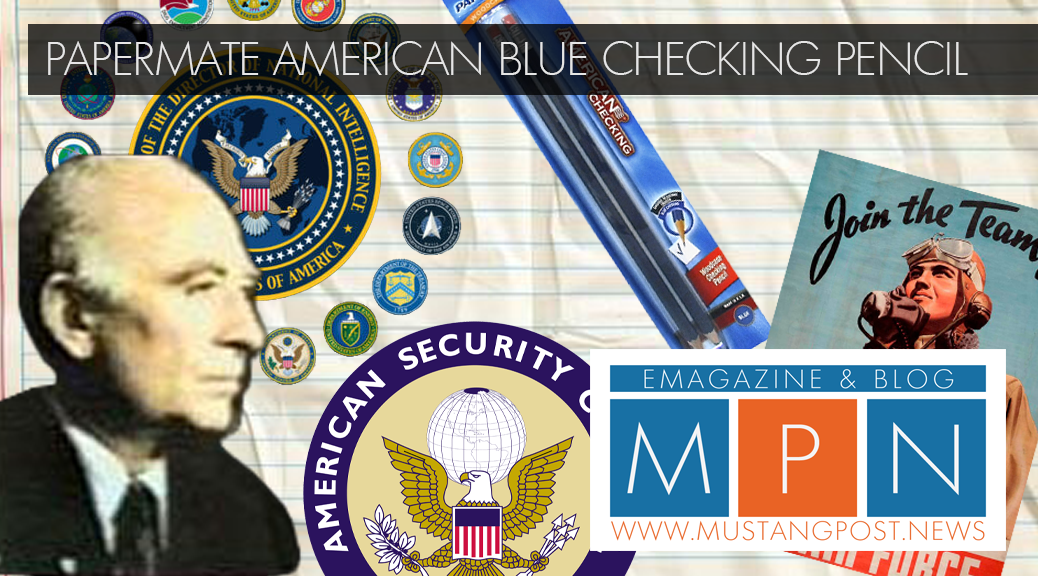
The PaperMate American Blue wood case checking pencil is not listed on the official PaperMate ‘about us’ list of advancements they’ve made to mankind. But was the PaperMate American Blue Wood Case checking pencil that insignificant or just unlucky? Lets see.

While WW II was simmering under a couple years of European warfare, Patrick J. Frawley Jr. was leading the charge on underperforming literary utensils. Creating a better quick drying ballpoint pen, he “revitalized” the inking industry, according to the PaperMate About Us section. He had previously acquired a ballpoint pen parts maker that defaulted on its loan, and rebranded as the Frawley Pen Company.

Hailing from Nicaragua, one of the poorest countries in the world, Patrick Joseph Frawley Junior is seemingly one of the lucky few to, I’d say properly achieve the American Dream. He was born to a banker, import-export Father and a stay-at-home mother in 1923. He learned how to wheel and deal from his father and negotiated a $300,000 deal between the Panamanian government and U.S. Rubber for tires at 18. He enlisted in the Royal Canadian Air Force and fought in WW II. He eventually went to and dropped out of college to keep working with his father.

At 23 he bought the downtrodden manufacturer for $18,000 and went on to sell over 51 million pens to what had previously been a market so disliked that you couldn’t give away prior ballpoint pens for free, said a 1955 Times newspaper. He sold the company to Gillette the same year for $11.4 million, equivalent to over $139,000,000 today after 1955 taxes.

He went on to buy shares in the Schick razor company and Technicolor Inc., became an outspoken anticommunist after Fidel Castro took over his factory in Cuba, and presented his opinion in a Catholic newspaper he founded.

Frawley also found himself as one of the first members in the American Security Council. Seemingly a pile of people that were born into money and politics that wanted better communist protection after the failure of the Korean war; feeling as though it were lost due to commie infiltrators. Though he is just one of the many people that started mass surveillance on the American public back in the day. He heavily funded a few conservative political campaigns, as well as INCA, the Information Council of America. They had a blacklist of over 6 million names that they gave to companies in hopes of weeding out commies trying to work in the private sector. You’d both be baffled and completely unsurprised at how any semi to official government funded mass surveillance programs there were, and probably still are.

He goes on to find treatment for his alcoholism and buys the hospital because of how well he felt the negative reinforcement treatment worked. He starts selling off his shares or ownerships of a few assets around now. Tries to blame the assassination of JFK, MLK, and RFK on the commies in his newspaper. Builds and buys and sells a mansion or two. And feared assassination due to reportedly being involved with “political espionage matters.” Patrick Joseph Frawley Jr., living until the ripe age of 75 in 1998, having seen the most human advancement in the history of our species, becoming a millionaire and governmental something or other, dies after lung surgery.
This pencil sent me down the most random and interesting rabbit hole by complete accident, but I’ve used better.


Crossfade Chronicles 2

In part one, I looked over Crossfades’ first two albums, and how the second strayed somewhat heavily away from what made me fall in love with the band. It would seem that I wasn’t the only one disillusioned with the band’s second album, Falling Away.

After the bombshell success of the first, platinuming with over a million records sold; the disappointing sales figures of the second, only selling about 200,000 copies, caused Columbia Records to drop Crossfade.

Lead singer Ed Sloan said he found himself in a depression, a darker place that seems to have helped his artistic intent. He felt abandoned in a way, after being on top of the world with their first album.

“Coming off the success of the first record and our way after the second album hit me hard [. . .] music had always been my escape, but then music became my enemy. I shut down as a songwriter and, actually, pretty much as a human being,” Isthmus reported.

They released We All Bleed independently, which meant no message to push or deadlines to rush for, and you can feel it right away in the composition of the first track. Each song is more willing to let the listener create an interpretation and spiral into themselves thinking about what was just sung. The bigger spaces between the singing parts also adds to this small but present feeling of superiority, it takes you back to the first album’s strives’ for more. It also makes the band feel more comfortable with their instruments, they don’t need to sing all the time for it to sound good, and that’s great. But this time around the conflict isn’t always as easy to nail down. It’s still a man struggling to find or become something he may not fully understand, but now with an air of wisdom, the burns of old failures are very palpable in some of the songs.

We All Bleed moves on from the girl of the second album and roughs the finely cut edges of the first to create something that is still trucking along even after all the self-medicating and personal pity parties. In less metaphorical terms, there aren’t any tracks I’d skip on repeat listenings. There’s stuff more articulate, angrier, and energizing than the first, while still letting you think like the second allowed, without the relatively boring and same-y pitfalls the second fell into. The sound mixing of Les Hall is unbelievably good at times, I recommend listening to this album with a proper sound system if you can. And Ed definitely upped his shredding game, it makes you feel heavenly sometimes, like in Suffocate.

Like others have said, it wasn’t going to be the album to change the face of music, but it was more than worth what it was trying to be.

Crossfade Chronicles

Crossfade is an American rock band that finally coalesced in 2001 after a few name changes consisting of The Nothing and Sugardaddy Superstar. Crossfade is home to founders Ed Sloan, Mitch James, and later permanent member Les Hall. As well as a few others that’ve cycled through throughout the years.

Their first album, self-titled Crossfade, depicts a man struggling to find himself and sounds like a series of understandings the singer has, with the typical relationship sentiment burned in here and there with Cold and Colors. The second album descends slightly in value, onto largely the topic of a selfish or cold lover.

Those two songs don’t show off the capacity of the singer or the band nearly as well as the rest of the album does. They feel simpler and almost corporate, as though the contract they signed said they had to have two generic songs to endlessly repeat. Though, that’s no jab to the song’s success; if they weren’t considered good they wouldn’t have been so popular, obviously.

The rest of the album takes on this darker sensation and feel. Angsty, irritated guitars, backing the powerful vocals that’re speaking of trying to be more and not settling for less than what you wanted to achieve. It’s enthralling. And in the tone that they present, it doesn’t make it feel corny or manufactured. I’m not sure how often, but I’ve noticed when songs try to be inspiring or the like, that it’s difficult to feel their struggle. It doesn’t feel like the bad is what sculpted the good, it comes off more like ‘everything is awesome and life used to suck, but now it’s great.’ It’s all preference at the end of the day, but for my tastes I enjoy being taken on a bit of a Hero’s Journey.

That’s not to say there isn’t any presence of mechanicalness, it’s there and probably thanks to producer Randy Staub, who’s helped the likes of Nickelback, Evanescence, and a bunch of the other notable bands from that time.

Crossfade’s second album, Falling Away, is less original than the first and details the relationship between the singer and his ex-girlfriend. She didn’t want to believe in him, he got too angry sometimes, she was cold to him, he slowly started losing feeling for her and eventually made the decision to leave. It’s a tale . . . understandably retold but not any less reused. None of the music is bad, and some of it can be as enrapturing as the first album. On some level I do enjoy it more, producers ‘n’ such were less involved so there’s a more personal feeling of individuality to each song. But for me, just the ex-girlfriend thing is kind of boring. None of it clicked like the first one did.

Perhaps they redeemed themselves for their third.