
Tag Archives: featured

BUILDING A LEGACY IN THE MUSIC INDUSTRY

EPISODE THREE: THE LONGEVITY OF SUCCESS
By Logan Jacobs

Official Transcript:

Hailey Boehme: Welcome back, everyone. From Mustang Post News, West Fargo, this is Sheyenne Perspectives. I’m Hailey Boehme. 

In our last episode of Sheyenne Perspectives, Dairell Alvarico delved into change and how we react to change, whether we like that change or not.  This week Logan Jacobs continues our series by reflecting on success. Specifically, what success and failure means in the music industry. Here’s Logan. 

[THEME SONG – KOLBY THOMPSON.]

Logan Jacobs: How does success stand against the test of time? Will those that are successful now find success in 20, 30, even 40 years? How can we know?

Will we yearn for music like this in the future? What makes an artist successful and how long that success last. 

But what is success? 

Anthony Peterson: the easy answer is sales, in the short term.

Logan Jacobs: That’s Mr. Peterson, choir and History of Rock-n-roll teacher at Sheyenne High School.

Anthony Peterson: Are they selling records, digital downloads? Are they streaming on YouTube? All of this is now playing a factor into the top ten records or song in a country or in the world

Logan Jacobs: Although that may not be all there is to it, maybe success is something much more complicated. 

Anthony Peterson: Sustained success is really more about can you evolve with the time and be a trendsetter instead of just repeating yourself over and over.

Logan Jacobs: Take for example rapper Redveil. For three years now he’s been producing successful albums. Three, in fact. He’s certainly popular enough where people are taking inspiration from him at this point. But will his success last? Will he be able to evolve and maintain his trendsetting creativity?  

But who are some others that could be successful? 

Anthony Peterson: Well, historically if you look at the bands or the artists that were able to recreate themselves year after year and record to record and do new things, while doing it at a certain level and keeping their level of success and sales, you have to initially look at someone like the Beatles or the rolling stones in the 60s and the 70s as a group that not only was massively successful but they were pioneering new styles and genres every year, and doing it in a way no one else had before, so not only were they successful but they were trailblazers into new areas of music

Logan Jacobs: Chance, another rapper, was once trailblazer, yet in recent years he has seen a significant decline. He hasn’t adapted. He hasn’t maintained a level of creativity and work ethic that promotes continued success.

Will, however, he reach a turning point? An epiphany? A moment where he’ll regain his creativity that will lead to a level of success as he achieved before. Lead to record sales.  

Although, there are some who are still successful 

Anthony Peterson: More recently I think you have to look at someone like a Taylor Swift who started in a more traditional country world and every record she’s had in the last decade plus seems to change and evolve artistically and lyrically which allows her to not repeat herself and she’s finding new success with new audiences; and she’s in her mid 30s now, for 20 years of success is not easy. In the music world it’s very easy to be a one hit wonder and then disappear because you have nothing else in that bag.

Logan Jacobs: The key to finding sustainable success is not only to grow and change, but to be untouchable by others in your genre. An unrealistic level of ability is needed at all times for you to keep your success. Chance had built up this reputation that came crashing down through the release of one record. 

Anthony Peterson: The neat thing about older artists success is that it doesn’t seem to go away, there is still a market for something that is now dubbed classic rock, and if you look at, locally at arenas near here there’s going to be a plethora of artists that are selling massive amounts of tickets, that have had their biggest amount of success in the 80s, 70s, and maybe even the 60s. That are still touring and selling out all over the world.

So having that impact that they had in their time is still very relevant because there is still a market for it. I want to assume that modern artists are still going to be musically interesting and sophisticated 30 years from now and people are still going to be seeing their concerts. 

Logan Jacobs: Now fans are stuck romanticizing about what they can not have, an older version of Chance. One that has not stained his ethereal presence on the music world. Reminiscing about the past, until another “Chance” comes around.  

Anthony Peterson: The one unique thing I could spin in for some artists is some of them never had a reunion, like the Beatles were never able to reunite because John Lennon was killed and now another member of the band has since passed away, there is only two of the four left, they can’t be the Beatles anymore because after the band broke up they were never able to reunite so like with the Rolling Stones who started at around the same time, they’ve been a somewhat stable group for the past 50 years, some people think that tarnished their legacy and its like there not as good as they used to be, or they’re old or dad rockers but obviously people still want to see them,  

where you have a different group like the Beatles who only existed in that one decade and they never were able to do anything else, so there are different ways to look at it because I think some people like what they can’t have more than something that’s like still around, I think that’s benefited the Beatles success because they know they can’t see them in concerts so they yearn for that old music cause it only existed back then and there’s no way to ruin it.

Logan Jacobs: Can an entire music career die, only because of one poor release? Can an artist redeem themselves after failure? Or are they forever stuck, known as the person they formerly were?

This podcast was recorded and edited by Logan Jacobs and hosted by Hailey Boehme. Sheyenne Perspectives theme music was composed and performed by Kolby Thompson under the direction of Mark Berntson. Special thanks goes out to Anthony Peterson. 

Hailey Boehme:

Next week on Sheyenne Perspectives, Carter Phillips will dig deep into what fuels people’s desire to create.  

So long, everyone. See you soon.  

This has been a production of Mustang Post News. 

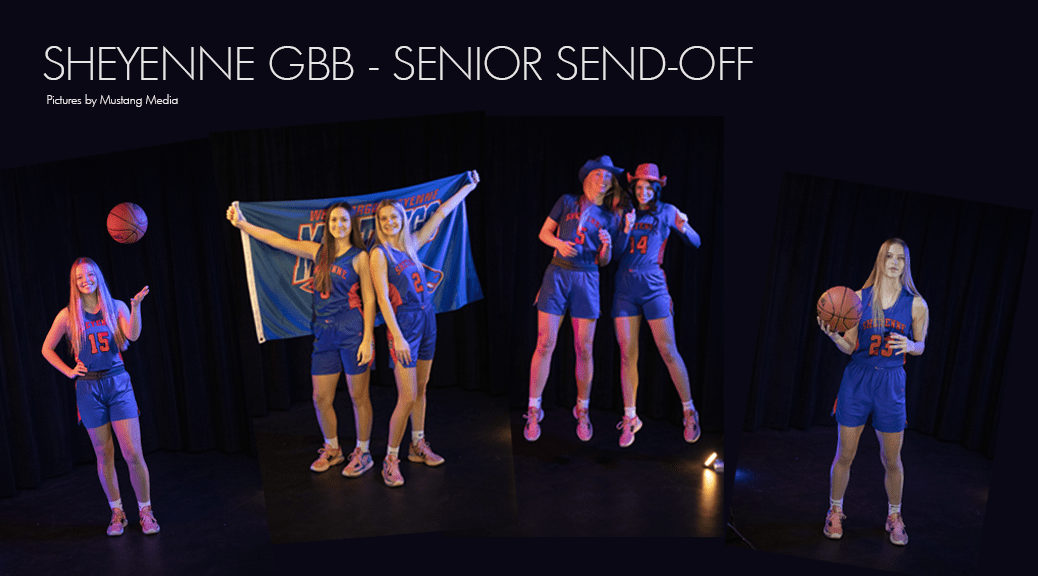
Sheyenne Girls’ Basketball – 2023 Senior Send-off

By Hailey Boehme

Coming off of a great 2021-22 season last year, the Mustang Girls’ Basketball team has continued to make some noise. Six seniors returned to the court this year with head coach, Kenyon Wingenbach. Since joining the Mustangs, Wingenbach has led them to 20 victories in the 21-22 season and 12 so far this year, as of February 22, 2023.

Hoping to end this season on another positive note, the Mustangs gear up for the end of season EDC and State Competitions. Their last run came close with a 5th place finish. 

The recent senior night, celebrated on February 21st, honored players Kaitlyn Haas, Peyton Breidenbach, Maya Metcalf, Brooke Johnson, Karson Sanders, and Alayna Holder, as well as student managers Maddy Hustad, Karli Urlacher, Connor Anderson, Lexy Terhark, Kyra Narum, and Jordyn Beyl. 

With the graduating class being so large, many wonder what Wingenbach will bring to the table next year, however, the roster looks promising even beyond the talented class of 2023. 

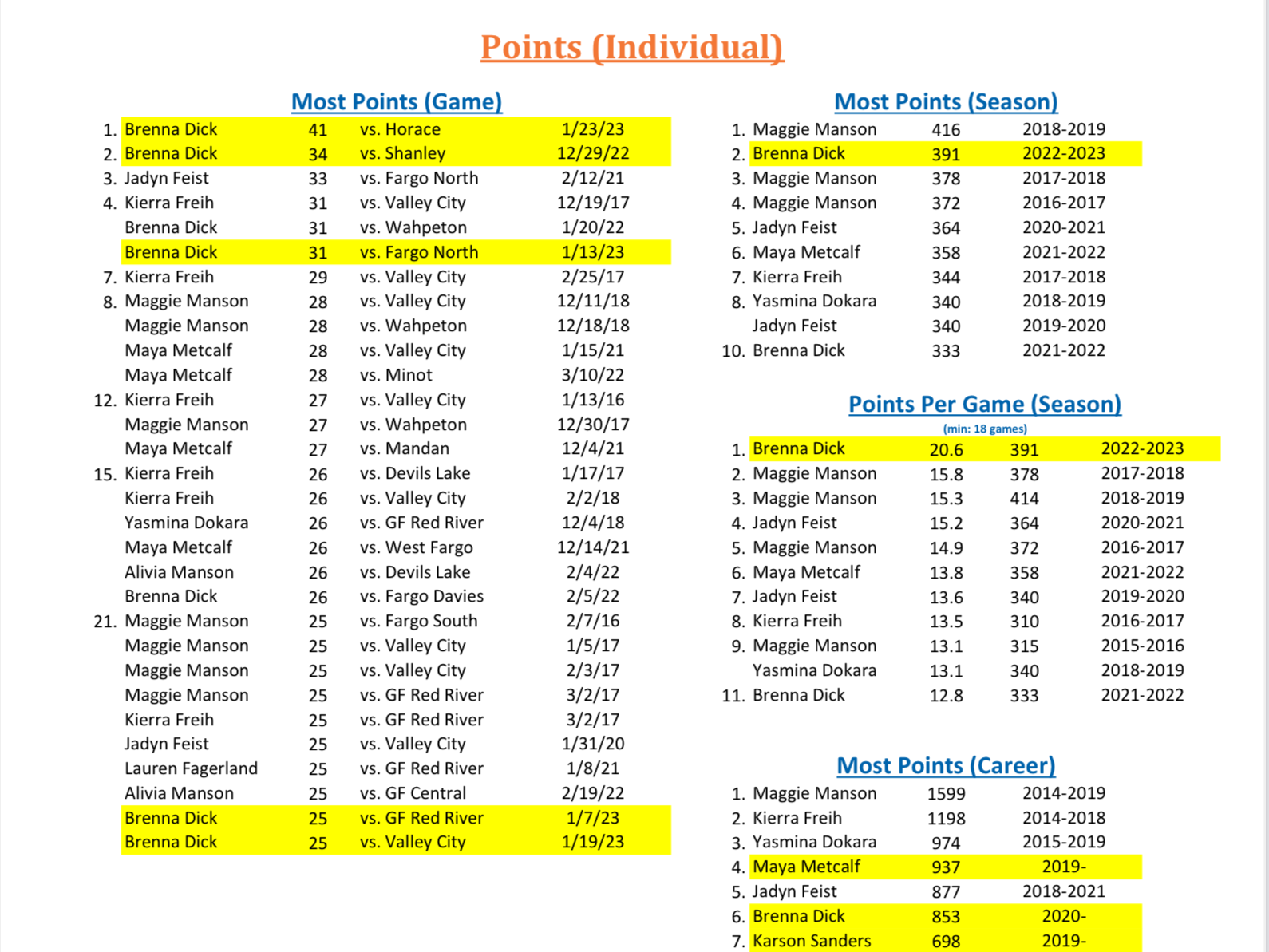
Coaches across the state are familiar with one in particular, the record breaking Brenna Dick. Brenna has demonstrated her phenomenal ability to make shots from any place on the court and play with incredible speed. Within the current season, she has shattered school scoring records numerous times.

In a game against the Shanley Deacons, Brenna put up 34 points, passing the 2021 graduate, Jadyn Feist (33 points). Despite the accomplishment, Brenna knew she could push herself even harder, and break her own record. On January 23rd at Horace High School, fans and the team yelled out in celebration following her 35th point. To no one’s surprise, she didn’t stop there. She ended the night with 41 points and rivalry game victory.

Aside from her total points, Brenna also holds a record for most 3-point makes in a game with 7 versus Valley City High School. Being only a junior, Brenna is well on her to becoming a 1,000 career point scorer. Her teammates and coaches couldn’t be more proud of her, and can’t wait to see what the future holds for her – on and off the court.

Access link to view updated Sheyenne GBB Program stats!
Sheyenne GBB Program Statistics as of 9:30 AM, 2/22/23. Current 22-23 season is highlighted in yellow.

Featured image photos are courtesy of Mustang Media. Thank you to Ruth and Lillian Wirtz for capturing so many amazing moments this season!

Food For Thought

EPISODE TWO: PERSPECTIVE ON PREFERENCE
By Dairell Alvarico
Hosted by Hailey Boehme

Official Transcript:

[THEME SONG – KOLBY THOMPSON.]

Hailey Boehme: Welcome back, everyone. From Mustang Post News, this is Sheyenne Perspectives. I’m Hailey Boehme. 

In our last episode of Sheyenne Perspectives, we took a look at the unconscious mind and its tendency toward routine and the unexpected.  

This week in our program Dairell Alvarico continues this theme through a student lens focusing on change in Food for Thought: Lunchroom Dynamics. Here’s Dairell. 

Dairell Alvarico: Imagine this.

[LUNCHROOM SOUNDS – FREESOUND]

Dairell Alvarico: You are at your high school and your class just ended… you are finally relieved that it’s your lunch period after hours of sitting, and listening to your lessons. 

Eager for your well-deserved break, you make your way to the cafeteria… where you see other students already forming their groups to find their seats. And just like them, you find yours. 

Now let’s pause for a moment… 

How did you choose your spot? Was it further away from all the noise? Did you and your friends have a mutual decision to sit there?  

Or maybe you sat there just for the simple reason of you wanting to. 

These are to be considered when it comes to lunchroom dynamics.

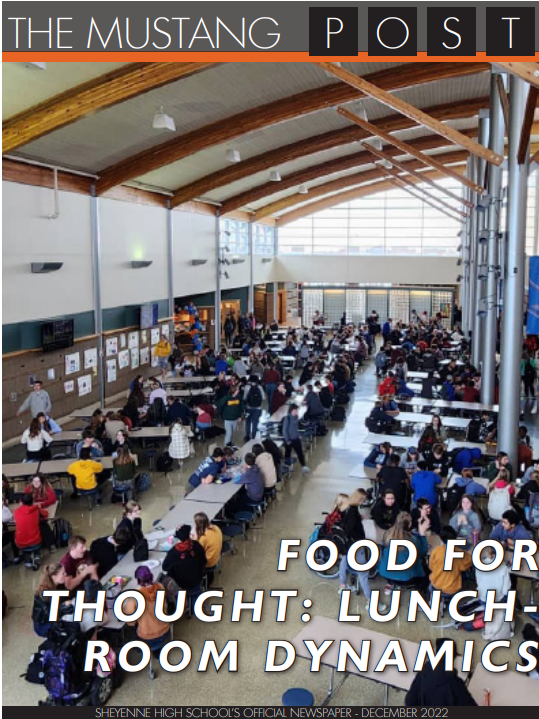
Sheyenne Highschool Lunchroom

Dairell Alvarico: Their relationships, the environment around them, and the people they tend to talk to or avoid, can create this simple but compelling dynamic that can be unique like no other. Yet, there are many questions to be answered. 

Do students agree by the  idea of change, or do they frown upon it? What are the factors of picking a spot, and why mostly stick with it throughout the school year?  

There’s always some form of basis, the root to all the decisions students make to create a dynamic, to have a routine. 

 If it were to be stripped down in a more simple way, we can grasp an idea of how social dynamics can be applied in the lunchroom. Or, ultimately, how change; even the most simple, impacts people. 

And what better way to find out more than asking the students themselves? 

Thomas: I think it’s like, kind of random.

Dairell Alvarico: This is Thomas, a Sheyenne student. Like everyone else, he has his own set of opinions on the matter. 

 A lot of things we do in high school are based on a whim. We don’t really think deep enough to gather logical factors as to why we do it. If it does the job, then there’s nothing else to consider. 

This can be applied in the lunchroom. Majority of the students just sat wherever; a common thought of, “Hey, I’ll just sit here.” without any specific reason. Thomas believes this is the most common cause of the lunchroom dynamics we have today. 

Thomas: You just choose it when it happens, you know? You kind of just go with the flow. Sometimes its like, situational of like um, they did it before in past years. or closer to a certain spot. All in all, I think it’s just random where they pick, and they just stick with it throughout the year. 

Dairell Alvarico: There are many instances where the situation was purely just leaving things to chance. But this does not pertain to everyone. A number of students  have their reasons other than randomly choosing their respected seats. If anything, there are a good deal of people who are more specific on what they like. 

For an example, Jan likes to sit with people who share the same ethnicity as him. He even likes to branch out more and meet new people. 

Jan: Currently my reason is because the people I sit with, is.. the people I know, for the purpose we’re both Filipino. (Laughs) 

Dairell Alvarico: Or Adrian, who thinks that food is a main factor as to why students choose their spots. 

Adrian: Probably because it affects ability and comfort to like the nearest, you know, the nearest food that they can get. 

Dairell Alvarico: Even Thomas prefers a certain side of the lunchroom. 

Thomas: Of my seating arrangement, it’s quiet, I can go wherever I please, and yeah it’s quiet, chill, go wherever I please… yeah I’m just free basically, that’s all I can say. 

Dairell Alvarico: Wanting to be closer to the people you’re similar with, to being in reach  to the ever changing food the cafeteria has to offer, or being in the more discreet part of the area. These are very precise judgements, how does this come to be? 

Well, it all lies with preference. According to Merriam-Webster, it means “The power or opportunity of choosing”.  

Everyday, students choose something that would benefit others or themselves. Preference laid the groundwork for lunchroom dynamics. When asked about anything regarding their seats, all of them have inclined to what they want, or what they don’t want.

But if it were to be changed under different circumstances, to move out of the comfortable bubble they have made for themselves, how are they willing to adapt into a different environment, or do they like to stay where they are?   

Carefree is one way to handle it.

Adrian: I’ll be consistent with it because I already like my spot, and I don’t really wanna change anything. Well, I’m fine with doing anything.  

Dairell Alvarico: Prone to change isn’t far off either. 

Jan: Uh, I guess I prefer to be consistent, but change is constant nonetheless. Uh I guess it’s, uh it will be nice to talk to other people but yeah I still prefer with the people I’m with. 

Dairell Alvarico: Or the unyielding drive to not change at all. 

Thomas: Personally, I don’t like change, when you have a certain like seating arrangement in the lunchroom, I don’t feel like it should be changed because it’s an order and if you break that order things just go crazy because then you could steal a spot from another group and then that one person can’t sit there. So I think lunchroom dynamics shouldn’t really change.

Dairell Alvarico: When asked about change, a lot of students preferred the opposite. They’d rather have change as the last option and would prefer to stay where they’ve already made a familiar routine on.

Consistency is key, and they prefer to stick with it and not break the chain that already binds them to conformity.  

They have a routine, breaking that would leave them muddled and they’d be forced to sit somewhere else. But then again, their new spot could be someone else’s and that person would find a new seat and it just goes on and on until there’s just an unorganized chaos.

Anything being unpredictable can set people off course. Students have enough of that as it is, so they find comfort in knowing where they are in the lunchroom. 

Lunchroom dynamics ties with the concept of change, despite it being inevitable, students would rather go by their own pace. This is their preference, it’s what they like.

Will they have to accept it at some point? Of course, but consistency is what made change unhurried and when it comes to the lunchroom, there is no better way than that. 

[THEME SONG – KOLBY THOMPSON.]

Dairell Alvarico: This podcast was recorded and edited by Dairell Alvarico and hosted by Hailey Boehme.

Sheyenne Perspectives theme music was composed and performed by Kolby Thompson under the direction of Mark Berntson. Our thanks goes out to Jan, Adrian, and all others who participated in this podcast but wished to remain anonymous. 

Hailey Boehme: Next week on the podcast of Sheyenne Perspectives, Logan Jacobs will take over with his take on success and failure in the music industry.  

So long, everyone. We hope to see you soon.  

This has been a production of Mustang Post News. 

The Will of the Unconscious Mind

EPISODE ONE: ROUTINE AND THE UNEXPECTED
By Hailey Boehme

Official Transcript:

Hailey Boehme: I’m so happy to finally introduce you to our new exploration: podcasts! This episode dives right into our first series on human behavior. From the perspective of wins and losses, fitting in and standing out, or hiding behind the camera versus standing right in front of it…. Welcome to Sheyenne Perspectives from Mustang Post News, I’m Hailey Boehme.

[THEME SONG – KOLBY THOMPSON.]

Hailey Boehme: Through our research we have discovered truths of the unconscious mind and learned things about ourselves that we never noticed before.

This journey into understanding the nature of our minds began with school psychologist Emily Dempster. But where should we start? In no better place than our very own Sheyenne High School.

There must be a method to the chaos…some hidden factor to navigate the constant chatter, full trays of food, and tightly packed tables…

[LUNCH ROOM SOUNDS]

Sheyenne High School’s lunchroom left empty moments before class begins.

Hailey Boehme: Certainly, to an outsider it would appear to be nothing short of a disaster, but to the regulars of the Sheyenne High School lunchroom, dodging bodies in an attempt to secure a seat by their best friend is second nature.

To get a better view of this dynamic, we have decided to take a step back and observe the behaviors that occurred; and sure enough, like ants running about, each person seemed to know exactly where they were going amidst the madness.

People sat in the same spots every day, careful not to sit too close to the unacquainted group next to them, yet comfortable in the routine of their daily arrangements. Almost down to each minute, it was easily identifiable who would be coming to sit down next, what table they would choose, and the other students who would sit there.

Even after days of paying attention to the arrangements everyone made for themselves, I was surprised that they rarely changed. Despite the tables shifting to different spots, students filed into designated seats without hesitation.

Though this may seem normal to those who participate in it every school day, I couldn’t help but wonder why we form groups for ourselves. After all, no one was making anyone sit there, so what caused this phenomenon to take place? Was it simply routine, or did it rely on something bigger?

What is the psychology behind this tendency?

Emily Dempster: My name is Ms. Dempster, and I am the school psychologist here at Sheyenne.

Hailey Boehme: Routine. And the unexpected.

Emily Dempster: I think we definitely all benefit from routines. We like to know what’s coming up in our day. Like, you probably enjoy knowing that you have English first, and then science. Could you imagine coming to school and not knowing what class you would have first? That would probably cause a lot of anxiety, so people do benefit- um.. from routine- just so they know what’s going on in their day and so that they get done what they need to get done.

Hailey Boehme: At first, I couldn’t help but to wonder why humans enjoyed doing the same thing every day, yet the thought of never knowing what might happen next seems stressful. For many, the lunchroom setting feels exactly that way.

Emily Dempster: Oh my gosh! SO many! I mean just depending on what kind of gives you those worries- maybe you are more worried about the social aspect. Like are your friends going to be there, are they going to want to talk to you… um…. maybe you’re worried about what they’re serving for lunch if you have some food aversions… maybe you have some sensory, you know… difficulties. Maybe it’s really loud in there and you don’t like the sound of the forks on the trays. So, it will be really dependent on the person, but there- in a big space like that, especially here at school, there’s a lot of stressors that kids and students and even teachers can encounter. Depending on the day and who you are, I think the biggest thing to remember is that even like, as worried as you might be about someone looking at you, or being embarrassed, everyone is as equally worried about themselves. They don’t have time to worry about anything else.

Hailey Boehme: There was one overarching point: personality. No matter what the situation is, it is safe to assume that the amount of stress one might feel depends on how it personally affects them.

Emily Dempster: You know, if you enjoy sitting around in big groups of people and that kind of, “fills your cup”… um- then you’re probably going to enjoy high school lunch a little bit more. But if you don’t like big group of people, lots of noise, if you like to have, you know, conversation with more just you and a friend, uh, the lunchroom could certainly be a tricky, tough place for you.

Hailey Boehme: So if we all enjoy different aspects of socializing….does that impact our chosen spot? Would we find the extroverts at the heart of the lunchroom? There was only one way to find out…

Kennedy Kambeitz: Yes, who else is sitting at the table

Hailey Boehme: With the establishment of personality traits came a new focus: location preference. In the end, they seemed to connect to the same word, “routine.” Students confidently stated again and again how they just went through the motions, not realizing everything that factored into those choices,

Hailey Boehme: How do you decide who you sit by in a big group?

Anonymous Student: I would say it’s like a routine.

Hailey Boehme: Yeah, is it by like who you like more?

Anonymous Student: Oh yeah, I would say it’s sort of by who you like more.

Alison Hollatz: It depends on the size of the group, like if it’s a lot of people, I’m going to sit who I’m closest to.

Hailey Boehme: So, if certain people put us more at ease, how do we find those people? Do we group ourselves by similar interests or unintentionally become confined to fit into a social norm. For example, do I choose not to sit by a group that knows each other from orchestra simply because I don’t think I possess the shared experiences they do? Or is it more complex? It is possible that I could have unconsciously labelled myself in such a way that I don’t feel like I fit in anymore? By straining to fit into a group I don’t believe that I belong in, I would make myself uncomfortable and prone to social anxiety. Now I’m thinking to myself, how do I even begin to navigate through the hour when everything is making me feel nervous.

Emily Dempster: Human kind all over, we’re always looking for like an ”in” group… or for people that like, kind of get us or we share a similar interest with. We’re looking to be accepted into a larger group of people that we feel comfortable with…. So, it might be natural that yeah, if you play basketball you likely are going to sit with your teammates. Or if you really enjoy art or music, you’re likely going to sit with people who also enjoy that, and that’s pretty natural.”

Hailey Boehme: The answers are pretty consistent: most people felt at ease when they focused on the value of comfort, relationships, and being themselves. No matter how much of those elements are needed to thrive, it is likely that a routine will form from the perfect mixture – whether it’s intentional or not. There is something so beautiful about the endless preferences for food, location, noise, style, and conversation topics. Yet we all exist simultaneously, functioning together as a community. At the end of the day, maybe we aren’t so different after all.

[THEME SONG – KOLBY THOMPSON.]

Hailey Boehme: Up next week in Sheyenne Perspectives is Dairell Alvarico with a unique take on change and social dynamics.

This podcast was recorded and edited by Hailey Boehme. Today’s theme music was composed and performed by Kolby Thompson under the direction of Mark Berntson. And our thanks goes out to Emily Dempster, and students Jasmine Brisonet, Alison Hollatz, Kennedy Kambeitz and all others who participated in this podcast, we couldn’t have done it without you! This has been a production of Mustang Post News.

Rise of Bangtan: Powerhouse BTS Surges K-pop Popularity

By Ashleigh Varing

Last month we looked at K-pop’s rise to fame not only in South Korea, but internationally as well, and why so many have taken to the community. BTS was a huge help in this popularity surge, but how did they become the powerhouses in the industry that they are today? 

BTS shortly after debut

It all started with Kim Namjoon. At thirteen, he became an underground rapper, his prominence within the community growing over time. He was invited to audition for an underground hip-hop agency, and one of the judges (Sleepy from the rap duo Untouchable) was so impressed with Namjoon’s skills that he referred him to Bang Si-hyuk, the CEO of Big Hit Entertainment. Namjoon ended up auditioning for the company, becoming the first member of BTS. 

The second member to join was Min Yoongi, who was active as a rapper and producer under the name ‘Gloss.’ He had made a name for himself as a member of a group titled “D-TOWN” (named for the city, Daegu, where the group originated). At seventeen years old, he tried out for Big Hit Entertainment after seeing a poster advertising the auditions. He ended up getting second place and joined the agency as a producer. He was later “tricked” into joining BTS, becoming the group’s second member. 

Jung Hoseok, despite being one of BTS’ rappers, wasn’t in the underground hip-hop scene like Namjoon or Yoongi. In fact, he was a street dancer in a dance team called Neuron. He auditioned for one of the largest companies in K-pop, JYP Entertainment, though he was rejected and later decided to give Big Hit a chance. He had plenty of potential, so Si-hyuk didn’t hesitate to accept him into the agency as a trainee. He almost wasn’t included in BTS’ lineup, though Namjoon convinced the company that the group needed him, and so he became the group’s third member. 

Kim Seokjin, the band’s fourth addition, wasn’t planning to have a career in music at all; he was an acting major with no experience in singing, rapping, or dancing. A Big Hit representative saw him exiting a bus and persuaded him to sign on with the label, and through eight months of hard work and dedication, Seokjin managed to perfect the pristine vocals he’s known for. 

Jeon Jungkook, the youngest member of the band, was only thirteen when he auditioned for a show called “Superstar K” in his hometown of Busan. He was eliminated from the competition, though seven agencies scouted him in hopes of signing him to their label, one being JYP Entertainment. Why, then, did Jungkook turn down most of those offers and choose to sign with Big Hit? Well, as said by Jungkook himself, “I thought Namjoon was so cool, so I wanted to sign with them. I told my parents that I wanted to join, and so I signed.” 

Kim Taehyung, the sixth member to join the group, came to the auditions in Daegu to support a friend of his. He didn’t plan on auditioning, though a staff member encouraged him to try out, so he got permission from his father and auditioned on the spot. He passed the audition and was welcomed into the company, though he was kept a secret until eleven days prior to their debut. 

Park Jimin was encouraged by his dance teacher to audition for Big Hit due to his raw talent, and he passed. He became a trainee, though he was nearly kicked out about eight times due to several people thinking he would do poorly in the group. Thankfully, he was included as the seventh and final member of BTS. 

BTS celebrating winning Rookie of the Year

They debuted on June 13, 2013, as “Bangtan Sonyeondan,” translating to “Bulletproof Boys,” with their album 2 Cool 4 Skool. Selling 24,441 copies in total, the album was placed at number 65 for Gaon’s 2013 year-end album chart, which was good for a rookie group not under the Big 3 (JYP, SM, or YG Entertainment). The title track, “No More Dream,” criticized the way society views dreams and aspirations, a theme reflected in quite a few of their later songs.  

Later that same year, on September 11, their album O!RUL8,2? (Oh! Are you late, too?) was released. The album debuted at number 4 on the Gaon Weekly Chart and ended the year as the 55th best-selling album in South Korea. The title track, “N.O,” goes into detail about how the school system forces children to ignore other aspects of life in favor of studying and becoming “the best.” On November 14, 2013, they won the “Rookie of the Year” award at Melon Music Awards, proving their hard work had paid off. 

But for BTS, this was only the beginning. 

Letter from the Editor

Dear Readers,

The winter season is upon us, and as North Dakotans, we know the worst weather is yet to come. With a holiday break fast approaching and snow days looming in our near future, the Mustang Post has decided to deliver the news in a brand-new format…PODCASTS!

Despite our consistent mention of this upcoming feature, progress has been difficult to come by. Our staff has been busy interviewing, writing, designing, and more!

It is our utmost priority to deliver quality content, so that being said, this e-magazine has seen a late release for the holiday season. We appreciate your patience as we work through the details of creating content and learning how to use software that is new to each one of us.

Since we are so eager to share our passions and the school’s latest news even throughout the busy December month, blog posts will be scheduled for release sporadically, so stay on the lookout for a great read!

Make sure to stay warm for the holidays. We will see you next year!

With much appreciation,

Hailey Boehme, Editor in Chief

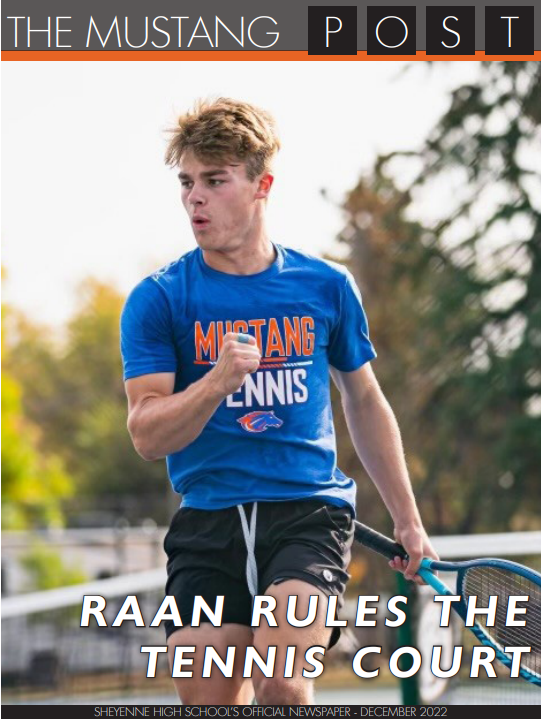
Raan Rules Tennis Court: Makes SHS History

By Jaxson Miller

West Fargo Sheyenne senior Ethan Raan is on top of the North Dakota high school tennis world after he claimed the singles championship on Saturday, October 8, at Hammond Park in Minot.

Raan defeated Grand Forks Red River’s Espen Schneider in the final round of the NDHSAA (North Dakota High School Activities Association) Boys Tennis Singles State Tournament.

Raan is the first player to win an individual state championship for the Sheyenne boys’ tennis program.

“It was very rewarding to bring the boys’ tennis program at Sheyenne its first state title and I couldn’t have done it without my teammates” Raan said. “Coach Anderson and Coach Healy have always set high standards for the team and encouraged hard work, and I feel that my success is a direct product of that.”

Ethan Raan holds the bracket of the singles state tournament after his state championship victory. Photo courtesy Mustang Media.

He redeemed himself against Schneider in a third set tiebreaker, 6-1, 1-6, 7-6 (7-3). Schneider defeated Raan 6-2 and 6-4 in the EDC (Eastern Dakota Conference) singles championship just a week prior.

Ethan Raan had nothing but a humble attitude towards his state championship opponent, “In regards to Espen, my opponent, it was our fifth time playing against each other this season and at this point we were 2-2. He’s a great tennis player and I enjoy playing competitors like him.” Raan was able to get the last laugh.

Ethan Raan went into the state tournament as the number two seed player from the East region.

He started off with a great win (6-0, 6-1) over Bismarck’s Gabe Hanson in the first round and got the chance to play his Sheyenne teammate, junior Mason Christensen, in the quarterfinal round.

Raan defeated Christensen 6-4, 6-4, to move onto the semifinal round.

He had a blast playing against his teammate in a match that had a lot on the line, “Playing Mason in the quarterfinals was great because it meant we had both been successful in the rounds prior” Raan said. “We had fun playing each other and continued to support each other in the matches that followed. He’s a great player and teammate and I can’t wait to see where next season takes him.”

Raan continued his state title run with a semifinal win over Grand Forks Red River’s Saylor Kuenzel, capturing a 6-2, 6-2 victory.
The journey to the mountain top was complete with the win over Schneider in the final round.

The EDC players came to play at the state tournament as Ethan Raan was in the mix of seven players from Sheyenne, Fargo South, Fargo North, and Fargo Davies, who were either in the championship or consolation semifinals.

Grand Forks Central’s Evan Panzer and Cole Wilber won the doubles state championship over Mandan’s Karter Hatzenbuhler and Brady Helbling.

Raan was hungry for a state title this year as he was close to achieving one last year but lost in the single semifinals to Shanley’s Kai Pierce (3-6, 7-6(4), 6-4).

He finished last year’s season on a high note with a win (3-6, 6-1, 6-3) over Grand Forks Central’s Ryder McDonald in the third-place match.

Fortunately things turned out differently this year.

The state champion himself was extra motivated all season long, “I didn’t feel that I had to redeem myself after taking third place last year as I went out on a win and played great players in the semis and the third place match. If anything, I gained confidence from it and it encouraged me to work harder for my senior season.”

Due to his success, Ethan Raan was voted the 2022 Senior Athlete of the Year.

Sheyenne’s boys tennis team went 19-3 overall and 8-1 in conference play. The program took third place as a team in the state tournament.

The 2022 West Fargo Sheyenne boys tennis team took third place as a team at the state tournament in Minot, North Dakota. Photo courtesy Mustang Media.

Raan felt that the team’s success helped him create a champion mindest going into the state championship, “My mindset going into the state championship was it was now or never. It was my last match of my high school tennis career and for that reason I wanted to win for myself and for my team” he said.

With that mindset, Raan also felt no pressure, “Although I was very motivated to win, I was also grateful to have made it that far and felt fortunate to have the opportunity. With the team qualifying for state, it had already been a great season that I and my teammates were proud of. So I went into the match feeling no pressure.”

The three seniors, Ethan Raan (left), Nate Angus (middle), and Kasen Baer (right), with the third place team trophy. Photo courtesy Mustang Media.

One of the best things an athlete can do is finish their high school career on a high note, and go out with a bang, and Ethan Raan did just that. The young man has a bright future ahead of him.

Raan spoke about his future plans, “I plan on playing tennis in college in some capacity, whether it’s for a college team or club team. It all depends on what school I attend. At the moment, I’m interested in studying astrophysics/astronomy and aerospace engineering and aspire to have a career in a space-related field.”

It is safe to say that the Mustang faithful is very proud of Ethan Raan. He will look to have more success this spring, which will be his final high school track season.

Raan is an explosive, fast-twitch athlete, who will qualify for state in the 100m and 200m dashes once again along with being on the 4×100 and 4×200 relay teams.

One thing is for certain, Ethan Raan’s tennis state title run is something he will remember for the rest of his life.

Food For Thought: Sheyenne Lunchroom Dynamics

By Dairell Alvarico

There are many aspects to consider when creating a firm grasp on social dynamics. Things like circumstance, environment and relationships can determine how unique and diverse it can be.

Society has always been intertwined with the element of change, even if it’s forced. Considering all the characteristics of dynamics, this can be easily applied when it comes to the basic idea of school lunches, more specifically in Sheyenne.

If you were to think about it deeply, there is always a reason for certain students to sit in a particular spot and it varies based on their personal or practical interests.

But how do these types of things come to be? How does one decide to pick a preference in a place as common as a school cafeteria? There are many factors to evaluate to gain understanding.

Sheyenne Highschool cafeteria

We can first consider the new arrangement of the lunch tables that happened recently.

Due to this unexpected change, students have taken new spots to eat their meals since the ones they usually go to have been positioned differently from what they remember and yet they migrated to the same, general location yet created new lunchroom dynamics.

Everybody has a preferred spot to sit in the commons. Their reasons differ from each other based on how specific it can be.

Understandably, many students wished to remain anonymous. So, we won’t be using the students’ real names. Let start with, say Sam.

According to Sam, “I sit near the counseling office, because on the first day, me and my friend just chose that spot, so we have been sitting there.”

Based by this quote, it has been shown that circumstances may just have been rooted from an in the moment decision.

There is no deep reasoning other than the fact that they both chose a random spot and stuck with it since it was their first choice.

The same student shared that there were no benefits at all that relates to their position, and if there was a day that their seats were occupied, they would either sit on the front or the back of the commons but only for the reason of finding available seats and nothing more.

However, this versatility isn’t always the case.
Many students refuse to sit anywhere else. They’ve chosen a table and that is their table.

Even within their groups, they have a seating chart: one friend sits on one stool and the others have their own stools.

Take, for example, Alex and Alex’s friend group. They have their seating positions set. This is because they sit together with another group of students well acquainted with one of their companions, who isn’t fond of eating lunch with just one group.

Alex and the others aren’t particularly familiar with them, so they tend to sit on the right while the other group sits on the left with the mutual friend between them.

This writes down that relationship status is considered when it comes to who sits beside who. According to a student who will be referred to as Tony, seating arrangements in his group are figured out by who is closer with who because, “Some people are like best friends.”

This checks out Alex’s situation as well. Several groups in the lunchroom consist of more than two students, a lot tend to sit closer to those they are more friendly with, creating a social dynamic that shows how familiar they are to other people.

In other circumstances, most lunch groups with two people prefer the other person to be across them rather than beside them.
A student who will be named Amy agrees with this wholeheartedly.

“Me and my friend sit facing each other to talk easier.” she shared. “About whom sits where doesn’t really matter. My friend tends to be there first, so I just sit across wherever she is.”

Another student who will be called Chris made a similar statement as well. “I mean, I don’t like to turn my head to the side when I talk to my friend. It gets awkward later and I like to talk while looking at his entire face. That’s why I sit across him.”

This preference is based on how comfortable they prefer to talk to someone. Despite multiple people agreeing with sitting across their friend, there are some students that don’t mind being beside them either.

Someone who will be called Kim said, “I’m used to sitting beside my friend. I don’t really want to change that.”

The number of students in an area can also decide someone’s seating arrangements.

A student who will be referred to as “Tony” prefers an emptier and more obscured spot because he prefers a less crowded room.

But if he were to sit beside other people, he would like to sit near the “smart and goofy” students.

In contrast, Jody is more influenced by the types of people she sits next to.

Instead of choosing a more vacant area like Tony, she prefers a controlled environment where other students are not “jumping on tables and smashing food.” Which also lies in her sitting with quieter people.

This shows that many students have a bias when it comes to the personalities and behaviors of the people around them if they want to interact with anyone at all.

Usually, many students prefer minimum interaction in the lunchroom for reasons that involve their desire to have time for only themselves, but it doesn’t stop there.

Cooler area of the lunchroom

Room temperature is also a factor when it comes to choosing different seats.

Jody likes to sit near the doors because she likes a cooler environment. A student named Jacob also has the same preference.

“Anywhere is fine as long as it’s not in the heat.” He speaks.

From what was gathered, a few students want to be in the cooler area of the lunchroom. This ties with the fact that a crowded room will be likely to form up heat from body temperature.

I have noticed that Jacob doesn’t sit near the doors that lead outside, but he is around the area near the vending machines where the double doors that lead to a freezer are usually open and a cold breeze would come out from time to time, also he is always at the edge of the table, the area with less people.

Seating arrangements are also chosen by the conveniences that students want to be closer to for less distance between them and what they need.

Take for example, Jody; she likes it when she is close to the garbage cans and restrooms. The reasons are clear enough.

She likes to clean her tray with less time to waste compared to if she were to be across the room where her walk would be lengthy and time consuming.

Additionally, she would also use the restroom without worrying about borrowed time or vacancy.

Area near the restroom and garbage cans

Tony’s seating position is more on his convenience after lunch break ends. His arrangement helps him with his desired convenience to be closer to his next class.

This is applied to many other students who would be near the stairs or the tables across the theater or gym.

Time is of the essence and in this scenario, a factor in how students find their place in the lunchroom.

Surprisingly, the intent to be closer to people is a familiar factor in seating arrangements.

A student called John likes to sit beside someone he is interested in to increase the chances of them talking to each other.

Other students have also admitted to this but for the respect for privacy, no names will be revealed.

Based on all of this information, lunchroom dynamics are formed by one or more components based on what a student wants or needs.

Relationships, environment, peers and personal taste in certain parts of the room. All these alone create diverse surroundings revolving around a student’s preference.