By: Allison Ambuehl
Texas Chainsaw Massacre the horrifying thriller that changed independent films’ reputations forever, proving they can compete against full on productions.
The movie was made in 1974 on a $140,000 budget and a dream. Their budget proved to be no problem when compared to its success, as it rose to gross $30 million dollars. The return on investment makes the original the most profitable film in the $252.7 million dollar franchise.
However, one question has lingered in my mind while researching Texas Chainsaw Massacre: how much of the movie is fictional and how much is following the heinous crimes of serial killer Ed Gein?
At the beginning of the original film, the words “One of the most bizarre crimes in the annual of American history”, are disclosed by the narrator, leaving many to rightfully believe the events that happened are based on a true story.
This line was not a thoughtless choice thrown in just to make the following events more thrilling; it was a deliberate tactic to get viewers talking about the film.
A simple conversation stater, “Hey, did you know Texas Chainsaw Massacre, that horror movie that just came out, is a real story?” The person hearing this information is immediately intrigued, their curiosity gets the better of them and they cave.
They purchase a ticket, maybe two, so they can bring a friend, and the cycle repeats.
The opening statement purposefully leaves out details of how accurate Texas Chainsaw Massacre is to the true story.
Ed Gein was an incredibly heinous serial killer and grave robber from Wisconsin, and he is also the man that inspired Texas Chainsaw Massacre.
His crimes stood out to the public not just because he gruesomely murdered multiple women, but because of the odd tendencies he was rumored to have.
A popular belief was that he cross dressed as a woman while killing his victims and then wore their skin. Although he used human remains in other atrocious ways, there has never been any solid evidence that he had any transsexual fixation or desire for womanhood that was the sole reason he commited these murders. He never cross-dressed or wore his victim’s skin, that belief was made popular by the public.
Texas Chainsaw Massacre capitalized on the media’s idea of Ed Geins identity, and made a movie based on this fantasy persona. Due to the film’s popularity, Ed Geins crimes were ramified and heavily over-dramatized even further.
Now, let’s get into what crimes he actually committed. Gein started out grave robbing in 1947 from cemeteries near his home, which was roughly six miles away from Plainfield Wisconsin.
After stealing people from their eternal resting spots, Gein used their remains to make furniture. He made bowls of human skulls, upholstered chairs with human skin, and a multitude of more household items.
Gein didn’t make his first kill until 1954, when he cruelly murdered a woman named Mary Hogan, and used her remains to decorate his home.
He struck again in 1957 with a woman named Bernice Worden, who ended up being his last known kill because he was arrested later that year in November.
When he was tried in court after the arrest, Gein was proven to not be mentally fit, so instead of spending the rest of his life in jail he was sent to Central State Hospital for the Criminally Insane.
Gein spent the majority of his life there until he was later transferred to Mendota Mental Health Institution in 1968 until he passed away from cancer in 1984.
The way Texas Chainsaw Massacre capitalizes Ed Geins crimes is sickening. Making a movie based on a nightmarish, unjustified attack that ended multiple human beings’ lives, and embellishing it, making it seem as though the original story isn’t gruesome and horrible enough.
Unfortunately, Texas Chainsaw Massacre isn’t the first movie to do something like this and won’t be the last.
Next time you’re watching a horror movie and something along the lines of ‘based on a true story’ pops up, take some time to research the real story, and think long and hard about what horrible things had to happen in order for you to sit comfortably in the dark with a bowl of popcorn, watching a heavily dramatized version of someone else’s worst night of their life.
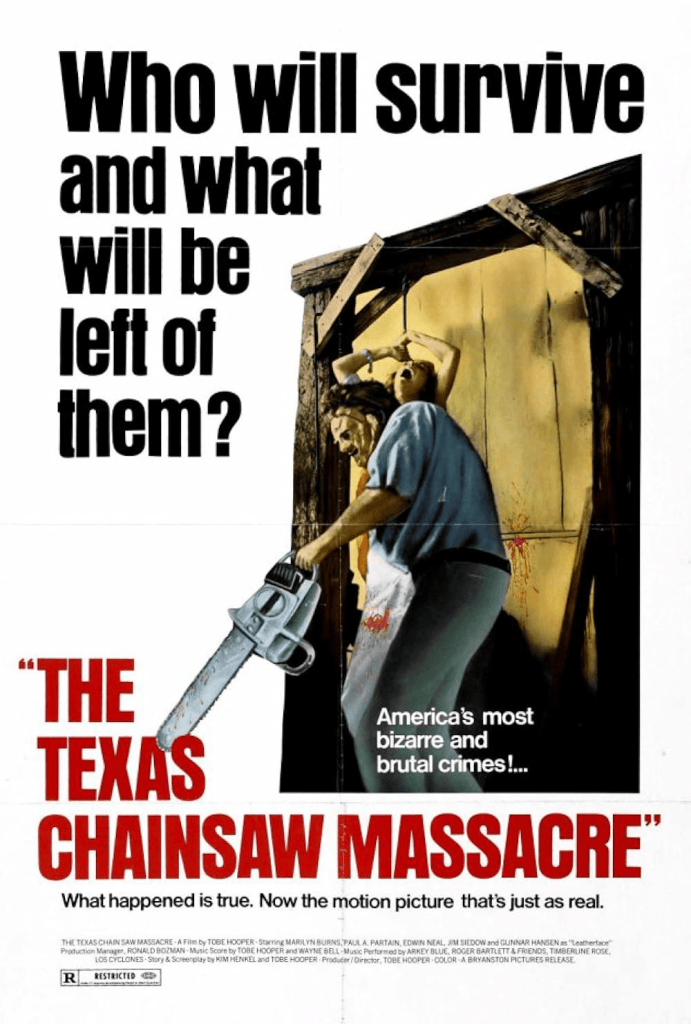
Image curtesy of IMDb